
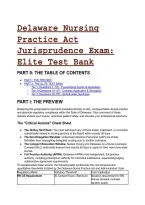
Delaware Nursing
Practice Act
Jurisprudence Exam:
Elite Test Bank
PART 0: THE TABLE OF CONTENTS
● PART I: THE PREVIEW
● PART II: THE ELITE TEST BANK
○ Tier 1 (Questions 1–18) - Foundational Syntax & Application
○ Tier 2 (Questions 19–37) - Complex Application & Simulation
○ Tier 3 (Questions 38–55) - Grandmaster Synthesis
PART I: THE PREVIEW
Mastering this jurisprudence test bank translates directly to elite, unimpeachable clinical practice
and absolute regulatory compliance within the State of Delaware. Total command of these
statutes shields your license, optimizes patient safety, and elevates your professional autonomy.
The "Critical Axioms" Cheat Sheet
● The 30-Day Hard Deck: You must self-report any criminal arrest, indictment, or conviction
substantially related to nursing practice to the Board within exactly 30 days.
● The Non-Delegation Mandate: Unlicensed Assistive Personnel (UAP) are strictly
forbidden from reassigning delegated nursing acts to another individual.
● The Compact Relocation Window: Nurses moving into Delaware on a Nurse Licensure
Compact (NLC) multi-state license have exactly 60 days to apply for their new home-state
license.
● Full Practice Authority (APRN): Delaware APRNs hold independent, full-practice
authority, including prescriptive authority for controlled substances, superseding legacy
collaborative agreement requirements.
To operationalize these axioms, the following table synthesizes the core temporal and
quantitative thresholds dictated by the Delaware Nurse Practice Act and Administrative Code:
Regulatory Metric Statutory Threshold Core Implication
RN CE Requirement 30 Contact Hours / Biennium Baseline requirement for RN
license renewal; includes
random audits.
,Regulatory Metric Statutory Threshold Core Implication
LPN CE Requirement 24 Contact Hours / Biennium Baseline requirement for LPN
license renewal.
APRN CE Requirement 24 Contact Hours / Biennium Must include 10 hours of
pharmacotherapeutics. If DEA
registered, 2 hours must cover
controlled substances.
Late Renewal Grace Period 60 Days Practicing beyond this window
without renewal constitutes
unauthorized practice.
Initial Temporary Permit 90 Days Granted pending final
administrative clearances (e.g.,
background checks);
extendable in 60 and 30-day
increments.
CE Audit Response Time 21 Days (3 Weeks) Licensees must submit physical
or digital CE proof within this
window upon receiving a Board
audit notice.
PART II: THE ELITE TEST BANK
### Tier 1 (Questions 1–18) - Foundational Syntax & Application
Q1: A Registered Nurse is renewing their Delaware license for the upcoming biennium. Based
on the principles of the Delaware Nurse Practice Act, which continuing education (CE)
completion requirement is MANDATORY? A) 24 contact hours, including 3 hours in substance
abuse. B) 30 contact hours, with random audits verifying completion. C) 30 contact hours, with a
mandatory 5 hours in academic research. D) 24 contact hours, plus a mandatory
Board-approved opioid course.
● Answer: B (30 contact hours, with random audits verifying completion.)
● Distractor Analysis:
○ A is incorrect: 24 contact hours is the threshold requirement for Licensed Practical
Nurses (LPNs), not RNs.
○ C is incorrect: While academic research can count toward CE (maximum 5 hours),
it is strictly optional, not a mandatory sub-requirement.
○ D is incorrect: This blends the APRN controlled substance requirement and LPN
hour requirement, presenting an invalid hybrid for an RN.
The Mentor's Analysis: Baseline CE requirements are non-negotiable thresholds for continued
clinical privilege. When facing a renewal cycle, the immediate priority is securing 30 approved
contact hours for RNs. By utilizing a proactive tracking system, you bypass the common trap of
failing random Board audits. Professional Intuition: Always align the exact numerical CE
requirement with the specific licensure tier (RN=30, LPN=24).
Q2: A nurse was arrested over the weekend for a crime substantially related to the practice of
nursing. The charges were subsequently dropped 14 days later. Based on the principles of 24
Del. C. § 1930A, which action is the MOST APPROPRIATE? A) Report the arrest to the Board
of Nursing within 30 days of the arrest date. B) Withhold reporting, as the criminal charges were
formally dismissed. C) Report the arrest within 60 days of the incident. D) Report the incident
only during the next biennial license renewal questionnaire.
, ● Answer: A (Report the arrest to the Board of Nursing within 30 days of the arrest date.)
● Distractor Analysis:
○ B is incorrect: Delaware law requires reporting of the arrest itself regardless of the
final legal disposition or dismissal.
○ C is incorrect: The statutory window is strictly 30 days, making 60 days a clear
violation resulting in disciplinary action.
○ D is incorrect: Waiting until the renewal cycle constitutes a failure to self-report in a
timely manner, exposing the nurse to additional sanctions.
The Mentor's Analysis: The Board of Nursing assesses the conduct leading to an arrest, not just
the judicial outcome. When facing a criminal charge, the immediate priority is radical
transparency with the regulatory body. By utilizing the 30-day reporting window, you bypass the
common trap of compounded disciplinary action for concealment. Professional Intuition: An
arrest triggers the regulatory clock independently of the judicial clock; report within 30
days regardless of dismissal.
Q3: An experienced Unlicensed Assistive Personnel (UAP) is assigned a specific task by the
charge RN. The UAP is called away and asks another UAP to complete the task. Based on the
principles of 24 DE Admin. Code 1900, which conclusion is ACCURATE? A) The transfer is
legal if the second UAP has documented competency. B) The transfer is illegal because UAPs
may not reassign a delegated act. C) The transfer is legal only if the charge RN is notified within
one hour. D) The transfer is illegal unless the task involves non-invasive vital signs.
● Answer: B (The transfer is illegal because UAPs may not reassign a delegated act.)
● Distractor Analysis:
○ A is incorrect: Regardless of the second UAP's competency, sub-delegation by an
unlicensed person is strictly prohibited.
○ C is incorrect: Post-transfer notification does not cure the illegal nature of
UAP-to-UAP reassignment.
○ D is incorrect: The nature of the task (invasive vs. non-invasive) does not alter the
absolute prohibition on UAP reassignment.
The Mentor's Analysis: Delegation flows from a licensed practitioner to an unlicensed one; it
never flows laterally between unlicensed staff. When facing task saturation, the immediate
priority is returning the delegated act to the supervising nurse. By utilizing the chain of
command, you bypass the common trap of unauthorized practice by proxy. Professional
Intuition: Only a licensed nurse holds the legal authority to delegate; UAPs can execute,
but never reassign.
Q4: A Registered Nurse is reviewing the disciplinary framework under 24 Del. C. § 1922. If
found guilty of a violation, what is the MAXIMUM monetary penalty the Board may impose per
violation? A) $1,000 B) $500 C) $5,000 D) $10,000
● Answer: B ($500)
● Distractor Analysis:
○ A is incorrect: $1,000 is the criminal fine for unlawful practices under § 1925 (e.g.,
fraudulent diploma), not the Board's administrative monetary penalty per violation.
○ C is incorrect: $5,000 exceeds the statutory limit for nursing board administrative
sanctions.
○ D is incorrect: $10,000 is the starting fine for failing to report an impaired medical
practitioner under a different statute, not a general NPA violation penalty.
The Mentor's Analysis: Administrative penalties operate under strict statutory caps distinct from
criminal fines. When facing Board discipline, the immediate priority is understanding the scope
of administrative vs. criminal liability. By utilizing precise statutory limits, you bypass the
Practice Act
Jurisprudence Exam:
Elite Test Bank
PART 0: THE TABLE OF CONTENTS
● PART I: THE PREVIEW
● PART II: THE ELITE TEST BANK
○ Tier 1 (Questions 1–18) - Foundational Syntax & Application
○ Tier 2 (Questions 19–37) - Complex Application & Simulation
○ Tier 3 (Questions 38–55) - Grandmaster Synthesis
PART I: THE PREVIEW
Mastering this jurisprudence test bank translates directly to elite, unimpeachable clinical practice
and absolute regulatory compliance within the State of Delaware. Total command of these
statutes shields your license, optimizes patient safety, and elevates your professional autonomy.
The "Critical Axioms" Cheat Sheet
● The 30-Day Hard Deck: You must self-report any criminal arrest, indictment, or conviction
substantially related to nursing practice to the Board within exactly 30 days.
● The Non-Delegation Mandate: Unlicensed Assistive Personnel (UAP) are strictly
forbidden from reassigning delegated nursing acts to another individual.
● The Compact Relocation Window: Nurses moving into Delaware on a Nurse Licensure
Compact (NLC) multi-state license have exactly 60 days to apply for their new home-state
license.
● Full Practice Authority (APRN): Delaware APRNs hold independent, full-practice
authority, including prescriptive authority for controlled substances, superseding legacy
collaborative agreement requirements.
To operationalize these axioms, the following table synthesizes the core temporal and
quantitative thresholds dictated by the Delaware Nurse Practice Act and Administrative Code:
Regulatory Metric Statutory Threshold Core Implication
RN CE Requirement 30 Contact Hours / Biennium Baseline requirement for RN
license renewal; includes
random audits.
,Regulatory Metric Statutory Threshold Core Implication
LPN CE Requirement 24 Contact Hours / Biennium Baseline requirement for LPN
license renewal.
APRN CE Requirement 24 Contact Hours / Biennium Must include 10 hours of
pharmacotherapeutics. If DEA
registered, 2 hours must cover
controlled substances.
Late Renewal Grace Period 60 Days Practicing beyond this window
without renewal constitutes
unauthorized practice.
Initial Temporary Permit 90 Days Granted pending final
administrative clearances (e.g.,
background checks);
extendable in 60 and 30-day
increments.
CE Audit Response Time 21 Days (3 Weeks) Licensees must submit physical
or digital CE proof within this
window upon receiving a Board
audit notice.
PART II: THE ELITE TEST BANK
### Tier 1 (Questions 1–18) - Foundational Syntax & Application
Q1: A Registered Nurse is renewing their Delaware license for the upcoming biennium. Based
on the principles of the Delaware Nurse Practice Act, which continuing education (CE)
completion requirement is MANDATORY? A) 24 contact hours, including 3 hours in substance
abuse. B) 30 contact hours, with random audits verifying completion. C) 30 contact hours, with a
mandatory 5 hours in academic research. D) 24 contact hours, plus a mandatory
Board-approved opioid course.
● Answer: B (30 contact hours, with random audits verifying completion.)
● Distractor Analysis:
○ A is incorrect: 24 contact hours is the threshold requirement for Licensed Practical
Nurses (LPNs), not RNs.
○ C is incorrect: While academic research can count toward CE (maximum 5 hours),
it is strictly optional, not a mandatory sub-requirement.
○ D is incorrect: This blends the APRN controlled substance requirement and LPN
hour requirement, presenting an invalid hybrid for an RN.
The Mentor's Analysis: Baseline CE requirements are non-negotiable thresholds for continued
clinical privilege. When facing a renewal cycle, the immediate priority is securing 30 approved
contact hours for RNs. By utilizing a proactive tracking system, you bypass the common trap of
failing random Board audits. Professional Intuition: Always align the exact numerical CE
requirement with the specific licensure tier (RN=30, LPN=24).
Q2: A nurse was arrested over the weekend for a crime substantially related to the practice of
nursing. The charges were subsequently dropped 14 days later. Based on the principles of 24
Del. C. § 1930A, which action is the MOST APPROPRIATE? A) Report the arrest to the Board
of Nursing within 30 days of the arrest date. B) Withhold reporting, as the criminal charges were
formally dismissed. C) Report the arrest within 60 days of the incident. D) Report the incident
only during the next biennial license renewal questionnaire.
, ● Answer: A (Report the arrest to the Board of Nursing within 30 days of the arrest date.)
● Distractor Analysis:
○ B is incorrect: Delaware law requires reporting of the arrest itself regardless of the
final legal disposition or dismissal.
○ C is incorrect: The statutory window is strictly 30 days, making 60 days a clear
violation resulting in disciplinary action.
○ D is incorrect: Waiting until the renewal cycle constitutes a failure to self-report in a
timely manner, exposing the nurse to additional sanctions.
The Mentor's Analysis: The Board of Nursing assesses the conduct leading to an arrest, not just
the judicial outcome. When facing a criminal charge, the immediate priority is radical
transparency with the regulatory body. By utilizing the 30-day reporting window, you bypass the
common trap of compounded disciplinary action for concealment. Professional Intuition: An
arrest triggers the regulatory clock independently of the judicial clock; report within 30
days regardless of dismissal.
Q3: An experienced Unlicensed Assistive Personnel (UAP) is assigned a specific task by the
charge RN. The UAP is called away and asks another UAP to complete the task. Based on the
principles of 24 DE Admin. Code 1900, which conclusion is ACCURATE? A) The transfer is
legal if the second UAP has documented competency. B) The transfer is illegal because UAPs
may not reassign a delegated act. C) The transfer is legal only if the charge RN is notified within
one hour. D) The transfer is illegal unless the task involves non-invasive vital signs.
● Answer: B (The transfer is illegal because UAPs may not reassign a delegated act.)
● Distractor Analysis:
○ A is incorrect: Regardless of the second UAP's competency, sub-delegation by an
unlicensed person is strictly prohibited.
○ C is incorrect: Post-transfer notification does not cure the illegal nature of
UAP-to-UAP reassignment.
○ D is incorrect: The nature of the task (invasive vs. non-invasive) does not alter the
absolute prohibition on UAP reassignment.
The Mentor's Analysis: Delegation flows from a licensed practitioner to an unlicensed one; it
never flows laterally between unlicensed staff. When facing task saturation, the immediate
priority is returning the delegated act to the supervising nurse. By utilizing the chain of
command, you bypass the common trap of unauthorized practice by proxy. Professional
Intuition: Only a licensed nurse holds the legal authority to delegate; UAPs can execute,
but never reassign.
Q4: A Registered Nurse is reviewing the disciplinary framework under 24 Del. C. § 1922. If
found guilty of a violation, what is the MAXIMUM monetary penalty the Board may impose per
violation? A) $1,000 B) $500 C) $5,000 D) $10,000
● Answer: B ($500)
● Distractor Analysis:
○ A is incorrect: $1,000 is the criminal fine for unlawful practices under § 1925 (e.g.,
fraudulent diploma), not the Board's administrative monetary penalty per violation.
○ C is incorrect: $5,000 exceeds the statutory limit for nursing board administrative
sanctions.
○ D is incorrect: $10,000 is the starting fine for failing to report an impaired medical
practitioner under a different statute, not a general NPA violation penalty.
The Mentor's Analysis: Administrative penalties operate under strict statutory caps distinct from
criminal fines. When facing Board discipline, the immediate priority is understanding the scope
of administrative vs. criminal liability. By utilizing precise statutory limits, you bypass the


