
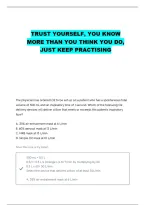
The physician has ordered O2 to be set up on a patient who has a spontaneous tidal
volume of 500 mL and an inspiratory time of 1 second. Which of the following O2
delivery devices will deliver a flow that meets or exceeds this patient's inspiratory
flow?
A. 35% air-entrainment mask at 6 L/min
B. 60% aerosol mask at 12 L/min
C. NRB mask at 15 L/min
D. Simple O2 mask at 10 L/min
Give this one a try later!
500 mL = 0.5 L
0.5/1 = 0.5 L/s (change L/s to ?/min by multiplying by 60
0.5 L x 60= 30 L/min
Select the device that delivers a flow of at least 30L/min
A. 35% air-entrainment mask at 6 L/min
,Which of the following will increase the possibility of the ET tube cuff causing tracheal
mucosa damage?
1. Maintaining intracuff pressure of 38 cm H2O
2. Using minimal leak technique
3. Using a low-volume, high-pressure cuff
4. Using minimal occluding volume technique
A. 1 and 3 only
B. 2 and 4 only
C. 1, 3 and 4 only
D. 2, 3, and 4
Give this one a try later!
A. 1 and 3 only
The following data are obtained for a patient who is receiving VC, A/C ventilation:
Peak pressure: 30 cm H2O
Plateau pressure: 20 cm H2O
Set Vt: 800 mL
Exhaled Vt: 700 mL
PEEP: 10 cm H2O
What is the static compliance?
A. 35
B. 40
C. 27
D. 70
Give this one a try later!
, D. 70
The following blood gas levels have been obtained from a patient using a 60%
aerosol mask.
pH: 7.47
PaCO2: 31 mmHg
PaO2: 58 mmHg
What should the RT recommend at this time?
A. Place the patient on CPAP
B. Increase the O2 to 70%
C. Intubate and place the patient on mechanical ventilation
D. Change to a nonrebreathing mask
Give this one a try later!
A. Place the patient on CPAP
While palpating the chest, the RT determines that there is decreased fremitus over the
right lower lobe. This may be the result of which of the following?
1. Pneumothorax
2. Pleural effusion
3. Pneumonia
A. 1 only
B. 2 only
C. 1 and 2 only
D. 2 and 3 only
Give this one a try later!


