
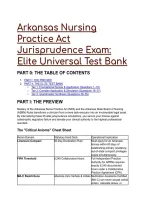
Arkansas Nursing
Practice Act
Jurisprudence Exam:
Elite Universal Test Bank
PART 0: THE TABLE OF CONTENTS
1. PART I: THE PREVIEW
2. PART II: THE ELITE TEST BANK
○ Tier 1: Foundational Syntax & Application (Questions 1–18)
○ Tier 2: Complex Application & Simulation (Questions 19–37)
○ Tier 3: Grandmaster Synthesis (Questions 38–55)
PART I: THE PREVIEW
Mastery of the Arkansas Nurse Practice Act (NPA) and the Arkansas State Board of Nursing
(ASBN) Rules transforms a clinician from a mere task-executor into an invulnerable legal asset.
By internalizing these 55 elite jurisprudence simulations, you secure your license against
catastrophic regulatory failure and elevate your clinical authority to the highest professional
standard.
The "Critical Axioms" Cheat Sheet
Axiom Domain Statutory Hard Deck Operational Implication
Licensure Compact 60-Day Declaration Rule Must apply for an Arkansas
license within 60 days of
establishing primary residency;
out-of-state compact privileges
expire simultaneously.
FIPA Threshold 6,240 Collaborative Hours Full Independent Practice
Authority for APRNs requires
exactly 6,240 documented
hours under a Collaborative
Practice Agreement (CPA).
MA-C Restrictions Absolute Zero Verbals & Initials Medication Assistants-Certified
(MA-C) can never accept verbal
orders, calculate doses, or
,Axiom Domain Statutory Hard Deck Operational Implication
administer initial medication
doses.
APRN Schedule II 5-Day Opioid Limit APRNs may prescribe
Schedule II opioids for a
maximum of 5 days; Schedule
II stimulants require a physician
evaluation within 6 months.
ArNAP Compliance Zero-Tolerance Abstinence The alternative-to-discipline
program treats missed
check-ins or poppy seed
consumption identically to a
failed drug screen.
PART II: THE ELITE TEST BANK
Tier 1: Foundational Syntax & Application (Questions 1–18) <a
name="tier-1"></a>
Q1: An actively practicing Registered Nurse (RN) in Arkansas is preparing for biennial license
renewal. Based on the principles of the ASBN continuing education requirements, which action
is the MOST APPROPRIATE mechanism to satisfy the mandatory educational standards? A)
Completing 10 contact hours of continuing education and 100 hours of active practice B)
Submitting a portfolio of in-service facility training totaling 20 hours C) Completing 15
practice-focused contact hours from a nationally recognized continuing education body D)
Completing 30 hours of professional nursing activities verified by an employer
● Answer: C (Completing 15 practice-focused contact hours from a nationally recognized
continuing education body)
● Distractor Analysis:
○ A is incorrect: Arkansas requires exactly 15 contact hours; practice hours cannot
offset this metric.
○ B is incorrect: Facility in-service training intended to fulfill employer expectations is
explicitly rejected as valid continuing education.
○ D is incorrect: Professional activities without accredited contact hours or national
certification do not satisfy the statute.
The Mentor's Analysis: Licensure renewal hinges on externally validated, practice-focused
education. When facing renewal, the immediate priority is securing accredited contact hours. By
utilizing ANCC or ASBN-recognized hours, you bypass the common trap of relying on internal
employer training. Professional Intuition: Always verify that your 15 contact hours are
accredited; facility orientations never count.
Q2: An Advanced Practice Registered Nurse (APRN) with prescriptive authority is finalizing their
renewal documentation. Based on the principles of advanced practice licensure, what is the
MANDATORY educational component they must complete in addition to standard RN
requirements? A) 10 contact hours of advanced physical assessment B) 15 contact hours of
broad medical-surgical updates C) 5 contact hours of pharmacotherapeutics related to their
specialty D) 24 contact hours of general continuing education
● Answer: C (5 contact hours of pharmacotherapeutics related to their specialty)
, ● Distractor Analysis:
○ A is incorrect: Physical assessment is not the targeted statutory requirement for
prescriptive authority.
○ B is incorrect: Broad updates fail the specificity requirement.
○ D is incorrect: APRNs in Arkansas need 15 general hours plus 5
pharmacotherapeutics hours, totaling 20, not 24.
The Mentor's Analysis: Prescriptive authority is a high-risk privilege demanding ongoing
pharmacological competence. When facing renewal, the immediate priority is specialty-specific
drug knowledge. By utilizing targeted pharmacology CE, you bypass the common trap of
generalized education deficits. Professional Intuition: Prescriptive authority always demands
a 5-hour pharmacotherapeutics surcharge.
Q3: A licensed nurse relocates their primary residence from a neighboring Nurse Licensure
Compact (NLC) state to Arkansas. Based on the principles of the Enhanced NLC, what is the
MAXIMUM timeframe allowed to apply for an Arkansas multistate license? A) 30 days B) 90
days C) 60 days D) Prior to beginning employment
● Answer: C (60 days)
● Distractor Analysis:
○ A is incorrect: 30 days is an outdated legacy rule.
○ B is incorrect: 90 days exceeds the allowable legal buffer, resulting in illegal
practice.
○ D is incorrect: Practice is permitted immediately, but the 60-day residency clock
dictates the application deadline regardless of employment status.
The Mentor's Analysis: The NLC provides mobility, but primary residency anchors legal
jurisdiction. When facing interstate relocation, the immediate priority is application submission.
By utilizing the 60-day rule, you bypass the common trap of accidental unauthorized practice.
Professional Intuition: The 60-day residency clock starts the moment you establish your
new permanent address, not your first day of work.
Q4: A Registered Nurse is assigned as the supervisor for Medication Assistants-Certified
(MA-C) in a long-term care facility. Based on the principles of ASBN delegation, what is the
ABSOLUTE LIMIT for the supervisor-to-MA-C ratio during a single shift? A) 1 Licensed Nurse to
4 MA-Cs B) 1 Licensed Nurse to 3 MA-Cs C) 1 Licensed Nurse to 2 MA-Cs D) 1 Licensed Nurse
to 1 MA-C
● Answer: C (1 Licensed Nurse to 2 MA-Cs)
● Distractor Analysis:
○ A is incorrect: This ratio dilutes necessary oversight for high-risk medication tasks.
○ B is incorrect: Three exceeds the statutory maximum.
○ D is incorrect: While a 1:1 ratio is required during student preceptorship, working
MA-Cs may operate at a 1:2 ratio.
The Mentor's Analysis: The delegation of medication administration carries immense vicarious
liability. When facing staffing assignments, the immediate priority is strict ratio compliance. By
utilizing the 1:2 ratio, you bypass the common trap of supervisory dilution. Professional Intuition:
Never accept a shift assignment that forces you to supervise more than two MA-Cs.
Q5: An MA-C is reviewing the medication administration record (MAR) for a patient. Based on
the principles of the MA-C scope of practice, which route of administration is EXPRESSLY
PROHIBITED? A) Transdermal patches B) Subcutaneous insulin C) Intramuscular antibiotics D)
Ophthalmic drops
● Answer: C (Intramuscular antibiotics)
● Distractor Analysis:
Practice Act
Jurisprudence Exam:
Elite Universal Test Bank
PART 0: THE TABLE OF CONTENTS
1. PART I: THE PREVIEW
2. PART II: THE ELITE TEST BANK
○ Tier 1: Foundational Syntax & Application (Questions 1–18)
○ Tier 2: Complex Application & Simulation (Questions 19–37)
○ Tier 3: Grandmaster Synthesis (Questions 38–55)
PART I: THE PREVIEW
Mastery of the Arkansas Nurse Practice Act (NPA) and the Arkansas State Board of Nursing
(ASBN) Rules transforms a clinician from a mere task-executor into an invulnerable legal asset.
By internalizing these 55 elite jurisprudence simulations, you secure your license against
catastrophic regulatory failure and elevate your clinical authority to the highest professional
standard.
The "Critical Axioms" Cheat Sheet
Axiom Domain Statutory Hard Deck Operational Implication
Licensure Compact 60-Day Declaration Rule Must apply for an Arkansas
license within 60 days of
establishing primary residency;
out-of-state compact privileges
expire simultaneously.
FIPA Threshold 6,240 Collaborative Hours Full Independent Practice
Authority for APRNs requires
exactly 6,240 documented
hours under a Collaborative
Practice Agreement (CPA).
MA-C Restrictions Absolute Zero Verbals & Initials Medication Assistants-Certified
(MA-C) can never accept verbal
orders, calculate doses, or
,Axiom Domain Statutory Hard Deck Operational Implication
administer initial medication
doses.
APRN Schedule II 5-Day Opioid Limit APRNs may prescribe
Schedule II opioids for a
maximum of 5 days; Schedule
II stimulants require a physician
evaluation within 6 months.
ArNAP Compliance Zero-Tolerance Abstinence The alternative-to-discipline
program treats missed
check-ins or poppy seed
consumption identically to a
failed drug screen.
PART II: THE ELITE TEST BANK
Tier 1: Foundational Syntax & Application (Questions 1–18) <a
name="tier-1"></a>
Q1: An actively practicing Registered Nurse (RN) in Arkansas is preparing for biennial license
renewal. Based on the principles of the ASBN continuing education requirements, which action
is the MOST APPROPRIATE mechanism to satisfy the mandatory educational standards? A)
Completing 10 contact hours of continuing education and 100 hours of active practice B)
Submitting a portfolio of in-service facility training totaling 20 hours C) Completing 15
practice-focused contact hours from a nationally recognized continuing education body D)
Completing 30 hours of professional nursing activities verified by an employer
● Answer: C (Completing 15 practice-focused contact hours from a nationally recognized
continuing education body)
● Distractor Analysis:
○ A is incorrect: Arkansas requires exactly 15 contact hours; practice hours cannot
offset this metric.
○ B is incorrect: Facility in-service training intended to fulfill employer expectations is
explicitly rejected as valid continuing education.
○ D is incorrect: Professional activities without accredited contact hours or national
certification do not satisfy the statute.
The Mentor's Analysis: Licensure renewal hinges on externally validated, practice-focused
education. When facing renewal, the immediate priority is securing accredited contact hours. By
utilizing ANCC or ASBN-recognized hours, you bypass the common trap of relying on internal
employer training. Professional Intuition: Always verify that your 15 contact hours are
accredited; facility orientations never count.
Q2: An Advanced Practice Registered Nurse (APRN) with prescriptive authority is finalizing their
renewal documentation. Based on the principles of advanced practice licensure, what is the
MANDATORY educational component they must complete in addition to standard RN
requirements? A) 10 contact hours of advanced physical assessment B) 15 contact hours of
broad medical-surgical updates C) 5 contact hours of pharmacotherapeutics related to their
specialty D) 24 contact hours of general continuing education
● Answer: C (5 contact hours of pharmacotherapeutics related to their specialty)
, ● Distractor Analysis:
○ A is incorrect: Physical assessment is not the targeted statutory requirement for
prescriptive authority.
○ B is incorrect: Broad updates fail the specificity requirement.
○ D is incorrect: APRNs in Arkansas need 15 general hours plus 5
pharmacotherapeutics hours, totaling 20, not 24.
The Mentor's Analysis: Prescriptive authority is a high-risk privilege demanding ongoing
pharmacological competence. When facing renewal, the immediate priority is specialty-specific
drug knowledge. By utilizing targeted pharmacology CE, you bypass the common trap of
generalized education deficits. Professional Intuition: Prescriptive authority always demands
a 5-hour pharmacotherapeutics surcharge.
Q3: A licensed nurse relocates their primary residence from a neighboring Nurse Licensure
Compact (NLC) state to Arkansas. Based on the principles of the Enhanced NLC, what is the
MAXIMUM timeframe allowed to apply for an Arkansas multistate license? A) 30 days B) 90
days C) 60 days D) Prior to beginning employment
● Answer: C (60 days)
● Distractor Analysis:
○ A is incorrect: 30 days is an outdated legacy rule.
○ B is incorrect: 90 days exceeds the allowable legal buffer, resulting in illegal
practice.
○ D is incorrect: Practice is permitted immediately, but the 60-day residency clock
dictates the application deadline regardless of employment status.
The Mentor's Analysis: The NLC provides mobility, but primary residency anchors legal
jurisdiction. When facing interstate relocation, the immediate priority is application submission.
By utilizing the 60-day rule, you bypass the common trap of accidental unauthorized practice.
Professional Intuition: The 60-day residency clock starts the moment you establish your
new permanent address, not your first day of work.
Q4: A Registered Nurse is assigned as the supervisor for Medication Assistants-Certified
(MA-C) in a long-term care facility. Based on the principles of ASBN delegation, what is the
ABSOLUTE LIMIT for the supervisor-to-MA-C ratio during a single shift? A) 1 Licensed Nurse to
4 MA-Cs B) 1 Licensed Nurse to 3 MA-Cs C) 1 Licensed Nurse to 2 MA-Cs D) 1 Licensed Nurse
to 1 MA-C
● Answer: C (1 Licensed Nurse to 2 MA-Cs)
● Distractor Analysis:
○ A is incorrect: This ratio dilutes necessary oversight for high-risk medication tasks.
○ B is incorrect: Three exceeds the statutory maximum.
○ D is incorrect: While a 1:1 ratio is required during student preceptorship, working
MA-Cs may operate at a 1:2 ratio.
The Mentor's Analysis: The delegation of medication administration carries immense vicarious
liability. When facing staffing assignments, the immediate priority is strict ratio compliance. By
utilizing the 1:2 ratio, you bypass the common trap of supervisory dilution. Professional Intuition:
Never accept a shift assignment that forces you to supervise more than two MA-Cs.
Q5: An MA-C is reviewing the medication administration record (MAR) for a patient. Based on
the principles of the MA-C scope of practice, which route of administration is EXPRESSLY
PROHIBITED? A) Transdermal patches B) Subcutaneous insulin C) Intramuscular antibiotics D)
Ophthalmic drops
● Answer: C (Intramuscular antibiotics)
● Distractor Analysis:


