
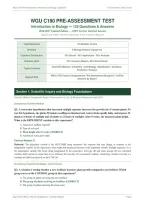
WGU C190 Pre-Assessment | Introduction to Biology | 2026/2027 125 Questions | 100% Correct
WGU C190 PRE-ASSESSMENT TEST
Introduction to Biology — 125 Questions & Answers
2026/2027 Updated Edition — 100% Correct Verified Answers
Aligned with WGU C190 OA Competencies & Pre-Assessment Blueprint
Total Questions 125 Multiple Choice
Sections 8 Biology Domain Categories
Cognitive Distribution 35% Recall / 45% Application / 20% Analysis
Question Style 70% Scenario-Based • 30% Direct Recall
Scientific Method | Chemistry | Cell Biology | Metabolism | Genetics |
Topics Covered
Evolution | Ecology
WGU C190 Course Competencies | Pre-Assessment Blueprint | Verified
Aligned With
Answers by Expert
Section 1: Scientific Inquiry and Biology Foundations
Scientific Method, Experimental Design, Characteristics of Life, & Biological Organization (Q1-Q14)
[Competency: Scientific Method]
Q1: A researcher hypothesizes that increased sunlight exposure increases the growth rate of tomato plants. To
test this hypothesis, she plants 50 tomato seedlings in identical soil, waters them equally daily, and exposes 25
plants to 6 hours of sunlight and 25 plants to 12 hours of sunlight. After 8 weeks, she measures plant height.
What is the DEPENDENT variable in this experiment?
A. Amount of sunlight exposure
B. Type of soil used
C. Plant height after 8 weeks [CORRECT]
D. Amount of water given daily
Correct Answer: C
Rationale: The dependent variable is the OUTCOME being measured—the response that may change in response to the
independent variable. In this experiment, plant height (the measured outcome) is the dependent variable. Sunlight exposure (A) is
the independent variable (the factor being manipulated by the researcher). Soil type (B) and water amount (D) are controlled
variables held constant to ensure they do not influence the outcome. Pre-assessment readiness: identifying variables correctly is a
foundational skill tested heavily on the C190 OA.
[Competency: Experimental Design - Control Group]
Q2: A scientist is testing whether a new fertilizer increases plant growth compared to no fertilizer. Which
group serves as the CONTROL group in this experiment?
A. The group of plants receiving the new fertilizer
B. The group of plants receiving no fertilizer [CORRECT]
C. The group of plants receiving the most water
Aligned with WGU C190 OA Competencies | Verified Answers Page 1
,WGU C190 Pre-Assessment | Introduction to Biology | 2026/2027 125 Questions | 100% Correct
D. The group of plants grown in the sunniest location
Correct Answer: B
Rationale: The control group is the group that does NOT receive the experimental treatment—it provides a baseline for
comparison. In this experiment, plants receiving no fertilizer (B) serve as the control group, allowing the researcher to determine if
the fertilizer actually causes increased growth. The treatment group (A) receives the experimental intervention. Water amount (C)
and sunlight (D) should be held constant across both groups (controlled variables). Pre-assessment readiness: distinguishing control
from experimental groups is essential for evaluating scientific claims.
[Competency: Hypothesis Formation]
Q3: Which of the following statements represents a valid SCIENTIFIC HYPOTHESIS?
A. Plants grow better when they are happy.
B. If tomato plants receive 8 hours of sunlight daily, then they will produce more tomatoes than plants
receiving 4 hours of sunlight. [CORRECT]
C. Sunlight is the most beautiful thing in nature.
D. God created plants to grow toward the sun.
Correct Answer: B
Rationale: A scientific hypothesis is a testable, falsifiable statement that predicts a relationship between variables, typically
phrased as an "If…then…" statement. Option B is testable (sunlight hours can be measured and tomato yield can be counted) and
falsifiable (results could disprove it). Option A is not testable ("happy" is not measurable). Option C is a value judgment
(subjective, not scientific). Option D is a religious claim that cannot be tested through scientific methods. Pre-assessment
readiness: distinguishing scientific from non-scientific claims is a recurring theme.
[Competency: Bias Reduction]
Q4: In a clinical trial testing a new blood pressure medication, researchers want to minimize bias. Which
technique is most effective for reducing bias in participant assignment?
A. Allow participants to choose whether they receive the medication or placebo
B. Assign participants to treatment or control groups based on their age
C. Use random assignment to distribute participants equally between treatment and control groups
[CORRECT]
D. Have the researcher decide which participants receive the medication
Correct Answer: C
Rationale: Random assignment (C) is the gold standard for minimizing bias in experimental design—each participant has an equal
chance of being assigned to either group, distributing known and unknown confounding variables equally. Allowing participants to
choose (A) introduces selection bias (those choosing medication may be more motivated). Assigning by age (B) introduces
systematic bias. Researcher assignment (D) introduces experimenter bias. Pre-assessment readiness: when possible, use
double-blind designs (neither participants nor researchers know group assignment) to further reduce bias.
[Competency: Characteristics of Life]
Q5: Which of the following is NOT considered a characteristic of living organisms?
A. Cellular organization
B. Ability to regulate internal environment (homeostasis)
C. Ability to grow and reproduce
D. Ability to move from place to place [CORRECT]
Correct Answer: D
Aligned with WGU C190 OA Competencies | Verified Answers Page 2
,WGU C190 Pre-Assessment | Introduction to Biology | 2026/2027 125 Questions | 100% Correct
Rationale: Movement from place to place (D) is NOT a universal characteristic of life—plants and many organisms are sessile
(do not move) yet are clearly alive. The key characteristics of life include: (1) cellular organization; (2) metabolism (energy
processing); (3) homeostasis (internal regulation); (4) growth and development; (5) reproduction; (6) response to stimuli; (7)
evolutionary adaptation. While some organisms move, others (plants, fungi, bacteria in colonies) do not locomote but still possess
all other characteristics of life.
[Competency: Levels of Biological Organization]
Q6: Which of the following sequences correctly lists the levels of biological organization from SIMPLEST to
MOST COMPLEX?
A. Organism → Population → Community → Ecosystem → Biosphere
B. Atom → Molecule → Organelle → Cell → Tissue → Organ → Organ System → Organism [CORRECT]
C. Cell → Tissue → Organ → Atom → Molecule → Organelle
D. Biosphere → Ecosystem → Community → Population → Organism
Correct Answer: B
Rationale: The levels of biological organization build from simplest (atoms) to most complex (biosphere). The correct sequence
is: Atom → Molecule → Organelle → Cell → Tissue → Organ → Organ System → Organism → Population → Community →
Ecosystem → Biosphere. Option B shows the cellular-to-organism portion correctly. Option A shows the ecological levels but in
the correct order (simple to complex), but option B covers the entire range. Option C incorrectly places atom and molecule after
organ. Option D is reverse order (complex to simple). Pre-assessment readiness: memorize this hierarchy—many C190 questions
require identification of levels.
[Competency: Homeostasis]
Q7: When a human body temperature rises above normal (98.6°F / 37°C), blood vessels near the skin dilate
and sweat glands become active. This is an example of which biological process?
A. Negative feedback maintaining homeostasis [CORRECT]
B. Positive feedback amplifying a response
C. Evolutionary adaptation
D. Cellular respiration
Correct Answer: A
Rationale: Negative feedback (A) is the primary mechanism for maintaining homeostasis—the body detects a deviation from a
set point and initiates responses that counteract the change, returning the system to normal. When body temperature rises, the body
responds by sweating and dilating blood vessels (vasodilation) to release heat, lowering temperature back to normal. Positive
feedback (B) amplifies a response (e.g., childbirth contractions, blood clotting) rather than reversing it. Evolutionary adaptation
(C) occurs over generations. Cellular respiration (D) is energy production in cells. Pre-assessment readiness: homeostasis and
negative feedback are heavily tested concepts.
[Competency: Theory vs Hypothesis]
Q8: Which statement BEST describes the difference between a scientific hypothesis and a scientific theory?
A. A hypothesis is a guess; a theory is a fact
B. A hypothesis is a testable explanation for a specific phenomenon; a theory is a well-substantiated
explanation supported by extensive evidence from multiple experiments [CORRECT]
C. A theory is less reliable than a hypothesis
D. Hypotheses and theories are essentially the same thing
Correct Answer: B
Rationale: A scientific hypothesis is a proposed, testable explanation for a specific observation—narrow in scope and awaiting
experimental verification. A scientific theory is a broader, well-substantiated explanation supported by extensive evidence from
Aligned with WGU C190 OA Competencies | Verified Answers Page 3
, WGU C190 Pre-Assessment | Introduction to Biology | 2026/2027 125 Questions | 100% Correct
many experiments and observations (e.g., theory of evolution, cell theory, germ theory). Theories are NOT "just guesses" or
"unproven" (a common misconception)—they represent the highest level of scientific understanding. Hypotheses are starting
points; theories are mature, evidence-backed explanations. Option D is incorrect: theories are broader and more strongly supported
than individual hypotheses.
[Competency: Experimental Variables]
Q9: A student tests the effect of three different fertilizers (A, B, C) on plant growth. She plants 10 seeds in
each of 4 pots: one with no fertilizer (control), one with fertilizer A, one with B, and one with C. All pots
receive the same soil type, water amount, and sunlight. How many INDEPENDENT variables are in this
experiment?
A. 1 [CORRECT]
B. 3
C. 4
D. 10
Correct Answer: A
Rationale: There is ONE independent variable: the TYPE of fertilizer used (which has multiple levels—A, B, C, and none). The
independent variable is the single factor being manipulated, even if it has multiple values or levels. The dependent variable is plant
growth (the measured outcome). Soil, water, and sunlight are controlled variables held constant. Option B (3) is a common
error—confusing the number of levels with the number of variables. Option C (4) counts the pots. Option D (10) counts the seeds.
Pre-assessment readiness: an experiment should manipulate ONE independent variable at a time to draw clear cause-effect
conclusions.
[Competency: Characteristics of Life - Reproduction]
Q10: A researcher discovers a new organism. To determine if it is living, she observes that it consumes
nutrients and grows larger over time. Which additional observation would provide the STRONGEST evidence
that the organism is alive?
A. It is composed of one or more cells and can reproduce [CORRECT]
B. It changes color when exposed to light
C. It contains carbon-based molecules
D. It is found in a warm environment
Correct Answer: A
Rationale: All living organisms share key characteristics: cellular organization, metabolism, homeostasis, growth, reproduction,
response to stimuli, and evolutionary adaptation. The strongest evidence that an unknown entity is alive would be that it is
composed of cells and can reproduce—two of the most fundamental characteristics of life. While consuming nutrients and
growing (mentioned in the stem) are characteristics of life, combining them with cellular structure and reproduction confirms
living status. Carbon-based molecules (C) are found in non-living things too (e.g., diamonds). Color change (B) could be a
chemical reaction. Warm environments (D) contain non-living matter. Pre-assessment readiness: a virus is a classic edge case—not
truly "alive" because it lacks cells and independent reproduction.
[Competency: Data Interpretation]
Q11: A researcher measures the heart rate of 50 individuals before and after drinking coffee. The data shows
that 45 of the 50 individuals had a higher heart rate after drinking coffee. Which conclusion is MOST
scientifically appropriate?
A. Coffee definitely causes increased heart rate in all people
B. The data suggests an association between coffee consumption and increased heart rate, but further
controlled studies are needed to establish causation [CORRECT]
Aligned with WGU C190 OA Competencies | Verified Answers Page 4
WGU C190 PRE-ASSESSMENT TEST
Introduction to Biology — 125 Questions & Answers
2026/2027 Updated Edition — 100% Correct Verified Answers
Aligned with WGU C190 OA Competencies & Pre-Assessment Blueprint
Total Questions 125 Multiple Choice
Sections 8 Biology Domain Categories
Cognitive Distribution 35% Recall / 45% Application / 20% Analysis
Question Style 70% Scenario-Based • 30% Direct Recall
Scientific Method | Chemistry | Cell Biology | Metabolism | Genetics |
Topics Covered
Evolution | Ecology
WGU C190 Course Competencies | Pre-Assessment Blueprint | Verified
Aligned With
Answers by Expert
Section 1: Scientific Inquiry and Biology Foundations
Scientific Method, Experimental Design, Characteristics of Life, & Biological Organization (Q1-Q14)
[Competency: Scientific Method]
Q1: A researcher hypothesizes that increased sunlight exposure increases the growth rate of tomato plants. To
test this hypothesis, she plants 50 tomato seedlings in identical soil, waters them equally daily, and exposes 25
plants to 6 hours of sunlight and 25 plants to 12 hours of sunlight. After 8 weeks, she measures plant height.
What is the DEPENDENT variable in this experiment?
A. Amount of sunlight exposure
B. Type of soil used
C. Plant height after 8 weeks [CORRECT]
D. Amount of water given daily
Correct Answer: C
Rationale: The dependent variable is the OUTCOME being measured—the response that may change in response to the
independent variable. In this experiment, plant height (the measured outcome) is the dependent variable. Sunlight exposure (A) is
the independent variable (the factor being manipulated by the researcher). Soil type (B) and water amount (D) are controlled
variables held constant to ensure they do not influence the outcome. Pre-assessment readiness: identifying variables correctly is a
foundational skill tested heavily on the C190 OA.
[Competency: Experimental Design - Control Group]
Q2: A scientist is testing whether a new fertilizer increases plant growth compared to no fertilizer. Which
group serves as the CONTROL group in this experiment?
A. The group of plants receiving the new fertilizer
B. The group of plants receiving no fertilizer [CORRECT]
C. The group of plants receiving the most water
Aligned with WGU C190 OA Competencies | Verified Answers Page 1
,WGU C190 Pre-Assessment | Introduction to Biology | 2026/2027 125 Questions | 100% Correct
D. The group of plants grown in the sunniest location
Correct Answer: B
Rationale: The control group is the group that does NOT receive the experimental treatment—it provides a baseline for
comparison. In this experiment, plants receiving no fertilizer (B) serve as the control group, allowing the researcher to determine if
the fertilizer actually causes increased growth. The treatment group (A) receives the experimental intervention. Water amount (C)
and sunlight (D) should be held constant across both groups (controlled variables). Pre-assessment readiness: distinguishing control
from experimental groups is essential for evaluating scientific claims.
[Competency: Hypothesis Formation]
Q3: Which of the following statements represents a valid SCIENTIFIC HYPOTHESIS?
A. Plants grow better when they are happy.
B. If tomato plants receive 8 hours of sunlight daily, then they will produce more tomatoes than plants
receiving 4 hours of sunlight. [CORRECT]
C. Sunlight is the most beautiful thing in nature.
D. God created plants to grow toward the sun.
Correct Answer: B
Rationale: A scientific hypothesis is a testable, falsifiable statement that predicts a relationship between variables, typically
phrased as an "If…then…" statement. Option B is testable (sunlight hours can be measured and tomato yield can be counted) and
falsifiable (results could disprove it). Option A is not testable ("happy" is not measurable). Option C is a value judgment
(subjective, not scientific). Option D is a religious claim that cannot be tested through scientific methods. Pre-assessment
readiness: distinguishing scientific from non-scientific claims is a recurring theme.
[Competency: Bias Reduction]
Q4: In a clinical trial testing a new blood pressure medication, researchers want to minimize bias. Which
technique is most effective for reducing bias in participant assignment?
A. Allow participants to choose whether they receive the medication or placebo
B. Assign participants to treatment or control groups based on their age
C. Use random assignment to distribute participants equally between treatment and control groups
[CORRECT]
D. Have the researcher decide which participants receive the medication
Correct Answer: C
Rationale: Random assignment (C) is the gold standard for minimizing bias in experimental design—each participant has an equal
chance of being assigned to either group, distributing known and unknown confounding variables equally. Allowing participants to
choose (A) introduces selection bias (those choosing medication may be more motivated). Assigning by age (B) introduces
systematic bias. Researcher assignment (D) introduces experimenter bias. Pre-assessment readiness: when possible, use
double-blind designs (neither participants nor researchers know group assignment) to further reduce bias.
[Competency: Characteristics of Life]
Q5: Which of the following is NOT considered a characteristic of living organisms?
A. Cellular organization
B. Ability to regulate internal environment (homeostasis)
C. Ability to grow and reproduce
D. Ability to move from place to place [CORRECT]
Correct Answer: D
Aligned with WGU C190 OA Competencies | Verified Answers Page 2
,WGU C190 Pre-Assessment | Introduction to Biology | 2026/2027 125 Questions | 100% Correct
Rationale: Movement from place to place (D) is NOT a universal characteristic of life—plants and many organisms are sessile
(do not move) yet are clearly alive. The key characteristics of life include: (1) cellular organization; (2) metabolism (energy
processing); (3) homeostasis (internal regulation); (4) growth and development; (5) reproduction; (6) response to stimuli; (7)
evolutionary adaptation. While some organisms move, others (plants, fungi, bacteria in colonies) do not locomote but still possess
all other characteristics of life.
[Competency: Levels of Biological Organization]
Q6: Which of the following sequences correctly lists the levels of biological organization from SIMPLEST to
MOST COMPLEX?
A. Organism → Population → Community → Ecosystem → Biosphere
B. Atom → Molecule → Organelle → Cell → Tissue → Organ → Organ System → Organism [CORRECT]
C. Cell → Tissue → Organ → Atom → Molecule → Organelle
D. Biosphere → Ecosystem → Community → Population → Organism
Correct Answer: B
Rationale: The levels of biological organization build from simplest (atoms) to most complex (biosphere). The correct sequence
is: Atom → Molecule → Organelle → Cell → Tissue → Organ → Organ System → Organism → Population → Community →
Ecosystem → Biosphere. Option B shows the cellular-to-organism portion correctly. Option A shows the ecological levels but in
the correct order (simple to complex), but option B covers the entire range. Option C incorrectly places atom and molecule after
organ. Option D is reverse order (complex to simple). Pre-assessment readiness: memorize this hierarchy—many C190 questions
require identification of levels.
[Competency: Homeostasis]
Q7: When a human body temperature rises above normal (98.6°F / 37°C), blood vessels near the skin dilate
and sweat glands become active. This is an example of which biological process?
A. Negative feedback maintaining homeostasis [CORRECT]
B. Positive feedback amplifying a response
C. Evolutionary adaptation
D. Cellular respiration
Correct Answer: A
Rationale: Negative feedback (A) is the primary mechanism for maintaining homeostasis—the body detects a deviation from a
set point and initiates responses that counteract the change, returning the system to normal. When body temperature rises, the body
responds by sweating and dilating blood vessels (vasodilation) to release heat, lowering temperature back to normal. Positive
feedback (B) amplifies a response (e.g., childbirth contractions, blood clotting) rather than reversing it. Evolutionary adaptation
(C) occurs over generations. Cellular respiration (D) is energy production in cells. Pre-assessment readiness: homeostasis and
negative feedback are heavily tested concepts.
[Competency: Theory vs Hypothesis]
Q8: Which statement BEST describes the difference between a scientific hypothesis and a scientific theory?
A. A hypothesis is a guess; a theory is a fact
B. A hypothesis is a testable explanation for a specific phenomenon; a theory is a well-substantiated
explanation supported by extensive evidence from multiple experiments [CORRECT]
C. A theory is less reliable than a hypothesis
D. Hypotheses and theories are essentially the same thing
Correct Answer: B
Rationale: A scientific hypothesis is a proposed, testable explanation for a specific observation—narrow in scope and awaiting
experimental verification. A scientific theory is a broader, well-substantiated explanation supported by extensive evidence from
Aligned with WGU C190 OA Competencies | Verified Answers Page 3
, WGU C190 Pre-Assessment | Introduction to Biology | 2026/2027 125 Questions | 100% Correct
many experiments and observations (e.g., theory of evolution, cell theory, germ theory). Theories are NOT "just guesses" or
"unproven" (a common misconception)—they represent the highest level of scientific understanding. Hypotheses are starting
points; theories are mature, evidence-backed explanations. Option D is incorrect: theories are broader and more strongly supported
than individual hypotheses.
[Competency: Experimental Variables]
Q9: A student tests the effect of three different fertilizers (A, B, C) on plant growth. She plants 10 seeds in
each of 4 pots: one with no fertilizer (control), one with fertilizer A, one with B, and one with C. All pots
receive the same soil type, water amount, and sunlight. How many INDEPENDENT variables are in this
experiment?
A. 1 [CORRECT]
B. 3
C. 4
D. 10
Correct Answer: A
Rationale: There is ONE independent variable: the TYPE of fertilizer used (which has multiple levels—A, B, C, and none). The
independent variable is the single factor being manipulated, even if it has multiple values or levels. The dependent variable is plant
growth (the measured outcome). Soil, water, and sunlight are controlled variables held constant. Option B (3) is a common
error—confusing the number of levels with the number of variables. Option C (4) counts the pots. Option D (10) counts the seeds.
Pre-assessment readiness: an experiment should manipulate ONE independent variable at a time to draw clear cause-effect
conclusions.
[Competency: Characteristics of Life - Reproduction]
Q10: A researcher discovers a new organism. To determine if it is living, she observes that it consumes
nutrients and grows larger over time. Which additional observation would provide the STRONGEST evidence
that the organism is alive?
A. It is composed of one or more cells and can reproduce [CORRECT]
B. It changes color when exposed to light
C. It contains carbon-based molecules
D. It is found in a warm environment
Correct Answer: A
Rationale: All living organisms share key characteristics: cellular organization, metabolism, homeostasis, growth, reproduction,
response to stimuli, and evolutionary adaptation. The strongest evidence that an unknown entity is alive would be that it is
composed of cells and can reproduce—two of the most fundamental characteristics of life. While consuming nutrients and
growing (mentioned in the stem) are characteristics of life, combining them with cellular structure and reproduction confirms
living status. Carbon-based molecules (C) are found in non-living things too (e.g., diamonds). Color change (B) could be a
chemical reaction. Warm environments (D) contain non-living matter. Pre-assessment readiness: a virus is a classic edge case—not
truly "alive" because it lacks cells and independent reproduction.
[Competency: Data Interpretation]
Q11: A researcher measures the heart rate of 50 individuals before and after drinking coffee. The data shows
that 45 of the 50 individuals had a higher heart rate after drinking coffee. Which conclusion is MOST
scientifically appropriate?
A. Coffee definitely causes increased heart rate in all people
B. The data suggests an association between coffee consumption and increased heart rate, but further
controlled studies are needed to establish causation [CORRECT]
Aligned with WGU C190 OA Competencies | Verified Answers Page 4


