[STUDY GUIDE] • HIGH-YIELD PRACTICE & REVIEW EDITION
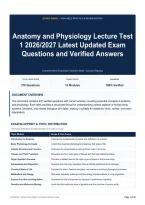
Anatomy and Physiology Lecture Test
1 2026/2027 Latest Updated Exam
Questions and Verified Answers
Comprehensive Examination Question Bank • Concept Mapping
TOTAL QUESTIONS EXAM TOPICS ANSWERS
276 Questions 12 Modules 100% Verified
DOCUMENT OVERVIEW
This document contains 276 verified questions with correct answers covering essential concepts in anatomy
and physiology. Each item provides a structured format for understanding various aspects of human body
systems, functions, and related biological principles, making it suitable for academic study, review, and exam
preparation.
EXAM BLUEPRINT & TOPIC DISTRIBUTION
Systematic breakdown of subject domains and exam coverage.
Topic Module Scope & Core Focus
Introduction to Anatomy Explores the fundamental principles and definitions of anatomy.
Basic Physiology Concepts Covers the essential physiological processes that support life.
Cellular Structure and Function Examines the components of cells and their roles in the body.
Tissues and Their Functions Discusses the four main types of tissues and their specialized functions.
Organ Systems Overview Provides a detailed look at the major organ systems in the human body.
Homeostasis and Regulation Analyzes how the body maintains internal stability despite external changes.
Chemical Basis of Life Explores the basic chemical principles and reactions underlying biological processes.
Metabolism and Energy Discusses metabolic pathways and the energy transformations in living organisms.
Enzyme Function and Regulation Examines the role of enzymes as catalysts in biochemical reactions.
Genetics and Molecular Biology Looks into the molecular basis of genetics and the structure of nucleic acids.
Confidential • Student Study Edition • Practice & Review Guide Page 1 of 80
,STUDENT STUDY & MASTERY EDITION PRACTICE & REVIEW GUIDE
Anatomical Terminology Introduces the language and terms used in anatomy for precise communication.
Integration of Body Systems Explains how different body systems interact to maintain overall health.
Total Exam Coverage 12 Integrated Topic Modules • 276 Examination Questions
QUESTION 1
The word "anatomy" comes from
A. Latin and means "to be born."
B. Hebrew and means "shape."
C. Greek and means "to cut apart."
D. German and means "body."
E. Italian and means "form."
Answer: C. Greek and means "to cut apart.".
QUESTION 2
Anatomy is the study of
A. stars.
B. function.
C. sharp tools.
D. structure and form.
E. word histories.
Answer: D. structure and form.
QUESTION 3
(T/F) Because the body has been the same for thousands of years, anatomy is
considered a static classification system instead of a dynamic science.
Answer: FALSE.
Confidential • Student Study Edition • Practice & Review Guide Page 2 of 80
,STUDENT STUDY & MASTERY EDITION PRACTICE & REVIEW GUIDE
QUESTION 4
A scientist who describes the layers of the heart wall and their relationship to the
surrounding pericardium would be a(n)
A. anatomist.
B. physiologist.
C. pathologist.
D. pulmonologist.
Answer: A. anatomist.
QUESTION 5
______ anatomy examines both superficial anatomic markings and internal body
structures as they relate to the skin covering them.
A. Regional
B. Surface
C. Radiographic
D. Surgical
E. Systemic
Answer: B. Surface.
QUESTION 6
Which branch of microscopic anatomy is the study of tissues?
A. Histology
B. Cytology
C. Embryology
D. Developmental anatomy
E. Surgical anatomy
Answer: A. Histology.
Confidential • Student Study Edition • Practice & Review Guide Page 3 of 80
, STUDENT STUDY & MASTERY EDITION PRACTICE & REVIEW GUIDE
QUESTION 7
(T/F) Cytology is a subdivision of gross anatomy.
Answer: FALSE.
QUESTION 8
Gross anatomy refers to the study of
A. cells.
B. structures formed by cells.
C. structures not visible to the unaided eye.
D. structures visible to the unaided eye.
E. nasal secretions.
Answer: D. structures visible to the unaided eye.
QUESTION 9
The anatomic changes that result from disease are studied under
A. pathologic anatomy.
B. systemic anatomy.
C. histology.
D. surgical anatomy.
E. developmental anatomy.
Answer: A. pathologic anatomy.
QUESTION 10
The two main divisions of microscopic anatomy are
A. embryology and parasitology.
B. cytology and histology.
C. comparative anatomy and pathological anatomy.
D. neurobiology and surface anatomy.
Answer: B. cytology and histology.
Confidential • Student Study Edition • Practice & Review Guide Page 4 of 80
Anatomy and Physiology Lecture Test
1 2026/2027 Latest Updated Exam
Questions and Verified Answers
Comprehensive Examination Question Bank • Concept Mapping
TOTAL QUESTIONS EXAM TOPICS ANSWERS
276 Questions 12 Modules 100% Verified
DOCUMENT OVERVIEW
This document contains 276 verified questions with correct answers covering essential concepts in anatomy
and physiology. Each item provides a structured format for understanding various aspects of human body
systems, functions, and related biological principles, making it suitable for academic study, review, and exam
preparation.
EXAM BLUEPRINT & TOPIC DISTRIBUTION
Systematic breakdown of subject domains and exam coverage.
Topic Module Scope & Core Focus
Introduction to Anatomy Explores the fundamental principles and definitions of anatomy.
Basic Physiology Concepts Covers the essential physiological processes that support life.
Cellular Structure and Function Examines the components of cells and their roles in the body.
Tissues and Their Functions Discusses the four main types of tissues and their specialized functions.
Organ Systems Overview Provides a detailed look at the major organ systems in the human body.
Homeostasis and Regulation Analyzes how the body maintains internal stability despite external changes.
Chemical Basis of Life Explores the basic chemical principles and reactions underlying biological processes.
Metabolism and Energy Discusses metabolic pathways and the energy transformations in living organisms.
Enzyme Function and Regulation Examines the role of enzymes as catalysts in biochemical reactions.
Genetics and Molecular Biology Looks into the molecular basis of genetics and the structure of nucleic acids.
Confidential • Student Study Edition • Practice & Review Guide Page 1 of 80
,STUDENT STUDY & MASTERY EDITION PRACTICE & REVIEW GUIDE
Anatomical Terminology Introduces the language and terms used in anatomy for precise communication.
Integration of Body Systems Explains how different body systems interact to maintain overall health.
Total Exam Coverage 12 Integrated Topic Modules • 276 Examination Questions
QUESTION 1
The word "anatomy" comes from
A. Latin and means "to be born."
B. Hebrew and means "shape."
C. Greek and means "to cut apart."
D. German and means "body."
E. Italian and means "form."
Answer: C. Greek and means "to cut apart.".
QUESTION 2
Anatomy is the study of
A. stars.
B. function.
C. sharp tools.
D. structure and form.
E. word histories.
Answer: D. structure and form.
QUESTION 3
(T/F) Because the body has been the same for thousands of years, anatomy is
considered a static classification system instead of a dynamic science.
Answer: FALSE.
Confidential • Student Study Edition • Practice & Review Guide Page 2 of 80
,STUDENT STUDY & MASTERY EDITION PRACTICE & REVIEW GUIDE
QUESTION 4
A scientist who describes the layers of the heart wall and their relationship to the
surrounding pericardium would be a(n)
A. anatomist.
B. physiologist.
C. pathologist.
D. pulmonologist.
Answer: A. anatomist.
QUESTION 5
______ anatomy examines both superficial anatomic markings and internal body
structures as they relate to the skin covering them.
A. Regional
B. Surface
C. Radiographic
D. Surgical
E. Systemic
Answer: B. Surface.
QUESTION 6
Which branch of microscopic anatomy is the study of tissues?
A. Histology
B. Cytology
C. Embryology
D. Developmental anatomy
E. Surgical anatomy
Answer: A. Histology.
Confidential • Student Study Edition • Practice & Review Guide Page 3 of 80
, STUDENT STUDY & MASTERY EDITION PRACTICE & REVIEW GUIDE
QUESTION 7
(T/F) Cytology is a subdivision of gross anatomy.
Answer: FALSE.
QUESTION 8
Gross anatomy refers to the study of
A. cells.
B. structures formed by cells.
C. structures not visible to the unaided eye.
D. structures visible to the unaided eye.
E. nasal secretions.
Answer: D. structures visible to the unaided eye.
QUESTION 9
The anatomic changes that result from disease are studied under
A. pathologic anatomy.
B. systemic anatomy.
C. histology.
D. surgical anatomy.
E. developmental anatomy.
Answer: A. pathologic anatomy.
QUESTION 10
The two main divisions of microscopic anatomy are
A. embryology and parasitology.
B. cytology and histology.
C. comparative anatomy and pathological anatomy.
D. neurobiology and surface anatomy.
Answer: B. cytology and histology.
Confidential • Student Study Edition • Practice & Review Guide Page 4 of 80