
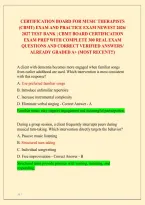
CERTIFICATION BOARD FOR MUSIC THERAPISTS
(CBMT) EXAM AND PRACTICE EXAM NEWEST 2026/
2027 TEST BANK | CBMT BOARD CERTIFICATION
EXAM PREP WITH COMPLETE 300 REAL EXAM
QUESTIONS AND CORRECT VERIFIED ANSWERS/
ALREADY GRADED A+ (MOST RECENT!!)
A client with dementia becomes more engaged when familiar songs
from earlier adulthood are used. Which intervention is most consistent
with this response?
A. Use preferred familiar songs
B. Introduce unfamiliar repertoire
C. Increase instrumental complexity
D. Eliminate verbal singing - Correct Answer - A
Familiar music may support engagement and meaningful participation.
During a group session, a client frequently interrupts peers during
musical turn-taking. Which intervention directly targets the behavior?
A. Passive music listening
B. Structured turn-taking
C. Individual songwriting
D. Free improvisation - Correct Answer - B
Structured turns provide practice with waiting, initiating, and
responding.
pg. 1
,A client with aphasia can sing familiar melodies but has difficulty
producing spontaneous speech. Which technique best uses this strength?
A. Instrumental improvisation
B. Rhythmic entrainment
C. Melodic speech support
D. Passive relaxation music - Correct Answer - C
Melodic support can facilitate targeted verbal production.
A patient becomes tense when loud percussion is introduced. Which
modification is most appropriate?
A. Increase volume
B. Maintain the volume
C. Add faster rhythms
D. Reduce intensity - Correct Answer - D
Reducing intensity respects the observed sensory response.
A therapist wants to measure improvement in social initiation. Which
measure provides the most direct data?
A. Number of initiations
B. Session enjoyment
C. Music preference
D. Therapist satisfaction - Correct Answer - A
Frequency of initiation directly measures the stated treatment target.
A child with autism has difficulty transitioning between activities.
Which intervention provides the clearest transition structure?
pg. 2
,A. Free improvisation
B. Musical transition cue
C. Extended music listening
D. Unstructured movement - Correct Answer - B
A consistent musical cue can signal predictable transitions.
A client repeatedly rejects peers' ideas during songwriting. The treatment
goal concerns cooperation. Which activity modification is most useful?
A. Solo songwriting
B. Passive listening
C. Shared songwriting
D. Individual instrument practice - Correct Answer - C
Shared songwriting creates opportunities to practice cooperation.
A therapist documents that a client “was difficult and attention-seeking.”
Which documentation is more appropriate?
A. Client had poor motivation.
B. Client was emotionally unstable.
C. Client wanted attention.
D. Client left the activity twice - Correct Answer: D
Documentation should emphasize observable behavior rather than
inferred motives.
A client with traumatic brain injury improves movement timing when
rhythmic cues are provided. What does this finding support?
A. Use of rhythmic cueing
pg. 3
, B. Removal of music
C. Increased verbal prompting
D. Passive listening - Correct Answer - A
The observed response supports continued use of rhythmic cueing.
A therapist receives a referral stating only “music therapy for anxiety.”
What information is most important before treatment planning?
A. Room availability
B. Functional concerns
C. Instrument inventory
D. Therapist preference - Correct Answer - B
Functional concerns help establish individualized treatment targets.
A client becomes increasingly independent with a rhythmic movement
task. Which change should the therapist consider?
A. Increase assistance
B. End treatment
C. Fade cueing
D. Remove rhythm - Correct Answer - C
Reduced cueing may allow assessment of independent performance.
A client becomes distressed when a culturally significant song is used.
What should the therapist do?
A. Repeat the song
B. Ignore the response
pg. 4


