
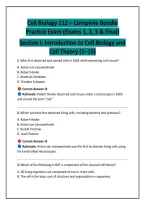
Cell Biology 112 – Complete Bundle
Practice Exam (Exams 1, 2, 3 & Final)
Section I: Introduction to Cell Biology and
Cell Theory (1–15)
1. Who first observed and named cells in 1665 while examining cork tissue?
A. Anton van Leeuwenhoek
B. Robert Hooke
C. Matthias Schleiden
D. Theodor Schwann
Correct Answer: B
Rationale: Robert Hooke observed cork tissue under a microscope in 1665
and coined the term "cell."
2. Which scientist first observed living cells, including bacteria and protozoa?
A. Robert Hooke
B. Anton van Leeuwenhoek
C. Rudolf Virchow
D. Louis Pasteur
Correct Answer: B
Rationale: Anton van Leeuwenhoek was the first to observe living cells using
his handcrafted microscopes.
3. Which of the following is NOT a component of the classical cell theory?
A. All living organisms are composed of one or more cells.
B. The cell is the basic unit of structure and organization in organisms.
,C. All cells arise from pre-existing cells.
D. Cells can arise spontaneously from non-living matter.
Correct Answer: D
Rationale: Spontaneous generation is not part of cell theory. Cell theory
states that all cells arise from pre-existing cells.
4. Who proposed that all cells arise from pre-existing cells?
A. Robert Hooke
B. Anton van Leeuwenhoek
C. Rudolf Virchow
D. Matthias Schleiden
Correct Answer: C
Rationale: Rudolf Virchow proposed "Omnis cellula e cellula" — all cells arise
from pre-existing cells.
5. Which type of cell lacks a membrane-bound nucleus?
A. Eukaryotic
B. Prokaryotic
C. Plant cell
D. Fungal cell
Correct Answer: B
Rationale: Prokaryotic cells lack a membrane-bound nucleus and other
membrane-bound organelles.
6. Which of the following is found in prokaryotic cells?
A. Nucleus
B. Mitochondria
C. Ribosomes
D. Endoplasmic reticulum
, Correct Answer: C
Rationale: Prokaryotic cells have ribosomes but lack a nucleus, mitochondria,
and endoplasmic reticulum.
7. What is the approximate size range of most prokaryotic cells?
A. 0.1–1 µm
B. 1–5 µm
C. 10–100 µm
D. 100–1000 µm
Correct Answer: B
Rationale: Most prokaryotic cells are 1–5 µm in diameter.
8. What is the approximate size range of most eukaryotic cells?
A. 0.1–1 µm
B. 1–5 µm
C. 10–100 µm
D. 1–10 mm
Correct Answer: C
Rationale: Most eukaryotic cells are 10–100 µm in diameter.
9. Which of the following is a key difference between prokaryotic and eukaryotic
cells?
A. Prokaryotes have a nucleus; eukaryotes do not.
B. Eukaryotes have membrane-bound organelles; prokaryotes do not.
C. Prokaryotes are larger than eukaryotes.
D. Eukaryotes lack ribosomes.
Correct Answer: B
Rationale: Eukaryotic cells have membrane-bound organelles, while
prokaryotic cells do not.
, 10. Which of the following is a characteristic of all cells?
A. Presence of a nucleus
B. Presence of a plasma membrane
C. Presence of mitochondria
D. Presence of chloroplasts
Correct Answer: B
Rationale: All cells have a plasma membrane that separates the internal
environment from the external environment.
11. What is the function of the plasma membrane?
A. To store genetic information
B. To control what enters and exits the cell
C. To produce ATP
D. To synthesize proteins
Correct Answer: B
Rationale: The plasma membrane is selectively permeable and controls the
movement of substances into and out of the cell.
12. Which of the following is a function of the cytoplasm?
A. To store genetic information
B. To provide a site for metabolic reactions
C. To produce ATP
D. To synthesize proteins
Correct Answer: B
Rationale: The cytoplasm is the site of many metabolic reactions and contains
the cytosol and organelles.
Practice Exam (Exams 1, 2, 3 & Final)
Section I: Introduction to Cell Biology and
Cell Theory (1–15)
1. Who first observed and named cells in 1665 while examining cork tissue?
A. Anton van Leeuwenhoek
B. Robert Hooke
C. Matthias Schleiden
D. Theodor Schwann
Correct Answer: B
Rationale: Robert Hooke observed cork tissue under a microscope in 1665
and coined the term "cell."
2. Which scientist first observed living cells, including bacteria and protozoa?
A. Robert Hooke
B. Anton van Leeuwenhoek
C. Rudolf Virchow
D. Louis Pasteur
Correct Answer: B
Rationale: Anton van Leeuwenhoek was the first to observe living cells using
his handcrafted microscopes.
3. Which of the following is NOT a component of the classical cell theory?
A. All living organisms are composed of one or more cells.
B. The cell is the basic unit of structure and organization in organisms.
,C. All cells arise from pre-existing cells.
D. Cells can arise spontaneously from non-living matter.
Correct Answer: D
Rationale: Spontaneous generation is not part of cell theory. Cell theory
states that all cells arise from pre-existing cells.
4. Who proposed that all cells arise from pre-existing cells?
A. Robert Hooke
B. Anton van Leeuwenhoek
C. Rudolf Virchow
D. Matthias Schleiden
Correct Answer: C
Rationale: Rudolf Virchow proposed "Omnis cellula e cellula" — all cells arise
from pre-existing cells.
5. Which type of cell lacks a membrane-bound nucleus?
A. Eukaryotic
B. Prokaryotic
C. Plant cell
D. Fungal cell
Correct Answer: B
Rationale: Prokaryotic cells lack a membrane-bound nucleus and other
membrane-bound organelles.
6. Which of the following is found in prokaryotic cells?
A. Nucleus
B. Mitochondria
C. Ribosomes
D. Endoplasmic reticulum
, Correct Answer: C
Rationale: Prokaryotic cells have ribosomes but lack a nucleus, mitochondria,
and endoplasmic reticulum.
7. What is the approximate size range of most prokaryotic cells?
A. 0.1–1 µm
B. 1–5 µm
C. 10–100 µm
D. 100–1000 µm
Correct Answer: B
Rationale: Most prokaryotic cells are 1–5 µm in diameter.
8. What is the approximate size range of most eukaryotic cells?
A. 0.1–1 µm
B. 1–5 µm
C. 10–100 µm
D. 1–10 mm
Correct Answer: C
Rationale: Most eukaryotic cells are 10–100 µm in diameter.
9. Which of the following is a key difference between prokaryotic and eukaryotic
cells?
A. Prokaryotes have a nucleus; eukaryotes do not.
B. Eukaryotes have membrane-bound organelles; prokaryotes do not.
C. Prokaryotes are larger than eukaryotes.
D. Eukaryotes lack ribosomes.
Correct Answer: B
Rationale: Eukaryotic cells have membrane-bound organelles, while
prokaryotic cells do not.
, 10. Which of the following is a characteristic of all cells?
A. Presence of a nucleus
B. Presence of a plasma membrane
C. Presence of mitochondria
D. Presence of chloroplasts
Correct Answer: B
Rationale: All cells have a plasma membrane that separates the internal
environment from the external environment.
11. What is the function of the plasma membrane?
A. To store genetic information
B. To control what enters and exits the cell
C. To produce ATP
D. To synthesize proteins
Correct Answer: B
Rationale: The plasma membrane is selectively permeable and controls the
movement of substances into and out of the cell.
12. Which of the following is a function of the cytoplasm?
A. To store genetic information
B. To provide a site for metabolic reactions
C. To produce ATP
D. To synthesize proteins
Correct Answer: B
Rationale: The cytoplasm is the site of many metabolic reactions and contains
the cytosol and organelles.


