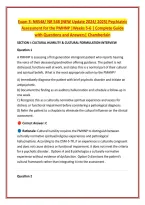
Exam 3: NR548/ NR 548 (NEW Update 2024/ 2025) Psychiatric
Assessment for the PMHNP |Weeks 5-6 | Complete Guide
with Questions and Answers| Chamberlain
SECTION I: CULTURAL HUMILITY & CULTURAL FORMULATION INTERVIEW
Question 1
A PMHNP is assessing a first-generation immigrant patient who reports hearing
the voice of their deceased grandmother offering guidance. The patient is not
distressed, functions well at work, and states this is a normal part of their cultural
and spiritual beliefs. What is the most appropriate action by the PMHNP?
A) Immediately diagnose the patient with brief psychotic disorder and initiate an
antipsychotic.
B) Document the finding as an auditory hallucination and schedule a follow-up in
one week.
C) Recognize this as a culturally normative spiritual experience and assess for
distress or functional impairment before considering a pathological diagnosis.
D) Refer the patient to a chaplain to eliminate the cultural influence on the clinical
assessment.
Correct Answer: C
Rationale: Cultural humility requires the PMHNP to distinguish between
culturally normative spiritual/religious experiences and pathological
hallucinations. According to the DSM-5-TR, if an experience is culturally congruent
and does not cause distress or functional impairment, it does not meet the criteria
for a psychotic disorder . Options A and B pathologize a culturally normative
experience without evidence of dysfunction. Option D dismisses the patient's
cultural framework rather than integrating it into the assessment .
Question 2
,Which of the following best describes the purpose of the DSM-5 Cultural
Formulation Interview (CFI)?
A) To diagnose culture-bound syndromes using standardized criteria.
B) To elicit the patient's cultural identity, illness narrative, psychosocial stressors,
and cultural features of the clinician-patient relationship.
C) To replace the standard psychiatric interview when working with minority
populations.
D) To determine whether a patient's symptoms are "real" or culturally fabricated.
Correct Answer: B
Rationale: The DSM-5 Cultural Formulation Interview is a semi-structured
instrument designed to elicit cultural identity, idioms of distress, explanatory
models, psychosocial stressors, and cultural features of the clinician-patient
relationship . It supplements—not replaces—standard assessment. It does not
determine whether symptoms are "real"; rather, it enhances diagnostic accuracy
by contextualizing the patient's experience.
Question 3
A 28-year-old Vietnamese-American woman presents with somatic complaints of
"weakness" and "nerves" without clear medical etiology. Which DSM-5 tool
should the PMHNP prioritize to understand her cultural context and avoid
pathologizing normal cultural experiences?
A) Mini-Mental State Examination (MMSE)
B) DSM-5 Cultural Formulation Interview (CFI)
C) Hamilton Anxiety Rating Scale (HAM-A)
D) Personality Assessment Inventory (PAI)
Correct Answer: B
Rationale: The Cultural Formulation Interview is specifically designed to elicit
cultural identity, illness narratives, idioms of distress, and psychosocial stressors .
,MMSE assesses cognition, HAM-A measures anxiety severity, and PAI assesses
personality—none assess cultural context.
Question 4
A PMHNP is working with a patient from a cultural background different from
their own. Which approach best demonstrates cultural humility?
A) Assume that all members of the cultural group share identical beliefs and
practices.
B) Engage in ongoing self-reflection, ask the patient about their cultural identity,
beliefs, and preferences, and integrate this understanding into care.
C) Avoid discussing cultural differences to prevent the patient from feeling
uncomfortable.
D) Rely solely on textbook descriptions of the culture to guide the assessment.
Correct Answer: B
Rationale: Cultural humility involves ongoing self-reflection, inquiry into the
patient's cultural identity and preferences, and integration of this understanding
into assessment and care . Assuming cultural homogeneity, avoiding discussion, or
relying only on textbook descriptions is inadequate and can lead to stereotyping.
Question 5
Which of the following statements about cultural competence and health
disparities is most accurate?
A) Mental health treatment rates are equal across all racial and ethnic groups in
the United States.
B) Only 10.3% of adults with a mental illness receive treatment, and disparities
disproportionately affect minority populations.
C) Cultural factors do not significantly influence help-seeking behaviors.
, D) The PMHNP should use the same assessment approach for all patients
regardless of cultural background.
Correct Answer: B
Rationale: While the prevalence of mental health disorders remains high,
treatment rates remain low, with only about 10.3% of adults with a mental illness
receiving treatment . Disparities disproportionately affect minority populations.
Cultural factors significantly influence help-seeking, symptom expression, and
treatment engagement. The PMHNP must adapt assessment approaches
accordingly.
Question 6
A PMHNP is assessing a patient who describes their depression as "a curse from
God" rather than a medical condition. Which response best demonstrates cultural
responsiveness?
A) "Depression is a medical illness, not a curse. Let me explain the neurobiology."
B) "Tell me more about how you understand what is happening to you."
C) "That belief is not consistent with medical science."
D) "We don't discuss religious beliefs in psychiatric assessment."
Correct Answer: B
Rationale: Asking the patient to elaborate on their explanatory model
demonstrates cultural responsiveness and builds therapeutic alliance. The PMHNP
should first understand the patient's framework before offering education or
biomedical explanations . Dismissing or arguing with the patient's belief damages
rapport.
Question 7
According to the ANA Code of Ethics, Provision 8 (Cultural Humility), PMHNPs
should:
Assessment for the PMHNP |Weeks 5-6 | Complete Guide
with Questions and Answers| Chamberlain
SECTION I: CULTURAL HUMILITY & CULTURAL FORMULATION INTERVIEW
Question 1
A PMHNP is assessing a first-generation immigrant patient who reports hearing
the voice of their deceased grandmother offering guidance. The patient is not
distressed, functions well at work, and states this is a normal part of their cultural
and spiritual beliefs. What is the most appropriate action by the PMHNP?
A) Immediately diagnose the patient with brief psychotic disorder and initiate an
antipsychotic.
B) Document the finding as an auditory hallucination and schedule a follow-up in
one week.
C) Recognize this as a culturally normative spiritual experience and assess for
distress or functional impairment before considering a pathological diagnosis.
D) Refer the patient to a chaplain to eliminate the cultural influence on the clinical
assessment.
Correct Answer: C
Rationale: Cultural humility requires the PMHNP to distinguish between
culturally normative spiritual/religious experiences and pathological
hallucinations. According to the DSM-5-TR, if an experience is culturally congruent
and does not cause distress or functional impairment, it does not meet the criteria
for a psychotic disorder . Options A and B pathologize a culturally normative
experience without evidence of dysfunction. Option D dismisses the patient's
cultural framework rather than integrating it into the assessment .
Question 2
,Which of the following best describes the purpose of the DSM-5 Cultural
Formulation Interview (CFI)?
A) To diagnose culture-bound syndromes using standardized criteria.
B) To elicit the patient's cultural identity, illness narrative, psychosocial stressors,
and cultural features of the clinician-patient relationship.
C) To replace the standard psychiatric interview when working with minority
populations.
D) To determine whether a patient's symptoms are "real" or culturally fabricated.
Correct Answer: B
Rationale: The DSM-5 Cultural Formulation Interview is a semi-structured
instrument designed to elicit cultural identity, idioms of distress, explanatory
models, psychosocial stressors, and cultural features of the clinician-patient
relationship . It supplements—not replaces—standard assessment. It does not
determine whether symptoms are "real"; rather, it enhances diagnostic accuracy
by contextualizing the patient's experience.
Question 3
A 28-year-old Vietnamese-American woman presents with somatic complaints of
"weakness" and "nerves" without clear medical etiology. Which DSM-5 tool
should the PMHNP prioritize to understand her cultural context and avoid
pathologizing normal cultural experiences?
A) Mini-Mental State Examination (MMSE)
B) DSM-5 Cultural Formulation Interview (CFI)
C) Hamilton Anxiety Rating Scale (HAM-A)
D) Personality Assessment Inventory (PAI)
Correct Answer: B
Rationale: The Cultural Formulation Interview is specifically designed to elicit
cultural identity, illness narratives, idioms of distress, and psychosocial stressors .
,MMSE assesses cognition, HAM-A measures anxiety severity, and PAI assesses
personality—none assess cultural context.
Question 4
A PMHNP is working with a patient from a cultural background different from
their own. Which approach best demonstrates cultural humility?
A) Assume that all members of the cultural group share identical beliefs and
practices.
B) Engage in ongoing self-reflection, ask the patient about their cultural identity,
beliefs, and preferences, and integrate this understanding into care.
C) Avoid discussing cultural differences to prevent the patient from feeling
uncomfortable.
D) Rely solely on textbook descriptions of the culture to guide the assessment.
Correct Answer: B
Rationale: Cultural humility involves ongoing self-reflection, inquiry into the
patient's cultural identity and preferences, and integration of this understanding
into assessment and care . Assuming cultural homogeneity, avoiding discussion, or
relying only on textbook descriptions is inadequate and can lead to stereotyping.
Question 5
Which of the following statements about cultural competence and health
disparities is most accurate?
A) Mental health treatment rates are equal across all racial and ethnic groups in
the United States.
B) Only 10.3% of adults with a mental illness receive treatment, and disparities
disproportionately affect minority populations.
C) Cultural factors do not significantly influence help-seeking behaviors.
, D) The PMHNP should use the same assessment approach for all patients
regardless of cultural background.
Correct Answer: B
Rationale: While the prevalence of mental health disorders remains high,
treatment rates remain low, with only about 10.3% of adults with a mental illness
receiving treatment . Disparities disproportionately affect minority populations.
Cultural factors significantly influence help-seeking, symptom expression, and
treatment engagement. The PMHNP must adapt assessment approaches
accordingly.
Question 6
A PMHNP is assessing a patient who describes their depression as "a curse from
God" rather than a medical condition. Which response best demonstrates cultural
responsiveness?
A) "Depression is a medical illness, not a curse. Let me explain the neurobiology."
B) "Tell me more about how you understand what is happening to you."
C) "That belief is not consistent with medical science."
D) "We don't discuss religious beliefs in psychiatric assessment."
Correct Answer: B
Rationale: Asking the patient to elaborate on their explanatory model
demonstrates cultural responsiveness and builds therapeutic alliance. The PMHNP
should first understand the patient's framework before offering education or
biomedical explanations . Dismissing or arguing with the patient's belief damages
rapport.
Question 7
According to the ANA Code of Ethics, Provision 8 (Cultural Humility), PMHNPs
should: