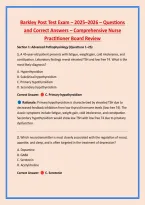
Barkley Post Test Exam – 2025–2026 – Questions
and Correct Answers – Comprehensive Nurse
Practitioner Board Review
Section 1: Advanced Pathophysiology (Questions 1–25)
1. A 45-year-old patient presents with fatigue, weight gain, cold intolerance, and
constipation. Laboratory findings reveal elevated TSH and low free T4. What is the
most likely diagnosis?
A. Hyperthyroidism
B. Subclinical hypothyroidism
C. Primary hypothyroidism
D. Secondary hypothyroidism
Correct Answer: C. Primary hypothyroidism
Rationale: Primary hypothyroidism is characterized by elevated TSH due to
decreased feedback inhibition from low thyroid hormone levels (low free T4). The
classic symptoms include fatigue, weight gain, cold intolerance, and constipation.
Secondary hypothyroidism would show low TSH with low free T4 due to pituitary
dysfunction .
2. Which neurotransmitter is most closely associated with the regulation of mood,
appetite, and sleep, and is often targeted in the treatment of depression?
A. Dopamine
B. GABA
C. Serotonin
D. Acetylcholine
Correct Answer: C. Serotonin
, Rationale: Serotonin plays a key role in mood regulation, appetite, and sleep.
SSRIs increase serotonin availability, alleviating depressive symptoms. Dopamine
relates more to reward and motivation, GABA to inhibition, and acetylcholine to
cognition .
3. A patient with type 2 diabetes mellitus develops peripheral neuropathy. Which
pathophysiological mechanism is primarily responsible?
A. Autoimmune destruction of pancreatic beta cells
B. Hyperglycemia-induced oxidative stress and microvascular damage
C. Insulin receptor resistance in skeletal muscle
D. Decreased hepatic glucose production
Correct Answer: B. Hyperglycemia-induced oxidative stress and
microvascular damage
Rationale: Chronic hyperglycemia leads to oxidative stress, advanced glycation
end-products (AGEs), and microvascular damage, causing neuronal ischemia and
damage. This results in peripheral neuropathy, a common complication of
diabetes .
4. A patient with heart failure exhibits jugular venous distention, peripheral
edema, and hepatomegaly. What type of heart failure does this represent?
A. Left-sided heart failure
B. Right-sided heart failure
C. High-output heart failure
D. Diastolic heart failure
Correct Answer: B. Right-sided heart failure
Rationale: Right-sided heart failure leads to systemic venous congestion,
causing jugular venous distention, peripheral edema, hepatomegaly, and ascites.
Left-sided failure primarily causes pulmonary congestion (dyspnea, crackles) .
,5. A patient presents with sudden onset of severe, tearing chest pain radiating to
the back. He has a history of hypertension and smokes one pack per day. His blood
pressure is 180/100 mmHg in the right arm and 150/90 mmHg in the left arm.
Which finding is most concerning for aortic dissection?
A. Equal blood pressures in both arms
B. Inter-arm blood pressure differential
C. Pain relieved by nitroglycerin
D. ST elevation on ECG
Correct Answer: B. Inter-arm blood pressure differential
Rationale: A significant inter-arm blood pressure differential (>20 mmHg) is a
classic finding in aortic dissection due to compromised flow in the subclavian
artery. This requires emergent imaging and surgical consultation .
6. A 34-year-old female presents with fatigue, weight gain, and cold intolerance.
Her TSH is elevated and free T4 is low. Which additional laboratory finding would
most support Hashimoto's thyroiditis?
A. Elevated thyroglobulin
B. Positive anti-thyroid peroxidase antibodies
C. Low reverse T3
D. Elevated thyroid-stimulating immunoglobulin
Correct Answer: B. Positive anti-thyroid peroxidase antibodies
Rationale: Anti-thyroid peroxidase (anti-TPO) antibodies are the hallmark of
Hashimoto's thyroiditis, confirming autoimmune destruction of the thyroid gland
as the etiology of hypothyroidism .
, 7. A 45-year-old male with a history of alcohol use disorder presents with
confusion, ataxia, and ophthalmoplegia. Which vitamin deficiency is most likely
responsible for his symptoms?
A. Vitamin B12
B. Thiamine (B1)
C. Folate
D. Vitamin C
Correct Answer: B. Thiamine (B1)
Rationale: Wernicke's encephalopathy, caused by thiamine deficiency,
presents with the triad of confusion, ataxia, and ophthalmoplegia. This is a
medical emergency requiring immediate thiamine administration .
8. Which neurotransmitter imbalance is most closely associated with the positive
symptoms of schizophrenia?
A. Decreased serotonin
B. Increased dopamine
C. Decreased glutamate
D. Increased GABA
Correct Answer: B. Increased dopamine
Rationale: Hyperactivity of dopamine in the mesolimbic pathway is linked to
hallucinations and delusions—core positive symptoms of schizophrenia .
9. A 59-year-old is having a follow-up evaluation two years after the successful
conclusion of radiation therapy for leukemia. He reports feeling run-down with
unexplained weight loss, night sweats, fever, and pain below his ribs on the left
side. He is at risk for chronic lymphocytic leukemia. Which result is considered the
hallmark of this disease?
and Correct Answers – Comprehensive Nurse
Practitioner Board Review
Section 1: Advanced Pathophysiology (Questions 1–25)
1. A 45-year-old patient presents with fatigue, weight gain, cold intolerance, and
constipation. Laboratory findings reveal elevated TSH and low free T4. What is the
most likely diagnosis?
A. Hyperthyroidism
B. Subclinical hypothyroidism
C. Primary hypothyroidism
D. Secondary hypothyroidism
Correct Answer: C. Primary hypothyroidism
Rationale: Primary hypothyroidism is characterized by elevated TSH due to
decreased feedback inhibition from low thyroid hormone levels (low free T4). The
classic symptoms include fatigue, weight gain, cold intolerance, and constipation.
Secondary hypothyroidism would show low TSH with low free T4 due to pituitary
dysfunction .
2. Which neurotransmitter is most closely associated with the regulation of mood,
appetite, and sleep, and is often targeted in the treatment of depression?
A. Dopamine
B. GABA
C. Serotonin
D. Acetylcholine
Correct Answer: C. Serotonin
, Rationale: Serotonin plays a key role in mood regulation, appetite, and sleep.
SSRIs increase serotonin availability, alleviating depressive symptoms. Dopamine
relates more to reward and motivation, GABA to inhibition, and acetylcholine to
cognition .
3. A patient with type 2 diabetes mellitus develops peripheral neuropathy. Which
pathophysiological mechanism is primarily responsible?
A. Autoimmune destruction of pancreatic beta cells
B. Hyperglycemia-induced oxidative stress and microvascular damage
C. Insulin receptor resistance in skeletal muscle
D. Decreased hepatic glucose production
Correct Answer: B. Hyperglycemia-induced oxidative stress and
microvascular damage
Rationale: Chronic hyperglycemia leads to oxidative stress, advanced glycation
end-products (AGEs), and microvascular damage, causing neuronal ischemia and
damage. This results in peripheral neuropathy, a common complication of
diabetes .
4. A patient with heart failure exhibits jugular venous distention, peripheral
edema, and hepatomegaly. What type of heart failure does this represent?
A. Left-sided heart failure
B. Right-sided heart failure
C. High-output heart failure
D. Diastolic heart failure
Correct Answer: B. Right-sided heart failure
Rationale: Right-sided heart failure leads to systemic venous congestion,
causing jugular venous distention, peripheral edema, hepatomegaly, and ascites.
Left-sided failure primarily causes pulmonary congestion (dyspnea, crackles) .
,5. A patient presents with sudden onset of severe, tearing chest pain radiating to
the back. He has a history of hypertension and smokes one pack per day. His blood
pressure is 180/100 mmHg in the right arm and 150/90 mmHg in the left arm.
Which finding is most concerning for aortic dissection?
A. Equal blood pressures in both arms
B. Inter-arm blood pressure differential
C. Pain relieved by nitroglycerin
D. ST elevation on ECG
Correct Answer: B. Inter-arm blood pressure differential
Rationale: A significant inter-arm blood pressure differential (>20 mmHg) is a
classic finding in aortic dissection due to compromised flow in the subclavian
artery. This requires emergent imaging and surgical consultation .
6. A 34-year-old female presents with fatigue, weight gain, and cold intolerance.
Her TSH is elevated and free T4 is low. Which additional laboratory finding would
most support Hashimoto's thyroiditis?
A. Elevated thyroglobulin
B. Positive anti-thyroid peroxidase antibodies
C. Low reverse T3
D. Elevated thyroid-stimulating immunoglobulin
Correct Answer: B. Positive anti-thyroid peroxidase antibodies
Rationale: Anti-thyroid peroxidase (anti-TPO) antibodies are the hallmark of
Hashimoto's thyroiditis, confirming autoimmune destruction of the thyroid gland
as the etiology of hypothyroidism .
, 7. A 45-year-old male with a history of alcohol use disorder presents with
confusion, ataxia, and ophthalmoplegia. Which vitamin deficiency is most likely
responsible for his symptoms?
A. Vitamin B12
B. Thiamine (B1)
C. Folate
D. Vitamin C
Correct Answer: B. Thiamine (B1)
Rationale: Wernicke's encephalopathy, caused by thiamine deficiency,
presents with the triad of confusion, ataxia, and ophthalmoplegia. This is a
medical emergency requiring immediate thiamine administration .
8. Which neurotransmitter imbalance is most closely associated with the positive
symptoms of schizophrenia?
A. Decreased serotonin
B. Increased dopamine
C. Decreased glutamate
D. Increased GABA
Correct Answer: B. Increased dopamine
Rationale: Hyperactivity of dopamine in the mesolimbic pathway is linked to
hallucinations and delusions—core positive symptoms of schizophrenia .
9. A 59-year-old is having a follow-up evaluation two years after the successful
conclusion of radiation therapy for leukemia. He reports feeling run-down with
unexplained weight loss, night sweats, fever, and pain below his ribs on the left
side. He is at risk for chronic lymphocytic leukemia. Which result is considered the
hallmark of this disease?