
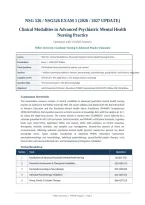
NSG 526 / NSG526 EXAM 1 ( UPDATE)
Clinical Modalities in Advanced Psychiatric Mental Health
Nursing Practice
Questions with Verified Answers
Wilkes University | Graduate Nursing & Advanced Practice Education
Course NSG 526 - Clinical Modalities in Advanced Psychiatric Mental Health Nursing Practice
Examination Exam 1 - 2026/2027 Edition
Total Questions 100 Multiple-Choice Questions (4 options, one correct)
Sections 7 sections covering foundations, theories, pharmacology, psychotherapy, group/family, crisis/trauma, integrative
Cognitive Levels 25% Recall | 50% Application | 25% Analysis (clinical reasoning)
Question Style 75% Scenario-based | 25% Direct knowledge
Alignment AACN Essentials of Master's Education, PMHNP Competencies (2026/2027), Wilkes NSG 526 Syllabus
Examination Instructions
This examination assesses mastery of clinical modalities in advanced psychiatric-mental health nursing
practice as outlined in the Wilkes University NSG 526 course syllabus and aligned with the AACN Essentials
of Master's Education and the Psychiatric-Mental Health Nurse Practitioner (PMHNP) Competencies
(2026/2027 Edition). Each question presents a clinical scenario or knowledge item with four options (A, B, C,
D). Select the single best answer. The correct answer is marked with *[CORRECT]* and is followed by a
rationale grounded in NSG 526 curriculum, AACN Essentials, and PMHNP certification standards. Cognitive
levels span recall (25%), application (50%), and analysis (25%), with emphasis on clinical reasoning,
therapeutic modality selection, and complex case management. Seventy-five percent of items are
scenario-based, reflecting authentic psychiatric-mental health practice; twenty-five percent are direct
knowledge items. Topics include: foundations of advanced PMHN, theoretical frameworks,
psychopharmacology and neurobiology, individual psychotherapy, group/family/couples therapy, crisis
intervention and trauma-informed care, and complementary/integrative modalities.
Section Breakdown
Section Topic Questions
1 Foundations of Advanced Psychiatric Mental Health Nursing Q1-Q15 (15)
2 Theoretical Frameworks & Therapeutic Modalities Q16-Q30 (15)
3 Psychopharmacology & Neurobiology Q31-Q50 (20)
4 Individual Psychotherapy Modalities Q51-Q65 (15)
5 Group, Family, & Couples Therapy Q66-Q77 (12)
Wilkes University | PMHNP Program | Page 1
,NSG 526 Exam 1 (2026/2027) | Clinical Modalities in Advanced Psychiatric Mental Health Nursing Practice
6 Crisis Intervention & Trauma-Informed Care Q78-Q90 (13)
7 Complementary & Integrative Modalities Q91-Q100 (10)
TOTAL 100 Questions
Section 1: Foundations of Advanced Psychiatric Mental Health Nursing
Q1: A PMHNP is establishing a new outpatient practice in a state with full practice authority. Which activity
falls within the PMHNP scope of practice as defined by the AACN Essentials and PMHNP Competencies
(2026/2027)?
A. Providing supportive psychotherapy only under a collaborating psychiatrist's written orders
B. Independently conducting comprehensive psychiatric evaluations, diagnosing mental disorders, and
prescribing Schedule II psychotropic medications *[CORRECT]*
C. Restricting practice exclusively to medication management; psychotherapy must be delegated to licensed
counselors
D. Managing only pediatric patients; adult psychiatric care requires a physician co-signer
Correct Answer: B
Rationale: Under full practice authority in states granting it, PMHNPs independently perform comprehensive psychiatric
evaluation, diagnosis, psychotherapy, and prescribe controlled substances including Schedule II agents, consistent with
AACN Essentials and PMHNP Competencies. Option A reflects a restricted-practice state model, not the full-scope
standard. Option C incorrectly fragments prescribing from psychotherapy, both of which are core PMHNP competencies.
Option D misrepresents scope, as PMHNPs treat across the lifespan when certified accordingly.
Q2: A 38-year-old veteran with PTSD abruptly cancels his third consecutive session, stating, "You can't help
me; nobody can." Which response by the PMHNP most strengthens the therapeutic alliance using a
recovery-oriented framework?
A. "I understand. Let's discharge you from the clinic so you can find a provider who is a better fit."
B. "It sounds like you're feeling hopeless right now. I'd like to keep working with you; what would feel safe
enough to come back?" *[CORRECT]*
C. "Per clinic policy, three cancellations mean I have to refer you to the VA mental health line."
D. "Have you considered that avoidance is reinforcing your PTSD symptoms?"
Correct Answer: B
Rationale: Option B reflects Rogerian empathy, validates the patient's lived experience, honors patient-centered
collaboration, and uses shared decision-making—all central to recovery-oriented care and the AACN Essentials'
emphasis on partnership. Option A abandons the alliance prematurely and contradicts the recovery principle of hope.
Option C enforces rigid policy without clinical engagement. Option D intellectualizes and may shame the patient,
rupturing the alliance.
Wilkes University | PMHNP Program | Page 2
,NSG 526 Exam 1 (2026/2027) | Clinical Modalities in Advanced Psychiatric Mental Health Nursing Practice
Q3: A 45-year-old woman with schizophrenia tells the PMHNP, "I want to work part-time at the library, even
though my voices still bother me." Which recovery-oriented response best supports shared decision-making?
A. "Let's focus first on eliminating your hallucinations before discussing employment."
B. "That's unrealistic given your diagnosis; let's consider a sheltered workshop instead."
C. "Tell me what supports would help you succeed at the library while we continue managing symptoms."
*[CORRECT]*
D. "I'll need to contact your employer to disclose your diagnosis for accommodations."
Correct Answer: C
Rationale: Recovery-oriented care emphasizes hope, self-determination, and meaningful role functioning alongside
ongoing symptoms, consistent with SAMHSA's recovery model and PMHNP competencies. Option C validates the goal,
invites shared decision-making, and treats the patient as a partner. Option A requires symptom elimination first,
contradicting recovery principles. Option B paternalistically dismisses the goal. Option D breaches confidentiality
without consent.
Q4: A PMHNP is designing an intake protocol for a community mental health center serving refugees. Which
action most consistently applies the trauma-informed care principle of "trustworthiness and transparency"?
A. Conducting a detailed trauma history during the first 15 minutes of intake to gather all relevant data
B. Explaining each step of the intake, who will see the records, and what the patient can expect before asking
any clinical questions *[CORRECT]*
C. Avoiding any mention of trauma so as not to "re-traumatize" the patient
D. Asking the patient to write down traumatic experiences to limit emotional discussion
Correct Answer: B
Rationale: SAMHSA's six trauma-informed principles identify trustworthiness and transparency as predictable, clearly
explained practices that restore control to trauma survivors. Option B operationalizes this by orienting the patient to
process and data sharing before clinical inquiry. Option A overwhelms the patient and removes choice. Option C
conflates avoidance with sensitivity and prevents needed care. Option D offloads clinical work and may feel dismissive.
Q5: A Mexican-American patient with depression presents with nervios, susto, and fatigue. The PMHNP
prescribes an SSRI but the patient prefers curanderismo rituals. Which culturally competent approach reflects
the PMHNP Competencies?
A. Refuse to prescribe until the patient agrees to forgo curanderismo, calling it "magical thinking"
B. Discontinue the SSRI and recommend curanderismo as the primary treatment
C. Validate the cultural framework, explore the patient's explanatory model, and integrate evidence-based
care with cultural practices where safe *[CORRECT]*
D. Document the patient as "non-adherent" for cultural beliefs and discharge from care
Correct Answer: C
Rationale: Cultural humility, the LEARN/Explanatory Model approach, and integration of safe cultural practices with
evidence-based care reflect the PMHNP cultural competence competency. Option C honors the patient's framework
while continuing evidence-based treatment. Option A is ethnocentric and dismissive. Option B abandons evidence-based
care entirely. Option D pathologizes culture and abandons the patient.
Wilkes University | PMHNP Program | Page 3
, NSG 526 Exam 1 (2026/2027) | Clinical Modalities in Advanced Psychiatric Mental Health Nursing Practice
Q6: Which of the following best defines health equity as articulated in the AACN Essentials and Healthy
People 2030?
A. Providing identical diagnostic tests and medications to every patient regardless of context
B. Ensuring every individual has a fair and just opportunity to attain their highest level of health by
addressing structural barriers *[CORRECT]*
C. Equalizing health outcomes across all populations through mandated treatment protocols
D. Limiting resource allocation to populations with the worst outcomes only
Correct Answer: B
Rationale: Health equity, per Healthy People 2030 and AACN Essentials, is the principle that everyone has a fair and just
opportunity to attain optimal health, requiring reduction of disparities in access, outcomes, and social determinants.
Option A confuses equality (sameness) with equity (need-based fairness). Option C implies mandated uniformity rather
than addressing root causes. Option D excludes populations and contradicts universal access goals.
Q7: A 28-year-old man with treatment-responsive schizophrenia is repeatedly referred to by staff as "a
schizophrenic." The PMHNP models stigma-reducing, person-first language during rounds. Which statement
best demonstrates this principle?
A. "The schizophrenic in bed 4 needs PRN medication."
B. "He's a non-compliant schizophrenic with chronic psychosis."
C. "The patient in bed 4 is living with schizophrenia and is currently distressed; let's review his triggers."
*[CORRECT]*
D. "Bed 4 is a psych case; nothing will help."
Correct Answer: C
Rationale: Person-first language ("person living with schizophrenia") separates identity from diagnosis and is central to
stigma reduction, recovery-oriented care, and PMHNP communication competencies. Option C identifies the patient,
names the diagnosis, and centers clinical reasoning. Options A, B, and D use diagnosis-as-identity language or
derogatory labels that reinforce stigma and therapeutic nihilism.
Q8: A 52-year-old patient with bipolar I disorder is offered lithium versus an atypical antipsychotic. The
PMHNP explains the evidence, side effects, monitoring requirements, and patient preferences. Which ethical
principle is most directly embodied?
A. Beneficence only, because the clinician ultimately chooses the safer medication
B. Paternalism, because the clinician knows best which medication the patient should take
C. Shared decision-making, honoring autonomy and evidence simultaneously *[CORRECT]*
D. Justice, because all patients with bipolar disorder receive the same first-line agent
Correct Answer: C
Rationale: Shared decision-making integrates best evidence with clinician expertise and patient values/preferences,
embodying autonomy, beneficence, and the AACN Essentials' patient-centered care competency. Option A overweights
clinician decision-making. Option B is paternalistic. Option D conflates justice with rigid protocol-driven care, ignoring
individualization.
Wilkes University | PMHNP Program | Page 4
Clinical Modalities in Advanced Psychiatric Mental Health
Nursing Practice
Questions with Verified Answers
Wilkes University | Graduate Nursing & Advanced Practice Education
Course NSG 526 - Clinical Modalities in Advanced Psychiatric Mental Health Nursing Practice
Examination Exam 1 - 2026/2027 Edition
Total Questions 100 Multiple-Choice Questions (4 options, one correct)
Sections 7 sections covering foundations, theories, pharmacology, psychotherapy, group/family, crisis/trauma, integrative
Cognitive Levels 25% Recall | 50% Application | 25% Analysis (clinical reasoning)
Question Style 75% Scenario-based | 25% Direct knowledge
Alignment AACN Essentials of Master's Education, PMHNP Competencies (2026/2027), Wilkes NSG 526 Syllabus
Examination Instructions
This examination assesses mastery of clinical modalities in advanced psychiatric-mental health nursing
practice as outlined in the Wilkes University NSG 526 course syllabus and aligned with the AACN Essentials
of Master's Education and the Psychiatric-Mental Health Nurse Practitioner (PMHNP) Competencies
(2026/2027 Edition). Each question presents a clinical scenario or knowledge item with four options (A, B, C,
D). Select the single best answer. The correct answer is marked with *[CORRECT]* and is followed by a
rationale grounded in NSG 526 curriculum, AACN Essentials, and PMHNP certification standards. Cognitive
levels span recall (25%), application (50%), and analysis (25%), with emphasis on clinical reasoning,
therapeutic modality selection, and complex case management. Seventy-five percent of items are
scenario-based, reflecting authentic psychiatric-mental health practice; twenty-five percent are direct
knowledge items. Topics include: foundations of advanced PMHN, theoretical frameworks,
psychopharmacology and neurobiology, individual psychotherapy, group/family/couples therapy, crisis
intervention and trauma-informed care, and complementary/integrative modalities.
Section Breakdown
Section Topic Questions
1 Foundations of Advanced Psychiatric Mental Health Nursing Q1-Q15 (15)
2 Theoretical Frameworks & Therapeutic Modalities Q16-Q30 (15)
3 Psychopharmacology & Neurobiology Q31-Q50 (20)
4 Individual Psychotherapy Modalities Q51-Q65 (15)
5 Group, Family, & Couples Therapy Q66-Q77 (12)
Wilkes University | PMHNP Program | Page 1
,NSG 526 Exam 1 (2026/2027) | Clinical Modalities in Advanced Psychiatric Mental Health Nursing Practice
6 Crisis Intervention & Trauma-Informed Care Q78-Q90 (13)
7 Complementary & Integrative Modalities Q91-Q100 (10)
TOTAL 100 Questions
Section 1: Foundations of Advanced Psychiatric Mental Health Nursing
Q1: A PMHNP is establishing a new outpatient practice in a state with full practice authority. Which activity
falls within the PMHNP scope of practice as defined by the AACN Essentials and PMHNP Competencies
(2026/2027)?
A. Providing supportive psychotherapy only under a collaborating psychiatrist's written orders
B. Independently conducting comprehensive psychiatric evaluations, diagnosing mental disorders, and
prescribing Schedule II psychotropic medications *[CORRECT]*
C. Restricting practice exclusively to medication management; psychotherapy must be delegated to licensed
counselors
D. Managing only pediatric patients; adult psychiatric care requires a physician co-signer
Correct Answer: B
Rationale: Under full practice authority in states granting it, PMHNPs independently perform comprehensive psychiatric
evaluation, diagnosis, psychotherapy, and prescribe controlled substances including Schedule II agents, consistent with
AACN Essentials and PMHNP Competencies. Option A reflects a restricted-practice state model, not the full-scope
standard. Option C incorrectly fragments prescribing from psychotherapy, both of which are core PMHNP competencies.
Option D misrepresents scope, as PMHNPs treat across the lifespan when certified accordingly.
Q2: A 38-year-old veteran with PTSD abruptly cancels his third consecutive session, stating, "You can't help
me; nobody can." Which response by the PMHNP most strengthens the therapeutic alliance using a
recovery-oriented framework?
A. "I understand. Let's discharge you from the clinic so you can find a provider who is a better fit."
B. "It sounds like you're feeling hopeless right now. I'd like to keep working with you; what would feel safe
enough to come back?" *[CORRECT]*
C. "Per clinic policy, three cancellations mean I have to refer you to the VA mental health line."
D. "Have you considered that avoidance is reinforcing your PTSD symptoms?"
Correct Answer: B
Rationale: Option B reflects Rogerian empathy, validates the patient's lived experience, honors patient-centered
collaboration, and uses shared decision-making—all central to recovery-oriented care and the AACN Essentials'
emphasis on partnership. Option A abandons the alliance prematurely and contradicts the recovery principle of hope.
Option C enforces rigid policy without clinical engagement. Option D intellectualizes and may shame the patient,
rupturing the alliance.
Wilkes University | PMHNP Program | Page 2
,NSG 526 Exam 1 (2026/2027) | Clinical Modalities in Advanced Psychiatric Mental Health Nursing Practice
Q3: A 45-year-old woman with schizophrenia tells the PMHNP, "I want to work part-time at the library, even
though my voices still bother me." Which recovery-oriented response best supports shared decision-making?
A. "Let's focus first on eliminating your hallucinations before discussing employment."
B. "That's unrealistic given your diagnosis; let's consider a sheltered workshop instead."
C. "Tell me what supports would help you succeed at the library while we continue managing symptoms."
*[CORRECT]*
D. "I'll need to contact your employer to disclose your diagnosis for accommodations."
Correct Answer: C
Rationale: Recovery-oriented care emphasizes hope, self-determination, and meaningful role functioning alongside
ongoing symptoms, consistent with SAMHSA's recovery model and PMHNP competencies. Option C validates the goal,
invites shared decision-making, and treats the patient as a partner. Option A requires symptom elimination first,
contradicting recovery principles. Option B paternalistically dismisses the goal. Option D breaches confidentiality
without consent.
Q4: A PMHNP is designing an intake protocol for a community mental health center serving refugees. Which
action most consistently applies the trauma-informed care principle of "trustworthiness and transparency"?
A. Conducting a detailed trauma history during the first 15 minutes of intake to gather all relevant data
B. Explaining each step of the intake, who will see the records, and what the patient can expect before asking
any clinical questions *[CORRECT]*
C. Avoiding any mention of trauma so as not to "re-traumatize" the patient
D. Asking the patient to write down traumatic experiences to limit emotional discussion
Correct Answer: B
Rationale: SAMHSA's six trauma-informed principles identify trustworthiness and transparency as predictable, clearly
explained practices that restore control to trauma survivors. Option B operationalizes this by orienting the patient to
process and data sharing before clinical inquiry. Option A overwhelms the patient and removes choice. Option C
conflates avoidance with sensitivity and prevents needed care. Option D offloads clinical work and may feel dismissive.
Q5: A Mexican-American patient with depression presents with nervios, susto, and fatigue. The PMHNP
prescribes an SSRI but the patient prefers curanderismo rituals. Which culturally competent approach reflects
the PMHNP Competencies?
A. Refuse to prescribe until the patient agrees to forgo curanderismo, calling it "magical thinking"
B. Discontinue the SSRI and recommend curanderismo as the primary treatment
C. Validate the cultural framework, explore the patient's explanatory model, and integrate evidence-based
care with cultural practices where safe *[CORRECT]*
D. Document the patient as "non-adherent" for cultural beliefs and discharge from care
Correct Answer: C
Rationale: Cultural humility, the LEARN/Explanatory Model approach, and integration of safe cultural practices with
evidence-based care reflect the PMHNP cultural competence competency. Option C honors the patient's framework
while continuing evidence-based treatment. Option A is ethnocentric and dismissive. Option B abandons evidence-based
care entirely. Option D pathologizes culture and abandons the patient.
Wilkes University | PMHNP Program | Page 3
, NSG 526 Exam 1 (2026/2027) | Clinical Modalities in Advanced Psychiatric Mental Health Nursing Practice
Q6: Which of the following best defines health equity as articulated in the AACN Essentials and Healthy
People 2030?
A. Providing identical diagnostic tests and medications to every patient regardless of context
B. Ensuring every individual has a fair and just opportunity to attain their highest level of health by
addressing structural barriers *[CORRECT]*
C. Equalizing health outcomes across all populations through mandated treatment protocols
D. Limiting resource allocation to populations with the worst outcomes only
Correct Answer: B
Rationale: Health equity, per Healthy People 2030 and AACN Essentials, is the principle that everyone has a fair and just
opportunity to attain optimal health, requiring reduction of disparities in access, outcomes, and social determinants.
Option A confuses equality (sameness) with equity (need-based fairness). Option C implies mandated uniformity rather
than addressing root causes. Option D excludes populations and contradicts universal access goals.
Q7: A 28-year-old man with treatment-responsive schizophrenia is repeatedly referred to by staff as "a
schizophrenic." The PMHNP models stigma-reducing, person-first language during rounds. Which statement
best demonstrates this principle?
A. "The schizophrenic in bed 4 needs PRN medication."
B. "He's a non-compliant schizophrenic with chronic psychosis."
C. "The patient in bed 4 is living with schizophrenia and is currently distressed; let's review his triggers."
*[CORRECT]*
D. "Bed 4 is a psych case; nothing will help."
Correct Answer: C
Rationale: Person-first language ("person living with schizophrenia") separates identity from diagnosis and is central to
stigma reduction, recovery-oriented care, and PMHNP communication competencies. Option C identifies the patient,
names the diagnosis, and centers clinical reasoning. Options A, B, and D use diagnosis-as-identity language or
derogatory labels that reinforce stigma and therapeutic nihilism.
Q8: A 52-year-old patient with bipolar I disorder is offered lithium versus an atypical antipsychotic. The
PMHNP explains the evidence, side effects, monitoring requirements, and patient preferences. Which ethical
principle is most directly embodied?
A. Beneficence only, because the clinician ultimately chooses the safer medication
B. Paternalism, because the clinician knows best which medication the patient should take
C. Shared decision-making, honoring autonomy and evidence simultaneously *[CORRECT]*
D. Justice, because all patients with bipolar disorder receive the same first-line agent
Correct Answer: C
Rationale: Shared decision-making integrates best evidence with clinician expertise and patient values/preferences,
embodying autonomy, beneficence, and the AACN Essentials' patient-centered care competency. Option A overweights
clinician decision-making. Option B is paternalistic. Option D conflates justice with rigid protocol-driven care, ignoring
individualization.
Wilkes University | PMHNP Program | Page 4


