
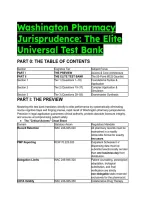
Washington Pharmacy
Jurisprudence: The Elite
Universal Test Bank
PART 0: THE TABLE OF CONTENTS
Section Cognitive Tier Subject Focus
PART I THE PREVIEW Axioms & Core Architecture
PART II THE ELITE TEST BANK The 55-Point MCQ Gauntlet
Section 1 Tier 1 (Questions 1–18) Foundational Syntax &
Application
Section 2 Tier 2 (Questions 19–37) Complex Application &
Simulation
Section 3 Tier 3 (Questions 38–55) Grandmaster Synthesis
PART I: THE PREVIEW
Mastering this test bank translates directly to elite performance by systematically eliminating
novice cognitive traps and forging precise, rapid recall of Washington pharmacy jurisprudence.
Precision in legal application guarantees clinical authority, protects absolute licensure integrity,
and ensures uncompromising patient safety.
● The "Critical Axioms" Cheat Sheet
Domain Statutory Axiom Regulatory Mandate
Record Retention WAC 246-945-020 All pharmacy records must be
maintained in a readily
retrievable format for exactly
two years.
PMP Reporting RCW 70.225.020 Outpatient Schedule II-V
dispensing data must be
submitted electronically no later
than one business day from
distribution.
Delegation Limits WAC 246-945-320 Patient counseling, prescription
adaptation, biological
substitution, and final
verification are strictly
non-delegable tasks reserved
exclusively for the pharmacist.
CDTA Validity WAC 246-945-350 Collaborative Drug Therapy
,Domain Statutory Axiom Regulatory Mandate
Agreements (CDTAs) are valid
for exactly two years. Any
clinical or protocol modification
requires a completely new
CDTA.
Telepharmacy WAC 246-945-430 Remote pharmacies require
30-day retention of continuous
A/V surveillance. The
responsible pharmacist must be
capable of arriving on-site
within 3 hours.
PART II: THE ELITE TEST BANK
Tier 1 - Foundational Syntax & Application
Q1: A Washington pharmacy is undergoing an annual audit. An inspector requests to review the
facility's hardcopy prescriptions and inventory invoices from three years prior. Based on the
principles of Washington recordkeeping rules, which action is the MOST APPROPRIATE
response? A) Provide the documents immediately, as all records must be retained for five years.
B) State that the records are unavailable, as Washington mandates all records be securely
destroyed after one year. C) Inform the inspector that the pharmacy is only required to retain
these records for two years. D) Request a 72-hour extension to retrieve the records from an
off-site DEA-approved vault.
● Answer: C (Inform the inspector that the pharmacy is only required to retain these records
for two years.)
● Distractor Analysis:
○ A is incorrect: Five years is a common misconception derived from specific federal
Medicare requirements, not the baseline state standard.
○ B is incorrect: One year is the validity period for many non-controlled prescriptions,
not the legal retention period.
○ D is incorrect: The baseline retention mandate itself is two years, making retrieval of
three-year-old documents legally unnecessary.
The Mentor's Analysis: Washington WAC 246-945-020 establishes a universal two-year
retention baseline for pharmaceutical records. When facing record requests, the immediate
priority is understanding the statutory timeline. By utilizing this exact timeframe, you bypass the
common trap of confusing prescription validity with record retention. Professional Intuition:
Always default to a two-year retention period for Washington pharmacy records unless a
specific federal law demands longer.
Q2: A community pharmacist dispenses a Schedule II controlled substance at 4:00 PM on a
Tuesday. Based on the principles of the Washington Prescription Monitoring Program (PMP),
which action regarding data submission is REQUIRED? A) The dispensing data must be
submitted by the end of the day on Wednesday. B) The dispensing data must be submitted
within seven calendar days. C) The dispensing data must be submitted instantly via a real-time
synchronous database. D) The dispensing data must be submitted by the end of the month.
● Answer: A (The dispensing data must be submitted by the end of the day on Wednesday.)
● Distractor Analysis:
, ○ B is incorrect: Seven days is an outdated legacy reporting requirement that was
completely phased out in 2021.
○ C is incorrect: Real-time reporting is not statutorily required; the mandate allows
until the next business day.
○ D is incorrect: Monthly reporting applies to precursor substances (e.g., ephedrine),
not controlled substance dispensing.
The Mentor's Analysis: RCW 70.225.020 requires PMP submission as soon as readily available,
but no later than one business day. When facing controlled substance dispensing, the
immediate priority is prompt data transmission. By utilizing next-business-day compliance, you
bypass the common trap of legacy weekly reporting. Professional Intuition: PMP data for
Schedule II-V drugs must hit the state database within one business day.
Q3: A newly licensed pharmacist is preparing for their first license renewal. Based on the
principles of Washington continuing education requirements, which conclusion regarding their
training is CORRECT? A) They must complete 15 hours of CPE annually, including three hours
of pharmacy law. B) They must complete 30 hours of CPE every two years, including a one-time
3-hour suicide screening training. C) They must complete 30 hours of CPE every two years, all
of which must be live webinars. D) They must complete 45 hours of CPE every three years,
focusing strictly on pharmacology.
● Answer: B (They must complete 30 hours of CPE every two years, including a one-time
3-hour suicide screening training.)
● Distractor Analysis:
○ A is incorrect: Washington operates on a two-year renewal cycle requiring 30 hours,
not an annual 15-hour cycle.
○ C is incorrect: There is no strict mandate that all 30 hours be live; they simply must
be ACPE-accredited.
○ D is incorrect: The renewal cycle is biennial, not triennial.
The Mentor's Analysis: WAC 246-945-178 demands 30 hours of ACPE-accredited CPE
biennially, plus specific structural mandates like suicide screening and health equity. When
facing license renewal, the immediate priority is verifying cycle length and specific course
mandates. By utilizing the 30-hour/2-year rule, you bypass the common trap of confusing state
and national certification timelines. Professional Intuition: Washington pharmacist licenses
renew biennially and require 30 total CPE hours.
Q4: A pharmaceutical representative offers to leave complimentary drug samples of a new
non-controlled legend drug at a retail community pharmacy. Based on the principles of
Washington sample prohibitions, which action is the MOST APPROPRIATE? A) Accept the
samples but store them physically separated from standard retail stock. B) Accept the samples
only if they are logged into a designated sample inventory binder. C) Refuse the samples, as
retail pharmacies are strictly prohibited from possessing them. D) Accept the samples provided
they are dispensed to patients entirely free of charge.
● Answer: C (Refuse the samples, as retail pharmacies are strictly prohibited from
possessing them.)
● Distractor Analysis:
○ A is incorrect: Physical separation does not circumvent the outright ban on retail
pharmacy possession.
○ B is incorrect: Logging inventory is irrelevant; the possession itself is a violation.
○ D is incorrect: Charging a fee or dispensing for free does not legitimize the
possession of samples in a retail setting.
The Mentor's Analysis: WAC 246-945-035 prohibits retail pharmacies from possessing,
Jurisprudence: The Elite
Universal Test Bank
PART 0: THE TABLE OF CONTENTS
Section Cognitive Tier Subject Focus
PART I THE PREVIEW Axioms & Core Architecture
PART II THE ELITE TEST BANK The 55-Point MCQ Gauntlet
Section 1 Tier 1 (Questions 1–18) Foundational Syntax &
Application
Section 2 Tier 2 (Questions 19–37) Complex Application &
Simulation
Section 3 Tier 3 (Questions 38–55) Grandmaster Synthesis
PART I: THE PREVIEW
Mastering this test bank translates directly to elite performance by systematically eliminating
novice cognitive traps and forging precise, rapid recall of Washington pharmacy jurisprudence.
Precision in legal application guarantees clinical authority, protects absolute licensure integrity,
and ensures uncompromising patient safety.
● The "Critical Axioms" Cheat Sheet
Domain Statutory Axiom Regulatory Mandate
Record Retention WAC 246-945-020 All pharmacy records must be
maintained in a readily
retrievable format for exactly
two years.
PMP Reporting RCW 70.225.020 Outpatient Schedule II-V
dispensing data must be
submitted electronically no later
than one business day from
distribution.
Delegation Limits WAC 246-945-320 Patient counseling, prescription
adaptation, biological
substitution, and final
verification are strictly
non-delegable tasks reserved
exclusively for the pharmacist.
CDTA Validity WAC 246-945-350 Collaborative Drug Therapy
,Domain Statutory Axiom Regulatory Mandate
Agreements (CDTAs) are valid
for exactly two years. Any
clinical or protocol modification
requires a completely new
CDTA.
Telepharmacy WAC 246-945-430 Remote pharmacies require
30-day retention of continuous
A/V surveillance. The
responsible pharmacist must be
capable of arriving on-site
within 3 hours.
PART II: THE ELITE TEST BANK
Tier 1 - Foundational Syntax & Application
Q1: A Washington pharmacy is undergoing an annual audit. An inspector requests to review the
facility's hardcopy prescriptions and inventory invoices from three years prior. Based on the
principles of Washington recordkeeping rules, which action is the MOST APPROPRIATE
response? A) Provide the documents immediately, as all records must be retained for five years.
B) State that the records are unavailable, as Washington mandates all records be securely
destroyed after one year. C) Inform the inspector that the pharmacy is only required to retain
these records for two years. D) Request a 72-hour extension to retrieve the records from an
off-site DEA-approved vault.
● Answer: C (Inform the inspector that the pharmacy is only required to retain these records
for two years.)
● Distractor Analysis:
○ A is incorrect: Five years is a common misconception derived from specific federal
Medicare requirements, not the baseline state standard.
○ B is incorrect: One year is the validity period for many non-controlled prescriptions,
not the legal retention period.
○ D is incorrect: The baseline retention mandate itself is two years, making retrieval of
three-year-old documents legally unnecessary.
The Mentor's Analysis: Washington WAC 246-945-020 establishes a universal two-year
retention baseline for pharmaceutical records. When facing record requests, the immediate
priority is understanding the statutory timeline. By utilizing this exact timeframe, you bypass the
common trap of confusing prescription validity with record retention. Professional Intuition:
Always default to a two-year retention period for Washington pharmacy records unless a
specific federal law demands longer.
Q2: A community pharmacist dispenses a Schedule II controlled substance at 4:00 PM on a
Tuesday. Based on the principles of the Washington Prescription Monitoring Program (PMP),
which action regarding data submission is REQUIRED? A) The dispensing data must be
submitted by the end of the day on Wednesday. B) The dispensing data must be submitted
within seven calendar days. C) The dispensing data must be submitted instantly via a real-time
synchronous database. D) The dispensing data must be submitted by the end of the month.
● Answer: A (The dispensing data must be submitted by the end of the day on Wednesday.)
● Distractor Analysis:
, ○ B is incorrect: Seven days is an outdated legacy reporting requirement that was
completely phased out in 2021.
○ C is incorrect: Real-time reporting is not statutorily required; the mandate allows
until the next business day.
○ D is incorrect: Monthly reporting applies to precursor substances (e.g., ephedrine),
not controlled substance dispensing.
The Mentor's Analysis: RCW 70.225.020 requires PMP submission as soon as readily available,
but no later than one business day. When facing controlled substance dispensing, the
immediate priority is prompt data transmission. By utilizing next-business-day compliance, you
bypass the common trap of legacy weekly reporting. Professional Intuition: PMP data for
Schedule II-V drugs must hit the state database within one business day.
Q3: A newly licensed pharmacist is preparing for their first license renewal. Based on the
principles of Washington continuing education requirements, which conclusion regarding their
training is CORRECT? A) They must complete 15 hours of CPE annually, including three hours
of pharmacy law. B) They must complete 30 hours of CPE every two years, including a one-time
3-hour suicide screening training. C) They must complete 30 hours of CPE every two years, all
of which must be live webinars. D) They must complete 45 hours of CPE every three years,
focusing strictly on pharmacology.
● Answer: B (They must complete 30 hours of CPE every two years, including a one-time
3-hour suicide screening training.)
● Distractor Analysis:
○ A is incorrect: Washington operates on a two-year renewal cycle requiring 30 hours,
not an annual 15-hour cycle.
○ C is incorrect: There is no strict mandate that all 30 hours be live; they simply must
be ACPE-accredited.
○ D is incorrect: The renewal cycle is biennial, not triennial.
The Mentor's Analysis: WAC 246-945-178 demands 30 hours of ACPE-accredited CPE
biennially, plus specific structural mandates like suicide screening and health equity. When
facing license renewal, the immediate priority is verifying cycle length and specific course
mandates. By utilizing the 30-hour/2-year rule, you bypass the common trap of confusing state
and national certification timelines. Professional Intuition: Washington pharmacist licenses
renew biennially and require 30 total CPE hours.
Q4: A pharmaceutical representative offers to leave complimentary drug samples of a new
non-controlled legend drug at a retail community pharmacy. Based on the principles of
Washington sample prohibitions, which action is the MOST APPROPRIATE? A) Accept the
samples but store them physically separated from standard retail stock. B) Accept the samples
only if they are logged into a designated sample inventory binder. C) Refuse the samples, as
retail pharmacies are strictly prohibited from possessing them. D) Accept the samples provided
they are dispensed to patients entirely free of charge.
● Answer: C (Refuse the samples, as retail pharmacies are strictly prohibited from
possessing them.)
● Distractor Analysis:
○ A is incorrect: Physical separation does not circumvent the outright ban on retail
pharmacy possession.
○ B is incorrect: Logging inventory is irrelevant; the possession itself is a violation.
○ D is incorrect: Charging a fee or dispensing for free does not legitimize the
possession of samples in a retail setting.
The Mentor's Analysis: WAC 246-945-035 prohibits retail pharmacies from possessing,


