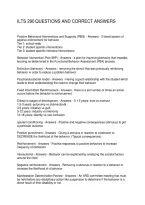
ILTS 290 QUESTIONS AND CORRECT ANSWERS
Positive Behavioral Interventions and Supports (PBIS) - Answers - 3 tiered system of
positive enforcement for behavior
Tier 1: school-wide
Tier 2: student specific interventions
Tier 3: student specific intensive interventions
Behavior Intervention Plan (BIP) - Answers - a plan for improving behavior that impedes
learning as determined in the Functional Behavior Assessment (FBA) process
Extinction (behavior) - Answers - removing the stimuli that was previously reinforcing
behavior in order to reduce a problem behavior
Psychoeducational model - Answers - Having a good relationship with the student which
leads to them understanding the need to change their behavior
Fixed Intermittent Reinforcement - Answers - there is a set number of times an action
occurs before the behavior is reinforcement
Erikson's stages of development - Answers - 0-1.5 years: trust vs mistrust
1.5-3 years: autonomy vs shame/doubt
3-5 years: initiative vs guilt
5-12 years: industry vs inferiority
12-18 years: identity vs role confusion
operant conditioning - Answers - Positive and negative consequences (stimulus) to get
a particular outcome
Positive punishment - Answers - Giving a stimulus in reaction to a behavior to
DECREASE the likelihood of the behavior. (Typical consequences)
Reinforcement - Answers - Positive responses to positive behaviors to increase
frequency of behaviors
Interactionist - Answers - Behavior can be explained by analyzing the societal factors
around the child
Negative reinforcement - Answers - Removing a stimulus in reaction to a behavior to
increase the likelihood of a behavior
Manifestation Determination Review - Answers - An ARD committee meeting that must
be held before any disciplinary action like suspension to determine if the behavior is a
direct result of their disability or not
, positive reinforcement - Answers - Increasing behaviors by presenting positive stimuli
Functional Behavior Assessment (FBA) - Answers - assesses what the negative
behaviors are, what causes them and what can be taught in order to lessen the
frequency
Variable Intermittent Reinforcement - Answers - the response to the behavior occurs
randomly
negative punishment - Answers - the removal of a stimulus to decrease the probability
of a behavior's recurring
504 Plan - Answers - the accommodations provided to a student who has an
impairment that significantly impacts their life
Latency - Answers - Measure the length of time it takes for a behavior to occur after a
verbal cue or inciting incident
classical conditioning - Answers - a learning process that occurs when two stimuli are
repeatedly paired; a response that is at first elicited by the second stimulus is eventually
elicited by the first stimulus alone.
intermittent reinforcement - Answers - The reinforcement occurs after a specific number
of occurrences
Behaviorism - Answers - Learning theory rooted in the notion that all behaviors are
learned through interaction with the environment
Metacognition - Answers - awareness and understanding of one's own thought
processes.
Backward Design / Planning - Answers - Lesson planning that begins with the desired
outcome in mind
Functional Curriculum - Answers - a curriculum that emphasizes practical life skills like
bathing, cleaning, etc.
Cloze Activity - Answers - a reading comprehension activity in which words are omitted
from a passage and students are required to fill in the blanks
Generalization - Answers - Forming a general concept from specific
task analysis - Answers - Breaking down a complex task into its component parts
Positive Behavioral Interventions and Supports (PBIS) - Answers - 3 tiered system of
positive enforcement for behavior
Tier 1: school-wide
Tier 2: student specific interventions
Tier 3: student specific intensive interventions
Behavior Intervention Plan (BIP) - Answers - a plan for improving behavior that impedes
learning as determined in the Functional Behavior Assessment (FBA) process
Extinction (behavior) - Answers - removing the stimuli that was previously reinforcing
behavior in order to reduce a problem behavior
Psychoeducational model - Answers - Having a good relationship with the student which
leads to them understanding the need to change their behavior
Fixed Intermittent Reinforcement - Answers - there is a set number of times an action
occurs before the behavior is reinforcement
Erikson's stages of development - Answers - 0-1.5 years: trust vs mistrust
1.5-3 years: autonomy vs shame/doubt
3-5 years: initiative vs guilt
5-12 years: industry vs inferiority
12-18 years: identity vs role confusion
operant conditioning - Answers - Positive and negative consequences (stimulus) to get
a particular outcome
Positive punishment - Answers - Giving a stimulus in reaction to a behavior to
DECREASE the likelihood of the behavior. (Typical consequences)
Reinforcement - Answers - Positive responses to positive behaviors to increase
frequency of behaviors
Interactionist - Answers - Behavior can be explained by analyzing the societal factors
around the child
Negative reinforcement - Answers - Removing a stimulus in reaction to a behavior to
increase the likelihood of a behavior
Manifestation Determination Review - Answers - An ARD committee meeting that must
be held before any disciplinary action like suspension to determine if the behavior is a
direct result of their disability or not
, positive reinforcement - Answers - Increasing behaviors by presenting positive stimuli
Functional Behavior Assessment (FBA) - Answers - assesses what the negative
behaviors are, what causes them and what can be taught in order to lessen the
frequency
Variable Intermittent Reinforcement - Answers - the response to the behavior occurs
randomly
negative punishment - Answers - the removal of a stimulus to decrease the probability
of a behavior's recurring
504 Plan - Answers - the accommodations provided to a student who has an
impairment that significantly impacts their life
Latency - Answers - Measure the length of time it takes for a behavior to occur after a
verbal cue or inciting incident
classical conditioning - Answers - a learning process that occurs when two stimuli are
repeatedly paired; a response that is at first elicited by the second stimulus is eventually
elicited by the first stimulus alone.
intermittent reinforcement - Answers - The reinforcement occurs after a specific number
of occurrences
Behaviorism - Answers - Learning theory rooted in the notion that all behaviors are
learned through interaction with the environment
Metacognition - Answers - awareness and understanding of one's own thought
processes.
Backward Design / Planning - Answers - Lesson planning that begins with the desired
outcome in mind
Functional Curriculum - Answers - a curriculum that emphasizes practical life skills like
bathing, cleaning, etc.
Cloze Activity - Answers - a reading comprehension activity in which words are omitted
from a passage and students are required to fill in the blanks
Generalization - Answers - Forming a general concept from specific
task analysis - Answers - Breaking down a complex task into its component parts