
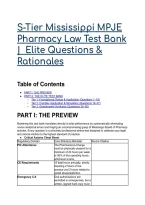
S-Tier Mississippi MPJE
Pharmacy Law Test Bank
| Elite Questions &
Rationales
Table of Contents
● PART I: THE PREVIEW
● PART II: THE ELITE TEST BANK
○ Tier 1: Foundational Syntax & Application (Questions 1–18)
○ Tier 2: Complex Application & Simulation (Questions 19–37)
○ Tier 3: Grandmaster Synthesis (Questions 38–55)
PART I: THE PREVIEW
Mastering this test bank translates directly to elite performance by systematically eliminating
novice analytical errors and forging an uncompromising grasp of Mississippi Board of Pharmacy
statutes. Every question is a simulated professional stress-test designed to calibrate your legal
and clinical intuition to the highest standard of practice.
● Critical Axioms Cheat Sheet:
Regulatory Domain Core Statutory Mandate Source Citation
PIC Attendance The Pharmacist-in-Charge
must be physically present for a
minimum of 20 hours per week
or 50% of the operating hours,
whichever is less.
CE Requirements 15 total hours annually; strictly
requiring 2 hours of live
seminar and 2 hours related to
opioid abuse/addiction.
Emergency C-II Oral authorizations are
permitted in emergencies, but a
written, signed hard copy must
,Regulatory Domain Core Statutory Mandate Source Citation
be furnished within 7 days.
CS Inventory An exact annual inventory of all
controlled substances is legally
mandated on or about May 1.
Medical Cannabis Qualified resident patients are
strictly limited to 24 MMCEUs
within a rolling 30-day period.
Flower is capped at 30% THC.
Benzodiazepines Prescriptions are limited to a
30-day supply with up to 2
refills, OR a 90-day supply with
0 refills.
PART II: THE ELITE TEST BANK
Tier 1: Foundational Syntax & Application (Questions
1–18)
Q1: A Mississippi pharmacist is appointed as the new Pharmacist-in-Charge (PIC) of a
community pharmacy operating 60 hours per week. Based on the principles of the Mississippi
Pharmacy Practice Regulations, which attendance requirement is the MOST APPROPRIATE
legal standard the PIC must satisfy? A) The PIC must be physically present for at least 30 hours
per week. B) The PIC must be physically present for a minimum of 20 hours per week. C) The
PIC must be physically present for 100% of the pharmacy's operating hours. D) The PIC must
be physically present for 15 hours per week.
● Answer: B (The PIC must be physically present for a minimum of 20 hours per week.)
● Distractor Analysis:
○ A is incorrect: This calculates 50% of a 60-hour workweek, but the law caps the
maximum required hours at 20 if 50% exceeds it .
○ C is incorrect: This is a legacy misconception regarding total oversight; physical
presence is capped by the 20-hour/50% rule .
○ D is incorrect: This confuses the 15-hour annual CE requirement with weekly PIC
physical presence requirements.
The Mentor's Analysis: When facing PIC attendance verification, the immediate priority is
calculating the "20 hours or 50%" rule. By utilizing the lesser of the two variables, you bypass
the common trap of overestimating required administrative presence in high-volume
pharmacies. Professional Intuition: Always calculate 50% of operating hours; if the result
exceeds 20, the Hard Deck legal requirement defaults strictly to 20 hours.
Q2: A licensed pharmacist in Mississippi is preparing for annual license renewal due December
31. Based on the principles of Board CE Requirements, which combination of Continuing
Education (CE) hours is the ABSOLUTE minimum standard? A) 15 total hours, including 5 live
hours and 2 opioid-specific hours. B) 15 total hours, including 2 live hours and 2 opioid-specific
hours. C) 15 total hours, all of which may be completed via home study. D) 20 total hours,
including 2 live hours and 1 law-specific hour.
● Answer: B (15 total hours, including 2 live hours and 2 opioid-specific hours.)
, ● Distractor Analysis:
○ A is incorrect: Five live hours exceeds the state mandate, representing
requirements from alternative jurisdictions, not Mississippi.
○ C is incorrect: Fails to meet the statutory requirement for mandatory live seminar
hours.
○ D is incorrect: Applies an outdated or out-of-state 20-hour biennial model;
Mississippi requires 15 hours annually.
The Mentor's Analysis: When facing license renewal audits, the immediate priority is verifying
categorical CE minimums. By utilizing the 15-2-2 framework, you bypass the common trap of
submitting generalized ACPE credits that lack specific statutory compliance. Professional
Intuition: Total hours (15) mean nothing if the sub-categorical mandates (2 Live, 2 Opioid)
are not explicitly documented.
Q3: A Mississippi pharmacy technician has worked at a community pharmacy for three years.
Based on the principles of the Mississippi Board of Pharmacy, which action is the REQUIRED
credentialing standard to maintain employment? A) Completion of 10 hours of CE annually. B)
Maintenance of national PTCB certification. C) Annual registration with the Mississippi Board of
Pharmacy. D) Completion of an ASHP-accredited training program every two years.
● Answer: C (Annual registration with the Mississippi Board of Pharmacy.)
● Distractor Analysis:
○ A is incorrect: Mississippi pharmacy technicians are explicitly exempt from state
continuing education requirements.
○ B is incorrect: Maintaining national certification is no longer a legal requirement for
technicians in Mississippi, only state registration is mandated.
○ D is incorrect: While training is valuable, repeated biennial ASHP program
completion is not a statutory requirement for retention.
The Mentor's Analysis: When facing technician credentialing scenarios, the immediate priority is
distinguishing between employer preferences and state legal baselines. By utilizing Board
Registration mandates, you bypass the common trap of confusing national certification with
state licensure rights. Professional Intuition: National certification (PTCB) may be an
employer prerequisite, but state registration is the sole legal baseline for technicians in
Mississippi.
Q4: A pharmacy permitted by the Mississippi Board of Pharmacy is preparing for its mandatory
controlled substance inventory. Based on the principles of the Pharmacy Practice Act, which
action is the MANDATED timeline for this process? A) Annually on or about December 31. B)
Annually on or about May 1. C) Biennially exactly on January 1. D) Biennially exactly on May 1.
● Answer: B (Annually on or about May 1.)
● Distractor Analysis:
○ A is incorrect: December 31 is the deadline for pharmacist license renewals, not the
statewide uniform inventory date.
○ C is incorrect: Applies federal DEA biennial rules rather than the stricter Mississippi
annual requirement .
○ D is incorrect: While May 1 is correct, Mississippi law strictly requires this inventory
annually, superseding the federal biennial rule .
The Mentor's Analysis: When facing controlled substance inventory regulations, the immediate
priority is applying the strictest applicable law. By utilizing Mississippi's annual May 1 mandate,
you bypass the common trap of defaulting to the more lenient DEA biennial schedule.
Professional Intuition: State law routinely restricts federal boundaries; Mississippi's
uniform inventory date is annually on or about May 1, without exception.
Pharmacy Law Test Bank
| Elite Questions &
Rationales
Table of Contents
● PART I: THE PREVIEW
● PART II: THE ELITE TEST BANK
○ Tier 1: Foundational Syntax & Application (Questions 1–18)
○ Tier 2: Complex Application & Simulation (Questions 19–37)
○ Tier 3: Grandmaster Synthesis (Questions 38–55)
PART I: THE PREVIEW
Mastering this test bank translates directly to elite performance by systematically eliminating
novice analytical errors and forging an uncompromising grasp of Mississippi Board of Pharmacy
statutes. Every question is a simulated professional stress-test designed to calibrate your legal
and clinical intuition to the highest standard of practice.
● Critical Axioms Cheat Sheet:
Regulatory Domain Core Statutory Mandate Source Citation
PIC Attendance The Pharmacist-in-Charge
must be physically present for a
minimum of 20 hours per week
or 50% of the operating hours,
whichever is less.
CE Requirements 15 total hours annually; strictly
requiring 2 hours of live
seminar and 2 hours related to
opioid abuse/addiction.
Emergency C-II Oral authorizations are
permitted in emergencies, but a
written, signed hard copy must
,Regulatory Domain Core Statutory Mandate Source Citation
be furnished within 7 days.
CS Inventory An exact annual inventory of all
controlled substances is legally
mandated on or about May 1.
Medical Cannabis Qualified resident patients are
strictly limited to 24 MMCEUs
within a rolling 30-day period.
Flower is capped at 30% THC.
Benzodiazepines Prescriptions are limited to a
30-day supply with up to 2
refills, OR a 90-day supply with
0 refills.
PART II: THE ELITE TEST BANK
Tier 1: Foundational Syntax & Application (Questions
1–18)
Q1: A Mississippi pharmacist is appointed as the new Pharmacist-in-Charge (PIC) of a
community pharmacy operating 60 hours per week. Based on the principles of the Mississippi
Pharmacy Practice Regulations, which attendance requirement is the MOST APPROPRIATE
legal standard the PIC must satisfy? A) The PIC must be physically present for at least 30 hours
per week. B) The PIC must be physically present for a minimum of 20 hours per week. C) The
PIC must be physically present for 100% of the pharmacy's operating hours. D) The PIC must
be physically present for 15 hours per week.
● Answer: B (The PIC must be physically present for a minimum of 20 hours per week.)
● Distractor Analysis:
○ A is incorrect: This calculates 50% of a 60-hour workweek, but the law caps the
maximum required hours at 20 if 50% exceeds it .
○ C is incorrect: This is a legacy misconception regarding total oversight; physical
presence is capped by the 20-hour/50% rule .
○ D is incorrect: This confuses the 15-hour annual CE requirement with weekly PIC
physical presence requirements.
The Mentor's Analysis: When facing PIC attendance verification, the immediate priority is
calculating the "20 hours or 50%" rule. By utilizing the lesser of the two variables, you bypass
the common trap of overestimating required administrative presence in high-volume
pharmacies. Professional Intuition: Always calculate 50% of operating hours; if the result
exceeds 20, the Hard Deck legal requirement defaults strictly to 20 hours.
Q2: A licensed pharmacist in Mississippi is preparing for annual license renewal due December
31. Based on the principles of Board CE Requirements, which combination of Continuing
Education (CE) hours is the ABSOLUTE minimum standard? A) 15 total hours, including 5 live
hours and 2 opioid-specific hours. B) 15 total hours, including 2 live hours and 2 opioid-specific
hours. C) 15 total hours, all of which may be completed via home study. D) 20 total hours,
including 2 live hours and 1 law-specific hour.
● Answer: B (15 total hours, including 2 live hours and 2 opioid-specific hours.)
, ● Distractor Analysis:
○ A is incorrect: Five live hours exceeds the state mandate, representing
requirements from alternative jurisdictions, not Mississippi.
○ C is incorrect: Fails to meet the statutory requirement for mandatory live seminar
hours.
○ D is incorrect: Applies an outdated or out-of-state 20-hour biennial model;
Mississippi requires 15 hours annually.
The Mentor's Analysis: When facing license renewal audits, the immediate priority is verifying
categorical CE minimums. By utilizing the 15-2-2 framework, you bypass the common trap of
submitting generalized ACPE credits that lack specific statutory compliance. Professional
Intuition: Total hours (15) mean nothing if the sub-categorical mandates (2 Live, 2 Opioid)
are not explicitly documented.
Q3: A Mississippi pharmacy technician has worked at a community pharmacy for three years.
Based on the principles of the Mississippi Board of Pharmacy, which action is the REQUIRED
credentialing standard to maintain employment? A) Completion of 10 hours of CE annually. B)
Maintenance of national PTCB certification. C) Annual registration with the Mississippi Board of
Pharmacy. D) Completion of an ASHP-accredited training program every two years.
● Answer: C (Annual registration with the Mississippi Board of Pharmacy.)
● Distractor Analysis:
○ A is incorrect: Mississippi pharmacy technicians are explicitly exempt from state
continuing education requirements.
○ B is incorrect: Maintaining national certification is no longer a legal requirement for
technicians in Mississippi, only state registration is mandated.
○ D is incorrect: While training is valuable, repeated biennial ASHP program
completion is not a statutory requirement for retention.
The Mentor's Analysis: When facing technician credentialing scenarios, the immediate priority is
distinguishing between employer preferences and state legal baselines. By utilizing Board
Registration mandates, you bypass the common trap of confusing national certification with
state licensure rights. Professional Intuition: National certification (PTCB) may be an
employer prerequisite, but state registration is the sole legal baseline for technicians in
Mississippi.
Q4: A pharmacy permitted by the Mississippi Board of Pharmacy is preparing for its mandatory
controlled substance inventory. Based on the principles of the Pharmacy Practice Act, which
action is the MANDATED timeline for this process? A) Annually on or about December 31. B)
Annually on or about May 1. C) Biennially exactly on January 1. D) Biennially exactly on May 1.
● Answer: B (Annually on or about May 1.)
● Distractor Analysis:
○ A is incorrect: December 31 is the deadline for pharmacist license renewals, not the
statewide uniform inventory date.
○ C is incorrect: Applies federal DEA biennial rules rather than the stricter Mississippi
annual requirement .
○ D is incorrect: While May 1 is correct, Mississippi law strictly requires this inventory
annually, superseding the federal biennial rule .
The Mentor's Analysis: When facing controlled substance inventory regulations, the immediate
priority is applying the strictest applicable law. By utilizing Mississippi's annual May 1 mandate,
you bypass the common trap of defaulting to the more lenient DEA biennial schedule.
Professional Intuition: State law routinely restricts federal boundaries; Mississippi's
uniform inventory date is annually on or about May 1, without exception.


