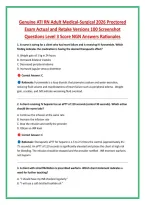
Genuine ATI RN Adult Medical-Surgical 2026 Proctored
Exam Actual and Retake Versions 100 Screenshot
Questions Level 3 Score NGN Answers Rationales
1. A nurse is caring for a client who has heart failure and is receiving IV furosemide. Which
finding indicates the medication is having the desired therapeutic effect?
A. Weight gain of 1 kg in 24 hours
B. Increased bilateral crackles
C. Decreased peripheral edema
D. Increased jugular venous distention
Correct Answer: C
Rationale: Furosemide is a loop diuretic that promotes sodium and water excretion,
reducing fluid volume and manifestations of heart failure such as peripheral edema . Weight
gain, crackles, and JVD indicate worsening fluid overload.
2. A client receiving IV heparin has an aPTT of 110 seconds (control 30 seconds). Which action
should the nurse take?
A. Continue the infusion at the same rate
B. Increase the infusion rate
C. Stop the infusion and notify the provider
D. Obtain an INR level
Correct Answer: C
Rationale: Therapeutic aPTT for heparin is 1.5 to 2.5 times the control (approximately 45–
75 seconds). An aPTT of 110 seconds is significantly elevated and places the client at high risk
for bleeding. The infusion should be stopped and the provider notified . INR monitors warfarin,
not heparin.
3. A client with atrial fibrillation is prescribed warfarin. Which client statement indicates a
need for further teaching?
A. “I should have my INR checked regularly.”
B. “I will use a soft-bristled toothbrush.”
,C. “I can take ibuprofen for my occasional headaches.”
D. “I will tell my dentist that I am on warfarin.”
Correct Answer: C
Rationale: Ibuprofen is an NSAID that inhibits platelet aggregation and can increase
bleeding risk when combined with warfarin . Acetaminophen is a safer alternative for occasional
pain.
4. A nurse is assessing a client who has a new onset of atrial fibrillation. Which finding
requires immediate intervention?
A. Heart rate of 110/min
B. Blood pressure of 88/52 mm Hg
C. Client reports palpitations
D. Irregular radial pulse
Correct Answer: B
Rationale: Hypotension in the setting of atrial fibrillation indicates hemodynamic instability
and inadequate cardiac output. This requires immediate intervention, including possible
synchronized cardioversion .
5. A nurse is teaching a client who has heart failure about a low-sodium diet. Which food
should the nurse instruct the client to avoid?
A. Fresh apples
B. Canned soup
C. Plain rice
D. Fresh chicken breast
Correct Answer: B
Rationale: Canned soups are typically high in sodium due to added salt as a preservative.
Clients with heart failure should limit sodium intake to reduce fluid retention and cardiac
workload .
6. A client who had a mechanical mitral valve replacement is prescribed warfarin. Which
laboratory value should the nurse monitor?
,A. aPTT
B. INR
C. Platelet count
D. Bleeding time
Correct Answer: B
Rationale: Warfarin therapy is monitored using the INR (International Normalized Ratio).
For clients with mechanical heart valves, the target INR is typically 2.5–3.5, which is higher than
for other indications .
7. A nurse is caring for a client who is 6 hours postoperative following a cardiac
catheterization via the femoral artery. Which finding should the nurse report immediately?
A. Small ecchymosis at the insertion site
B. Client reports mild back discomfort
C. Pedal pulse is weak and extremity is cool
D. Groin pain rated 2/10
Correct Answer: C
Rationale: A weak pedal pulse with a cool extremity indicates possible arterial occlusion or
hematoma formation compromising circulation. This requires immediate assessment and
provider notification .
8. A nurse is administering a blood transfusion to a client. Which finding indicates a possible
hemolytic transfusion reaction?
A. Temperature elevation of 1°C
B. Client reports feeling cold
C. Dark red or brown urine
D. Mild urticaria at IV site
Correct Answer: C
Rationale: Hemolytic transfusion reactions cause destruction of red blood cells, releasing
hemoglobin into the circulation, which appears as dark red or brown urine (hemoglobinuria) .
This is a medical emergency.
, 9. A client who is receiving the sixth unit of packed red blood cells demonstrates flushing,
headache, and fever. The nurse suspects a febrile nonhemolytic reaction. Which assessment
finding is most consistent with this reaction?
A. Increased anxiety since the transfusion began
B. Drowsiness after receiving diphenhydramine
C. Complaints of feeling cold
D. Flushed skin and headache
Correct Answer: D
Rationale: Febrile nonhemolytic reactions are related to leukocyte incompatibility and
cause chills, fever, headache, and flushing . This is the most common type of transfusion
reaction.
10. A nurse is assessing a client who has peripheral arterial disease. Which finding should the
nurse expect?
A. Dependent rubor
B. Pitting edema
C. Warm, red extremities
D. Shiny, hairless skin on lower legs
Correct Answer: D
Rationale: Peripheral arterial disease leads to decreased blood flow, resulting in shiny,
hairless skin, thickened nails, and cool extremities . Dependent rubor is also seen but shiny
hairless skin is a classic chronic finding.
11. A nurse is teaching a client who has hypertension about lifestyle modifications. Which
instruction should the nurse include?
A. “Limit physical activity to avoid straining your heart.”
B. “Increase your intake of potassium-rich foods.”
C. “Drink at least 3 cups of coffee daily.”
D. “Add salt to food to improve taste.”
Correct Answer: B
Exam Actual and Retake Versions 100 Screenshot
Questions Level 3 Score NGN Answers Rationales
1. A nurse is caring for a client who has heart failure and is receiving IV furosemide. Which
finding indicates the medication is having the desired therapeutic effect?
A. Weight gain of 1 kg in 24 hours
B. Increased bilateral crackles
C. Decreased peripheral edema
D. Increased jugular venous distention
Correct Answer: C
Rationale: Furosemide is a loop diuretic that promotes sodium and water excretion,
reducing fluid volume and manifestations of heart failure such as peripheral edema . Weight
gain, crackles, and JVD indicate worsening fluid overload.
2. A client receiving IV heparin has an aPTT of 110 seconds (control 30 seconds). Which action
should the nurse take?
A. Continue the infusion at the same rate
B. Increase the infusion rate
C. Stop the infusion and notify the provider
D. Obtain an INR level
Correct Answer: C
Rationale: Therapeutic aPTT for heparin is 1.5 to 2.5 times the control (approximately 45–
75 seconds). An aPTT of 110 seconds is significantly elevated and places the client at high risk
for bleeding. The infusion should be stopped and the provider notified . INR monitors warfarin,
not heparin.
3. A client with atrial fibrillation is prescribed warfarin. Which client statement indicates a
need for further teaching?
A. “I should have my INR checked regularly.”
B. “I will use a soft-bristled toothbrush.”
,C. “I can take ibuprofen for my occasional headaches.”
D. “I will tell my dentist that I am on warfarin.”
Correct Answer: C
Rationale: Ibuprofen is an NSAID that inhibits platelet aggregation and can increase
bleeding risk when combined with warfarin . Acetaminophen is a safer alternative for occasional
pain.
4. A nurse is assessing a client who has a new onset of atrial fibrillation. Which finding
requires immediate intervention?
A. Heart rate of 110/min
B. Blood pressure of 88/52 mm Hg
C. Client reports palpitations
D. Irregular radial pulse
Correct Answer: B
Rationale: Hypotension in the setting of atrial fibrillation indicates hemodynamic instability
and inadequate cardiac output. This requires immediate intervention, including possible
synchronized cardioversion .
5. A nurse is teaching a client who has heart failure about a low-sodium diet. Which food
should the nurse instruct the client to avoid?
A. Fresh apples
B. Canned soup
C. Plain rice
D. Fresh chicken breast
Correct Answer: B
Rationale: Canned soups are typically high in sodium due to added salt as a preservative.
Clients with heart failure should limit sodium intake to reduce fluid retention and cardiac
workload .
6. A client who had a mechanical mitral valve replacement is prescribed warfarin. Which
laboratory value should the nurse monitor?
,A. aPTT
B. INR
C. Platelet count
D. Bleeding time
Correct Answer: B
Rationale: Warfarin therapy is monitored using the INR (International Normalized Ratio).
For clients with mechanical heart valves, the target INR is typically 2.5–3.5, which is higher than
for other indications .
7. A nurse is caring for a client who is 6 hours postoperative following a cardiac
catheterization via the femoral artery. Which finding should the nurse report immediately?
A. Small ecchymosis at the insertion site
B. Client reports mild back discomfort
C. Pedal pulse is weak and extremity is cool
D. Groin pain rated 2/10
Correct Answer: C
Rationale: A weak pedal pulse with a cool extremity indicates possible arterial occlusion or
hematoma formation compromising circulation. This requires immediate assessment and
provider notification .
8. A nurse is administering a blood transfusion to a client. Which finding indicates a possible
hemolytic transfusion reaction?
A. Temperature elevation of 1°C
B. Client reports feeling cold
C. Dark red or brown urine
D. Mild urticaria at IV site
Correct Answer: C
Rationale: Hemolytic transfusion reactions cause destruction of red blood cells, releasing
hemoglobin into the circulation, which appears as dark red or brown urine (hemoglobinuria) .
This is a medical emergency.
, 9. A client who is receiving the sixth unit of packed red blood cells demonstrates flushing,
headache, and fever. The nurse suspects a febrile nonhemolytic reaction. Which assessment
finding is most consistent with this reaction?
A. Increased anxiety since the transfusion began
B. Drowsiness after receiving diphenhydramine
C. Complaints of feeling cold
D. Flushed skin and headache
Correct Answer: D
Rationale: Febrile nonhemolytic reactions are related to leukocyte incompatibility and
cause chills, fever, headache, and flushing . This is the most common type of transfusion
reaction.
10. A nurse is assessing a client who has peripheral arterial disease. Which finding should the
nurse expect?
A. Dependent rubor
B. Pitting edema
C. Warm, red extremities
D. Shiny, hairless skin on lower legs
Correct Answer: D
Rationale: Peripheral arterial disease leads to decreased blood flow, resulting in shiny,
hairless skin, thickened nails, and cool extremities . Dependent rubor is also seen but shiny
hairless skin is a classic chronic finding.
11. A nurse is teaching a client who has hypertension about lifestyle modifications. Which
instruction should the nurse include?
A. “Limit physical activity to avoid straining your heart.”
B. “Increase your intake of potassium-rich foods.”
C. “Drink at least 3 cups of coffee daily.”
D. “Add salt to food to improve taste.”
Correct Answer: B