WGU D441 OBJECTIVE ASSESSMENT
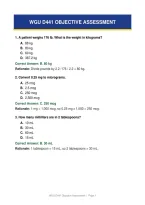
1. A patient weighs 176 lb. What is the weight in kilograms?
A. 88 kg
B. 80 kg
C. 60 kg
D. 387.2 kg
Correct Answer: B. 80 kg
Rationale: Divide pounds by 2.2: .2 = 80 kg.
2. Convert 0.25 mg to micrograms.
A. 25 mcg
B. 2.5 mcg
C. 250 mcg
D. 2,500 mcg
Correct Answer: C. 250 mcg
Rationale: 1 mg = 1,000 mcg, so 0.25 mg x 1,000 = 250 mcg.
3. How many milliliters are in 2 tablespoons?
A. 10 mL
B. 30 mL
C. 60 mL
D. 15 mL
Correct Answer: B. 30 mL
Rationale: 1 tablespoon = 15 mL, so 2 tablespoons = 30 mL.
WGU D441 Objective Assessment | Page 1
,4. The provider orders 500 mg of a medication. The tablets available are 250
mg each. How many tablets should the nurse give?
A. 4 tablets
B. 2 tablets
C. 1 tablet
D. 0.5 tablet
Correct Answer: B. 2 tablets
Rationale: Dose desired / dose on hand = 500 mg / 250 mg = 2 tablets.
5. The order is digoxin 0.125 mg PO. Available are 0.25 mg scored tablets. How
many tablets should be given?
A. 1 tablet
B. 0.5 tablet (one half)
C. 0.25 tablet
D. 2 tablets
Correct Answer: B. 0.5 tablet (one half)
Rationale: 0.125 mg / 0.25 mg = 0.5 tablet. Scored tablets may be split.
6. The order is 40 mg PO. The oral solution is labeled 20 mg per 5 mL. How
many milliliters should the nurse administer?
A. 20 mL
B. 10 mL
C. 5 mL
D. 8 mL
Correct Answer: B. 10 mL
Rationale: (40 mg / 20 mg) x 5 mL = 10 mL.
7. The order is 750 mg PO. The label reads 500 mg per 5 mL. How many
milliliters should be given?
A. 10 mL
B. 15 mL
C. 7.5 mL
D. 5 mL
Correct Answer: C. 7.5 mL
Rationale: (750 mg / 500 mg) x 5 mL = 7.5 mL.
WGU D441 Objective Assessment | Page 2
,8. A child weighing 22 kg is prescribed 15 mg/kg/day divided every 8 hours.
How many milligrams are in each dose?
A. 330 mg
B. 55 mg
C. 15 mg
D. 110 mg
Correct Answer: D. 110 mg
Rationale: 15 mg x 22 kg = 330 mg/day. Every 8 hours is 3 doses/day, so =
110 mg per dose.
9. The provider orders 1,000 mL of normal saline over 8 hours by IV pump. At
what rate in mL/hr should the pump be set?
A. 250 mL/hr
B. 8 mL/hr
C. 125 mL/hr
D. 100 mL/hr
Correct Answer: C. 125 mL/hr
Rationale: Volume / time = 1,000 mL / 8 hr = 125 mL/hr.
10. Administer 500 mL IV over 4 hours. The drop factor is 15 gtt/mL. What is
the flow rate in gtt/min (rounded to a whole number)?
A. 63 gtt/min
B. 21 gtt/min
C. 31 gtt/min
D. 125 gtt/min
Correct Answer: C. 31 gtt/min
Rationale: (500 mL x 15 gtt/mL) / 240 min = 31.25, rounded to 31 gtt/min.
WGU D441 Objective Assessment | Page 3
, 11. Infuse 100 mL of antibiotic over 30 minutes using tubing with a drop factor
of 10 gtt/mL. What is the rate in gtt/min?
A. 100 gtt/min
B. 20 gtt/min
C. 50 gtt/min
D. 33 gtt/min
Correct Answer: D. 33 gtt/min
Rationale: (100 mL x 10 gtt/mL) / 30 min = 33.3, rounded to 33 gtt/min.
12. A pump is set at 50 mL/hr with microdrip tubing (60 gtt/mL). What is the
flow rate in gtt/min?
A. 100 gtt/min
B. 25 gtt/min
C. 60 gtt/min
D. 50 gtt/min
Correct Answer: D. 50 gtt/min
Rationale: With microdrip tubing (60 gtt/mL), gtt/min equals mL/hr, so 50 mL/hr = 50
gtt/min.
13. Heparin 25,000 units in 250 mL D5W is infusing. The order is 1,200 units/hr.
What rate in mL/hr should the pump be set?
A. 48 mL/hr
B. 120 mL/hr
C. 1.2 mL/hr
D. 12 mL/hr
Correct Answer: D. 12 mL/hr
Rationale: Concentration = 25, = 100 units/mL. Then 1,200 units/hr / 100
units/mL = 12 mL/hr.
WGU D441 Objective Assessment | Page 4