
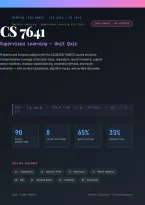
GEORGIA TECH OMSCS · CSE 6242 / CS 7641
CS 7641
Machine Learning · Supervised Learning Unit Quiz 100% CORRECT · GT VERIFIED
Supervised Learning — Unit Quiz
Problems and Solutions aligned with the 2026/2027 OMSCS course structure.
Comprehensive coverage of decision trees, regression, neural networks, support
vector machines, instance-based learning, ensemble methods, and model
evaluation — with worked calculations, algorithm traces, and verified rationales.
H(S) = − Σ pi log2 pi | IG(S,A) = H(S) − Σ (|Sv | / |S|) H(Sv ) | σ(z) = 1 / (1 +
e−z )
90 8 65% 35%
T OTA L T OP I C S EC T I ONS A P P L I C AT I ON C ONC EP T U A L
QU ES T I ONS
SECTION COVERAGE
S1 · Fundamentals S2 · Decision Trees S3 · Regression S4 · Neural Networks
S5 · SVM S6 · Instance-Based S7 · Ensembles S8 · Evaluation
UPDATE Problems & Solutions · Verified Rationales
,CS 7641 — Supervised Learning Unit Quiz | 90 Questions (Verified) Update | 100% Correct - GT
CS 7641 — Supervised Learning Unit
Quiz
Problems and Solutions | 2026/2027 Update | 100% Correct - GT
This unit quiz contains 90 verified multiple-choice questions aligned with the Georgia Tech OMSCS
CS 7641 Machine Learning Supervised Learning unit. Questions span eight sections: SL
Fundamentals, Decision Trees, Regression, Neural Networks, Support Vector Machines,
Instance-Based Learning, Ensemble Methods, and Model Evaluation. Cognitive distribution: ~25%
recall, ~55% application/calculation, ~20% analysis. Each question presents four options (A–D)
with one correct answer, followed by a detailed rationale containing mathematical justification,
algorithmic principles, and worked solution steps referencing standard ML theory (Mitchell,
Bishop, ESL).
CS 7641 Supervised Learning — Unit Quiz
(Q1–Q90)
90 Questions across 8 Sections covering Decision Trees (ID3/entropy/Gini), Regression
(linear/logistic/regularization), Neural Networks (perceptrons, MLPs, backpropagation), SVM
(margins, kernels, soft margin), K-NN, Ensembles (bagging/boosting/Random Forest/AdaBoost),
and Model Evaluation (bias-variance, cross-validation, ROC, overfitting).
Section 1: Supervised Learning Fundamentals (Problem Formulation,
Labels, & Generalization) - Q1-Q8
Q1: A dataset contains 1,000 emails labeled as 'spam' or 'not spam.' A model is
trained to predict the label of new, unseen emails. This task is best classified as:
A. Unsupervised clustering because the data is unlabeled
B. Binary classification because the target variable has two discrete categories and
labels are provided [CORRECT]
C. Regression because the output is a numeric probability
D. Reinforcement learning because the model receives rewards for correct predictions
Correct Answer: B
Rationale: Supervised learning requires labeled input-output pairs. With two discrete labels (spam /
not spam), this is binary classification. Regression (C) applies when the target is continuous (e.g.,
predicting probability as the only output would be regression of a probability score, but the task
described is label prediction). Unsupervised learning (A) requires no labels. Reinforcement learning (D)
involves sequential decision-making with reward signals, not static labeled data.
Page 1
,CS 7641 — Supervised Learning Unit Quiz | 90 Questions (Verified) Update | 100% Correct - GT
Q2: A student trains a decision tree on a training set, achieving 99.5% training
accuracy. On a held-out test set, accuracy is only 62%. The most likely diagnosis
is:
A. Underfitting: the model is too simple to capture the pattern
B. High bias: the model class cannot represent the target function
C. Overfitting: the model has memorized training noise and fails to generalize
[CORRECT]
D. The test set is drawn from the same distribution as training
Correct Answer: C
Rationale: A large gap between training accuracy (99.5%) and test accuracy (62%) is the signature of
overfitting — high variance, low bias. The model fits idiosyncratic noise in the training set rather than
the underlying function. Underfitting (A) and high bias (B) would manifest as low accuracy on BOTH
training and test sets. Option D describes the desired condition, not the cause of the gap. Remediation
includes pruning, regularization, more data, or simpler models.
Q3: Which of the following best describes the inductive hypothesis made by
supervised learning?
A. The training and test data are guaranteed to be drawn from different distributions
B. The training data and future unseen data are drawn from the same underlying
distribution, so a function that fits training data will likely generalize [CORRECT]
C. The model must always be a linear function of the inputs
D. The label of every test point can be perfectly predicted
Correct Answer: B
Rationale: Inductive learning rests on the assumption that the data distribution is stationary —
training and test examples are i.i.d. (independent and identically distributed) from the same source
distribution. Without this assumption, no learning algorithm can guarantee generalization (formalized
by the PAC learning framework). Option A is the opposite of the actual assumption. Linearity (C) is a
model-specific bias, not a general assumption. Perfect prediction (D) is impossible in the presence of
noise (Bayes error rate).
Q4: A dataset has 5,000 examples. A practitioner uses 5-fold cross-validation. How
many examples are used for training in each fold?
A. 1,000
B. 4,000 [CORRECT]
C. 5,000
D. 800
Correct Answer: B
Rationale: In k-fold cross-validation, the data is split into k equal folds; each fold serves as the test set
once while the remaining k-1 folds form the training set. With k=5 and 5,000 examples, each fold has
5,000/5 = 1,000 examples for testing and 5,000 - 1,000 = 4,000 for training. The reported
performance is the average across all 5 folds. Stratified k-fold maintains class proportions within each
fold, important for imbalanced datasets.
Page 2
, CS 7641 — Supervised Learning Unit Quiz | 90 Questions (Verified) Update | 100% Correct - GT
Q5: A classification problem has three classes: A (50 examples), B (30 examples),
and C (20 examples). A dummy classifier always predicts class A. What is its
accuracy on the training set?
A. 20%
B. 30%
C. 50% [CORRECT]
D. 100%
Correct Answer: C
Rationale: Accuracy = correct predictions / total examples. The dummy classifier predicts 'A' for all
100 examples. It is correct on the 50 actual class-A examples and wrong on the 30 B + 20 C. Accuracy
= 50/100 = 50%. This illustrates why accuracy is misleading on imbalanced datasets — a classifier that
beats 50% accuracy has actually learned something, but the dummy baseline is high. Metrics like
precision, recall, F1, and balanced accuracy should be considered alongside accuracy.
Q6: A model is said to generalize well if it:
A. Achieves zero training error on all datasets
B. Performs comparably on unseen test data as on training data, indicating low
generalization gap [CORRECT]
C. Always selects the most complex hypothesis in the model class
D. Has more parameters than training examples
Correct Answer: B
Rationale: Generalization is measured by the gap between training performance and test
performance. A small gap (with good test performance) indicates the model captures the true
underlying function rather than memorizing noise. Zero training error (A) often signals overfitting,
especially with flexible models. Maximum complexity (C) and parameter counts exceeding data (D)
typically increase variance and worsen generalization (memorization regime).
Q7: Consider the hypothesis class H = {all possible functions from input space X
to {0,1}}. Training on a finite dataset, which statement is correct?
A. H is highly constrained, so any consistent hypothesis will generalize well
B. H is so expressive that infinitely many hypotheses fit the training data but
disagree on unseen points — no-free-lunch theorem implies no generalization
guarantee without inductive bias [CORRECT]
C. H is guaranteed to contain the true target function
D. H is equivalent to the class of linear classifiers
Correct Answer: B
Rationale: When the hypothesis class is the set of ALL possible functions, any labeling of training
points is consistent with infinitely many hypotheses that differ on unseen points. The No Free Lunch
theorem states that, averaged over all possible target functions, every learning algorithm performs
identically — generalization requires restricting H (inductive bias). Options A, C, and D are incorrect: H
is unconstrained, may not contain the true function (which could be stochastic), and is far larger than
linear classifiers.
Page 3
CS 7641
Machine Learning · Supervised Learning Unit Quiz 100% CORRECT · GT VERIFIED
Supervised Learning — Unit Quiz
Problems and Solutions aligned with the 2026/2027 OMSCS course structure.
Comprehensive coverage of decision trees, regression, neural networks, support
vector machines, instance-based learning, ensemble methods, and model
evaluation — with worked calculations, algorithm traces, and verified rationales.
H(S) = − Σ pi log2 pi | IG(S,A) = H(S) − Σ (|Sv | / |S|) H(Sv ) | σ(z) = 1 / (1 +
e−z )
90 8 65% 35%
T OTA L T OP I C S EC T I ONS A P P L I C AT I ON C ONC EP T U A L
QU ES T I ONS
SECTION COVERAGE
S1 · Fundamentals S2 · Decision Trees S3 · Regression S4 · Neural Networks
S5 · SVM S6 · Instance-Based S7 · Ensembles S8 · Evaluation
UPDATE Problems & Solutions · Verified Rationales
,CS 7641 — Supervised Learning Unit Quiz | 90 Questions (Verified) Update | 100% Correct - GT
CS 7641 — Supervised Learning Unit
Quiz
Problems and Solutions | 2026/2027 Update | 100% Correct - GT
This unit quiz contains 90 verified multiple-choice questions aligned with the Georgia Tech OMSCS
CS 7641 Machine Learning Supervised Learning unit. Questions span eight sections: SL
Fundamentals, Decision Trees, Regression, Neural Networks, Support Vector Machines,
Instance-Based Learning, Ensemble Methods, and Model Evaluation. Cognitive distribution: ~25%
recall, ~55% application/calculation, ~20% analysis. Each question presents four options (A–D)
with one correct answer, followed by a detailed rationale containing mathematical justification,
algorithmic principles, and worked solution steps referencing standard ML theory (Mitchell,
Bishop, ESL).
CS 7641 Supervised Learning — Unit Quiz
(Q1–Q90)
90 Questions across 8 Sections covering Decision Trees (ID3/entropy/Gini), Regression
(linear/logistic/regularization), Neural Networks (perceptrons, MLPs, backpropagation), SVM
(margins, kernels, soft margin), K-NN, Ensembles (bagging/boosting/Random Forest/AdaBoost),
and Model Evaluation (bias-variance, cross-validation, ROC, overfitting).
Section 1: Supervised Learning Fundamentals (Problem Formulation,
Labels, & Generalization) - Q1-Q8
Q1: A dataset contains 1,000 emails labeled as 'spam' or 'not spam.' A model is
trained to predict the label of new, unseen emails. This task is best classified as:
A. Unsupervised clustering because the data is unlabeled
B. Binary classification because the target variable has two discrete categories and
labels are provided [CORRECT]
C. Regression because the output is a numeric probability
D. Reinforcement learning because the model receives rewards for correct predictions
Correct Answer: B
Rationale: Supervised learning requires labeled input-output pairs. With two discrete labels (spam /
not spam), this is binary classification. Regression (C) applies when the target is continuous (e.g.,
predicting probability as the only output would be regression of a probability score, but the task
described is label prediction). Unsupervised learning (A) requires no labels. Reinforcement learning (D)
involves sequential decision-making with reward signals, not static labeled data.
Page 1
,CS 7641 — Supervised Learning Unit Quiz | 90 Questions (Verified) Update | 100% Correct - GT
Q2: A student trains a decision tree on a training set, achieving 99.5% training
accuracy. On a held-out test set, accuracy is only 62%. The most likely diagnosis
is:
A. Underfitting: the model is too simple to capture the pattern
B. High bias: the model class cannot represent the target function
C. Overfitting: the model has memorized training noise and fails to generalize
[CORRECT]
D. The test set is drawn from the same distribution as training
Correct Answer: C
Rationale: A large gap between training accuracy (99.5%) and test accuracy (62%) is the signature of
overfitting — high variance, low bias. The model fits idiosyncratic noise in the training set rather than
the underlying function. Underfitting (A) and high bias (B) would manifest as low accuracy on BOTH
training and test sets. Option D describes the desired condition, not the cause of the gap. Remediation
includes pruning, regularization, more data, or simpler models.
Q3: Which of the following best describes the inductive hypothesis made by
supervised learning?
A. The training and test data are guaranteed to be drawn from different distributions
B. The training data and future unseen data are drawn from the same underlying
distribution, so a function that fits training data will likely generalize [CORRECT]
C. The model must always be a linear function of the inputs
D. The label of every test point can be perfectly predicted
Correct Answer: B
Rationale: Inductive learning rests on the assumption that the data distribution is stationary —
training and test examples are i.i.d. (independent and identically distributed) from the same source
distribution. Without this assumption, no learning algorithm can guarantee generalization (formalized
by the PAC learning framework). Option A is the opposite of the actual assumption. Linearity (C) is a
model-specific bias, not a general assumption. Perfect prediction (D) is impossible in the presence of
noise (Bayes error rate).
Q4: A dataset has 5,000 examples. A practitioner uses 5-fold cross-validation. How
many examples are used for training in each fold?
A. 1,000
B. 4,000 [CORRECT]
C. 5,000
D. 800
Correct Answer: B
Rationale: In k-fold cross-validation, the data is split into k equal folds; each fold serves as the test set
once while the remaining k-1 folds form the training set. With k=5 and 5,000 examples, each fold has
5,000/5 = 1,000 examples for testing and 5,000 - 1,000 = 4,000 for training. The reported
performance is the average across all 5 folds. Stratified k-fold maintains class proportions within each
fold, important for imbalanced datasets.
Page 2
, CS 7641 — Supervised Learning Unit Quiz | 90 Questions (Verified) Update | 100% Correct - GT
Q5: A classification problem has three classes: A (50 examples), B (30 examples),
and C (20 examples). A dummy classifier always predicts class A. What is its
accuracy on the training set?
A. 20%
B. 30%
C. 50% [CORRECT]
D. 100%
Correct Answer: C
Rationale: Accuracy = correct predictions / total examples. The dummy classifier predicts 'A' for all
100 examples. It is correct on the 50 actual class-A examples and wrong on the 30 B + 20 C. Accuracy
= 50/100 = 50%. This illustrates why accuracy is misleading on imbalanced datasets — a classifier that
beats 50% accuracy has actually learned something, but the dummy baseline is high. Metrics like
precision, recall, F1, and balanced accuracy should be considered alongside accuracy.
Q6: A model is said to generalize well if it:
A. Achieves zero training error on all datasets
B. Performs comparably on unseen test data as on training data, indicating low
generalization gap [CORRECT]
C. Always selects the most complex hypothesis in the model class
D. Has more parameters than training examples
Correct Answer: B
Rationale: Generalization is measured by the gap between training performance and test
performance. A small gap (with good test performance) indicates the model captures the true
underlying function rather than memorizing noise. Zero training error (A) often signals overfitting,
especially with flexible models. Maximum complexity (C) and parameter counts exceeding data (D)
typically increase variance and worsen generalization (memorization regime).
Q7: Consider the hypothesis class H = {all possible functions from input space X
to {0,1}}. Training on a finite dataset, which statement is correct?
A. H is highly constrained, so any consistent hypothesis will generalize well
B. H is so expressive that infinitely many hypotheses fit the training data but
disagree on unseen points — no-free-lunch theorem implies no generalization
guarantee without inductive bias [CORRECT]
C. H is guaranteed to contain the true target function
D. H is equivalent to the class of linear classifiers
Correct Answer: B
Rationale: When the hypothesis class is the set of ALL possible functions, any labeling of training
points is consistent with infinitely many hypotheses that differ on unseen points. The No Free Lunch
theorem states that, averaged over all possible target functions, every learning algorithm performs
identically — generalization requires restricting H (inductive bias). Options A, C, and D are incorrect: H
is unconstrained, may not contain the true function (which could be stochastic), and is far larger than
linear classifiers.
Page 3


