
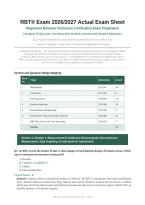
RBT® Exam 2026/2027 Actual Exam Sheet
Registered Behavior Technician Certification Exam Preparation
Complete 75-Question Test Bank with Verified Answers and Detailed Rationales
Aligned with the BACB RBT Task List (2nd Edition) and BACB Ethics Code for RBTs (2022)
7 Sections | 75 Questions | Cognitive Mix: 35% Recall, 45% Application, 20% Analysis
Independent Study Resource - This exam preparation resource is intended for educational and study purposes to support candidates
preparing for the RBT (Registered Behavior Technician) certification examination administered by the Behavior Analyst
Certification Board (BACB). Content is aligned with the current BACB RBT Task List (2nd Edition) and BACB Ethics Code for
RBTs. Verify all content with current BACB materials. RBT® is a registered trademark of the Behavior Analyst Certification Board.
This resource is not affiliated with, endorsed by, or sponsored by the BACB.
Section and Question Range Mapping
Secti
Topic Questions Count
on
1 Measurement Q1-Q10 10
2 Assessment Q11-Q18 8
3 Skill Acquisition Q19-Q34 16
4 Behavior Reduction Q35-Q50 16
5 Documentation and Reporting Q51-Q58 8
6 Professional Conduct and Scope of Practice Q59-Q68 10
7 RBT Role, Safety, and Crisis Procedures Q69-Q75 7
TOTAL 75
Section 1: Section 1: Measurement (Continuous Measurement, Discontinuous
Measurement, Data Graphing, & Interobserver Agreement)
Q1: An RBT records the number of times a client engages in hand-flapping during a 30-minute session. Which
type of continuous measurement is being used?
A. Duration.
B. Frequency. [CORRECT]
C. Latency.
D. Inter-response time.
Correct Answer: B
Rationale: Frequency refers to counting each instance of a behavior. The RBT is counting how many times hand-flapping
occurs. Duration (Option A) measures how long a behavior lasts. Latency (Option C) measures the time between a stimulus
and the onset of behavior. Inter-response time (Option D) measures the time between consecutive responses. BACB Task List
(2nd Ed.) reference: A-01 Measure frequency.
RBT Exam 2026/2027 Actual Exam Sheet | Page 1
,RBT EXAM 2026/2027 - 75 QUESTION ACTUAL EXAM SHEET
Q2: An RBT measures how long a client stays engaged in an academic task (from picking up the pencil to
putting it down). Which measurement procedure is being used?
A. Frequency.
B. Duration. [CORRECT]
C. Latency.
D. Rate.
Correct Answer: B
Rationale: Duration measures the total elapsed time of a behavior from start to finish. The RBT is measuring how long the
client stays engaged. Frequency (Option A) counts instances. Latency (Option C) measures time from stimulus to response
onset. Rate (Option D) is frequency divided by time. BACB Task List reference: A-02 Measure duration.
Q3: A teacher asks a client to clean up, and the RBT records the time from the instruction to when the client
begins to comply. Which measurement procedure is being used?
A. Latency. [CORRECT]
B. Duration.
C. Frequency.
D. Inter-response time (IRT).
Correct Answer: A
Rationale: Latency measures the time elapsed between a stimulus (e.g., instruction) and the onset of the response. The RBT is
measuring how long it takes the client to begin complying after the instruction. Duration (Option B) measures how long
behavior lasts. Frequency (Option C) counts instances. IRT (Option D) measures time between consecutive responses. BACB
Task List reference: A-03 Measure latency.
Q4: An RBT uses a data collection system in which a session is divided into 10-second intervals, and the
observer records whether the behavior occurred at any point during each interval. Which discontinuous
measurement procedure is this?
A. Whole interval recording.
B. Partial interval recording. [CORRECT]
C. Momentary time sampling.
D. Frequency count within intervals.
Correct Answer: B
Rationale: Partial interval recording marks an interval if the behavior occurred at any point during it, tending to overestimate
total duration of behavior. Whole interval (Option A) requires behavior throughout the entire interval (underestimates).
Momentary time sampling (Option C) records at specific moments (e.g., end of interval). BACB Task List reference: A-04
Measure partial interval recording.
Q5: An RBT records whether a behavior is occurring at the exact moment a timer beeps (every 30 seconds).
Which discontinuous measurement procedure is being used?
A. Whole interval recording.
B. Partial interval recording.
C. Momentary time sampling (MTS). [CORRECT]
D. Event recording.
Correct Answer: C
Rationale: Momentary time sampling (MTS) records whether behavior is occurring at specific moments in time (e.g., when a
timer beeps). It is useful for continuous behaviors and groups. Whole interval (Option A) and partial interval (Option B) record
during intervals. Event recording (Option D) is a continuous measure. BACB Task List reference: A-06 Measure momentary
time sampling.
RBT Exam 2026/2027 Actual Exam Sheet | Page 2
, RBT EXAM 2026/2027 - 75 QUESTION ACTUAL EXAM SHEET
Q6: Two RBTs independently record the frequency of a client's vocalizations during the same session. RBT 1
records 20 instances; RBT 2 records 25 instances. What is the interobserver agreement (IOA) using the exact
count method?
A. 20%.
B. 80%. [CORRECT]
C. 90%.
D. 125%.
Correct Answer: B
Rationale: Exact count IOA = (smaller count / larger count) x 100 = (20/25) x 100 = 80%. Option A is incorrect; Option C is
wrong math; Option D is greater than 100% (impossible). BACB Task List reference: A-08 Calculate IOA using exact count.
Note: A higher IOA (typically >80%) indicates reliable measurement.
Q7: Which measurement procedure would be most appropriate for tracking a behavior that occurs at a very
high rate and is difficult to count accurately (e.g., rapid hand-flapping)?
A. Frequency count.
B. Duration.
C. Partial interval recording. [CORRECT]
D. Latency.
Correct Answer: C
Rationale: For high-rate behaviors, frequency counting becomes impractical; partial interval recording is more practical.
Frequency (Option A) is impractical at high rates. Duration (Option B) is better for measuring how long behavior lasts, not
high-rate instances. Latency (Option D) measures time from stimulus to response onset. BACB Task List reference: A-04
Partial interval is suited for high-rate behaviors.
Q8: An RBT graphs frequency data on a graph with sessions on the x-axis and frequency on the y-axis. What
type of graph is most appropriate for displaying this continuous measurement data?
A. Bar graph.
B. Equal-interval line graph. [CORRECT]
C. Pie chart.
D. Cumulative record.
Correct Answer: B
Rationale: Equal-interval line graphs are the standard in ABA for displaying continuous data over sessions. Bar graphs
(Option A) are for discrete categories. Pie charts (Option C) show proportions. Cumulative records (Option D) display
cumulative responses over time, useful for rate. BACB Task List reference: A-10 Graph data using equal-interval line graphs.
Q9: When graphing data, the RBT observes a 'trend' that shows decreasing frequency of aggression over the
past 5 sessions. What does this trend indicate?
A. The intervention is causing harm.
B. The intervention appears to be effective in reducing the behavior. [CORRECT]
C. The data is unreliable.
D. A new intervention is needed immediately.
Correct Answer: B
Rationale: A decreasing trend in target behavior (aggression) suggests the intervention is effective. Option A is opposite of the
truth. Option C requires IOA data. Option D contradicts the data. Visual analysis examines trend (direction), level
(magnitude), and variability. BACB Task List reference: A-12 Interpret graphed data using trend, level, and variability.
RBT Exam 2026/2027 Actual Exam Sheet | Page 3
Registered Behavior Technician Certification Exam Preparation
Complete 75-Question Test Bank with Verified Answers and Detailed Rationales
Aligned with the BACB RBT Task List (2nd Edition) and BACB Ethics Code for RBTs (2022)
7 Sections | 75 Questions | Cognitive Mix: 35% Recall, 45% Application, 20% Analysis
Independent Study Resource - This exam preparation resource is intended for educational and study purposes to support candidates
preparing for the RBT (Registered Behavior Technician) certification examination administered by the Behavior Analyst
Certification Board (BACB). Content is aligned with the current BACB RBT Task List (2nd Edition) and BACB Ethics Code for
RBTs. Verify all content with current BACB materials. RBT® is a registered trademark of the Behavior Analyst Certification Board.
This resource is not affiliated with, endorsed by, or sponsored by the BACB.
Section and Question Range Mapping
Secti
Topic Questions Count
on
1 Measurement Q1-Q10 10
2 Assessment Q11-Q18 8
3 Skill Acquisition Q19-Q34 16
4 Behavior Reduction Q35-Q50 16
5 Documentation and Reporting Q51-Q58 8
6 Professional Conduct and Scope of Practice Q59-Q68 10
7 RBT Role, Safety, and Crisis Procedures Q69-Q75 7
TOTAL 75
Section 1: Section 1: Measurement (Continuous Measurement, Discontinuous
Measurement, Data Graphing, & Interobserver Agreement)
Q1: An RBT records the number of times a client engages in hand-flapping during a 30-minute session. Which
type of continuous measurement is being used?
A. Duration.
B. Frequency. [CORRECT]
C. Latency.
D. Inter-response time.
Correct Answer: B
Rationale: Frequency refers to counting each instance of a behavior. The RBT is counting how many times hand-flapping
occurs. Duration (Option A) measures how long a behavior lasts. Latency (Option C) measures the time between a stimulus
and the onset of behavior. Inter-response time (Option D) measures the time between consecutive responses. BACB Task List
(2nd Ed.) reference: A-01 Measure frequency.
RBT Exam 2026/2027 Actual Exam Sheet | Page 1
,RBT EXAM 2026/2027 - 75 QUESTION ACTUAL EXAM SHEET
Q2: An RBT measures how long a client stays engaged in an academic task (from picking up the pencil to
putting it down). Which measurement procedure is being used?
A. Frequency.
B. Duration. [CORRECT]
C. Latency.
D. Rate.
Correct Answer: B
Rationale: Duration measures the total elapsed time of a behavior from start to finish. The RBT is measuring how long the
client stays engaged. Frequency (Option A) counts instances. Latency (Option C) measures time from stimulus to response
onset. Rate (Option D) is frequency divided by time. BACB Task List reference: A-02 Measure duration.
Q3: A teacher asks a client to clean up, and the RBT records the time from the instruction to when the client
begins to comply. Which measurement procedure is being used?
A. Latency. [CORRECT]
B. Duration.
C. Frequency.
D. Inter-response time (IRT).
Correct Answer: A
Rationale: Latency measures the time elapsed between a stimulus (e.g., instruction) and the onset of the response. The RBT is
measuring how long it takes the client to begin complying after the instruction. Duration (Option B) measures how long
behavior lasts. Frequency (Option C) counts instances. IRT (Option D) measures time between consecutive responses. BACB
Task List reference: A-03 Measure latency.
Q4: An RBT uses a data collection system in which a session is divided into 10-second intervals, and the
observer records whether the behavior occurred at any point during each interval. Which discontinuous
measurement procedure is this?
A. Whole interval recording.
B. Partial interval recording. [CORRECT]
C. Momentary time sampling.
D. Frequency count within intervals.
Correct Answer: B
Rationale: Partial interval recording marks an interval if the behavior occurred at any point during it, tending to overestimate
total duration of behavior. Whole interval (Option A) requires behavior throughout the entire interval (underestimates).
Momentary time sampling (Option C) records at specific moments (e.g., end of interval). BACB Task List reference: A-04
Measure partial interval recording.
Q5: An RBT records whether a behavior is occurring at the exact moment a timer beeps (every 30 seconds).
Which discontinuous measurement procedure is being used?
A. Whole interval recording.
B. Partial interval recording.
C. Momentary time sampling (MTS). [CORRECT]
D. Event recording.
Correct Answer: C
Rationale: Momentary time sampling (MTS) records whether behavior is occurring at specific moments in time (e.g., when a
timer beeps). It is useful for continuous behaviors and groups. Whole interval (Option A) and partial interval (Option B) record
during intervals. Event recording (Option D) is a continuous measure. BACB Task List reference: A-06 Measure momentary
time sampling.
RBT Exam 2026/2027 Actual Exam Sheet | Page 2
, RBT EXAM 2026/2027 - 75 QUESTION ACTUAL EXAM SHEET
Q6: Two RBTs independently record the frequency of a client's vocalizations during the same session. RBT 1
records 20 instances; RBT 2 records 25 instances. What is the interobserver agreement (IOA) using the exact
count method?
A. 20%.
B. 80%. [CORRECT]
C. 90%.
D. 125%.
Correct Answer: B
Rationale: Exact count IOA = (smaller count / larger count) x 100 = (20/25) x 100 = 80%. Option A is incorrect; Option C is
wrong math; Option D is greater than 100% (impossible). BACB Task List reference: A-08 Calculate IOA using exact count.
Note: A higher IOA (typically >80%) indicates reliable measurement.
Q7: Which measurement procedure would be most appropriate for tracking a behavior that occurs at a very
high rate and is difficult to count accurately (e.g., rapid hand-flapping)?
A. Frequency count.
B. Duration.
C. Partial interval recording. [CORRECT]
D. Latency.
Correct Answer: C
Rationale: For high-rate behaviors, frequency counting becomes impractical; partial interval recording is more practical.
Frequency (Option A) is impractical at high rates. Duration (Option B) is better for measuring how long behavior lasts, not
high-rate instances. Latency (Option D) measures time from stimulus to response onset. BACB Task List reference: A-04
Partial interval is suited for high-rate behaviors.
Q8: An RBT graphs frequency data on a graph with sessions on the x-axis and frequency on the y-axis. What
type of graph is most appropriate for displaying this continuous measurement data?
A. Bar graph.
B. Equal-interval line graph. [CORRECT]
C. Pie chart.
D. Cumulative record.
Correct Answer: B
Rationale: Equal-interval line graphs are the standard in ABA for displaying continuous data over sessions. Bar graphs
(Option A) are for discrete categories. Pie charts (Option C) show proportions. Cumulative records (Option D) display
cumulative responses over time, useful for rate. BACB Task List reference: A-10 Graph data using equal-interval line graphs.
Q9: When graphing data, the RBT observes a 'trend' that shows decreasing frequency of aggression over the
past 5 sessions. What does this trend indicate?
A. The intervention is causing harm.
B. The intervention appears to be effective in reducing the behavior. [CORRECT]
C. The data is unreliable.
D. A new intervention is needed immediately.
Correct Answer: B
Rationale: A decreasing trend in target behavior (aggression) suggests the intervention is effective. Option A is opposite of the
truth. Option C requires IOA data. Option D contradicts the data. Visual analysis examines trend (direction), level
(magnitude), and variability. BACB Task List reference: A-12 Interpret graphed data using trend, level, and variability.
RBT Exam 2026/2027 Actual Exam Sheet | Page 3


