
BSN 225 HESI RN Specialty Fundamentals of Nursing Final Exam 2026/2027 Edition | Nightingale College | Grade A
BSN 225 HESI RN SPECIALTY FUNDAMENTALS OF
NURSING
FINAL EXAMINATION
Latest Update | Questions & Answers | 100% Correct | Grade A
Nightingale College | BSN 225 Course
Aligned to HESI RN Specialty Exam Blueprint | NCLEX-RN Test Plan
Fundamentals of Nursing Competencies (2026/2027 Edition)
Total Questions: 150 | Time Allotment: 180 minutes | Passing Score: 75%
Cognitive Distribution: 20% Recall | 50% Application | 30% Analysis
Item Style: 75% Scenario-Based | 25% Direct Knowledge
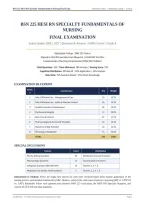
EXAMINATION BLUEPRINT
Sectio
Content Area #Q Weight
n
1 Safe & Effective Care - Management of Care 20 13.3%
2 Safe & Effective Care - Safety & Infection Control 20 13.3%
3 Health Promotion & Maintenance 18 12.0%
4 Psychosocial Integrity 15 10.0%
5 Basic Care & Comfort 22 14.7%
6 Pharmacological & Parenteral Therapies 20 13.3%
7 Reduction of Risk Potential 20 13.3%
8 Physiological Adaptation 15 10.0%
TOTAL 150 100%
SPECIAL INCLUSIONS
Feature Count Distribution
Priority-Setting Questions 20 Distributed across all 8 sections
Pharmacology Questions 15 Concentrated in Section 6
Delegation Questions (RN/LPN/UAP) 10 Sections 1, 5, 7, 8
Integrated Case Studies (multi-question) 5 Sections 1, 2, 4, 7, 8
Instructions to Student: Select the single best answer for each item. Scenario-based items require application of the
nursing process, prioritization frameworks (ABC, Maslow, safety-first), and scope-of-practice reasoning (RN vs. LPN/VN
vs. UAP). Rationales follow each question and reference BSN 225 curriculum, the HESI RN Specialty blueprint, and
current NCLEX-RN test plan standards.
Confidential - For BSN 225 Examination Preparation Use Only Page 1
,BSN 225 HESI RN Specialty Fundamentals of Nursing Final Exam 2026/2027 Edition | Nightingale College | Grade A
Section 1: Safe & Effective Care Environment - Management of Care
Client rights, advocacy, legal/ethical issues, informed consent, advance directives, delegation, prioritization, SBAR,
documentation, HIPAA, scope of practice, ethical principles. (20 questions)
Q1: An 82-year-old client with a terminal diagnosis asks the nurse, "What exactly is in my living will?" The client's
family has stated they "do not want the patient to know." Which action by the nurse best demonstrates advocacy and
respect for client autonomy?
A. Delay the conversation until the family is willing to allow disclosure.
B. Explain to the family that the client has the right to all information about advance directives and then
review the document with the client. *[CORRECT]*
C. Tell the client to ask the physician because nurses are not responsible for advance directive education.
D. Document the request but take no further action to avoid conflict with the family.
Correct Answer: B
Rationale: Autonomy and the Patient Self-Determination Act require that clients be informed of and have access to their
advance directives. The BSN 225 curriculum and HESI RN Specialty blueprint emphasize the RN's role as client advocate:
the nurse must facilitate disclosure of health information the client requests, even when family members object.
Deferring (A) violates autonomy; deflection (C) and inaction (D) constitute abandonment of the advocacy role.
Q2: A client scheduled for an emergent appendectomy is given an opioid analgesic 10 minutes before the surgeon
arrives to obtain informed consent. What is the nurse's most appropriate action?
A. Witness the consent since the client is alert and oriented.
B. Notify the surgeon that the medication may impair the client's ability to give informed consent and
request reassessment. *[CORRECT]*
C. Have the client sign a waiver acknowledging medication was administered.
D. Proceed with witnessing; opioids do not affect consent capacity.
Correct Answer: B
Rationale: Informed consent requires capacity, disclosure, understanding, and voluntariness. Opioids and sedatives
impair cognition and invalidate consent. The RN's advocacy obligation is to alert the provider that capacity is in question
and request reassessment or delay until the client is competent. Signing (A) constitutes negligent witnessing; waivers (C)
are not a substitute for capacity; (D) is factually incorrect and unsafe.
Q3: Which scenario most clearly reflects the ethical principle of justice in nursing practice?
A. Allocating the limited available bedside commode to the client with the greatest mobility deficit rather
than to the client who asks first. *[CORRECT]*
B. Telling the truth to a client about a terminal diagnosis even when it causes distress.
C. Keeping a promise to return at a specific time to administer pain medication.
D. Refusing to administer a medication because the dose is unsafe.
Correct Answer: A
Rationale: Justice is the fair distribution of care and resources regardless of personal characteristics or first-come order.
Triaging the commode to the client with greatest need demonstrates equitable resource allocation. Veracity (B), fidelity
(C), and nonmaleficence (D) are distinct ethical principles.
Confidential - For BSN 225 Examination Preparation Use Only Page 2
,BSN 225 HESI RN Specialty Fundamentals of Nursing Final Exam 2026/2027 Edition | Nightingale College | Grade A
Q4: A nurse discovers that a colleague has been documenting medications as administered before they were actually
given. The nurse's legal and ethical obligation under the Nurse Practice Act and mandatory reporting rules is to:
A. Discuss the issue privately with the colleague and ask them to self-correct.
B. Report the conduct through the facility chain of command and to the Board of Nursing as required.
*[CORRECT]*
C. Wait until the next shift to see if the pattern continues before reporting.
D. Tell only the charge nurse if patient harm has already occurred.
Correct Answer: B
Rationale: Falsification of medical records is fraud and a violation of the Nurse Practice Act. The RN has a mandatory
obligation to report unsafe, illegal, or unethical practice to the chain of command and, where required, to the Board of
Nursing. Private warnings (A) and waiting (C) allow ongoing harm; reporting only after harm (D) violates the duty to
protect clients proactively.
Q5: A client refuses a blood transfusion based on religious beliefs. The physician insists the transfusion is
life-saving. Which nursing action respects both client autonomy and professional standards?
A. Administer the transfusion because life-saving treatment supersedes religious preference.
B. Notify the health care provider of the refusal, document the client's decision, and request ethics
committee consultation if conflict persists. *[CORRECT]*
C. Have the family sign a release permitting the transfusion.
D. Cancel the transfusion order and continue IV fluids without further action.
Correct Answer: B
Rationale: A competent adult has the right to refuse any treatment, including life-saving transfusions (e.g., Jehovah's
Witness). The nurse's role is to ensure informed refusal, notify the provider, document thoroughly, and escalate to ethics
if conflict persists. Forcing treatment (A) constitutes battery. Family consent (C) cannot override a competent client's
refusal, and silent cancellation (D) abandons the advocacy role.
Q6: When communicating a change in client status to the oncoming shift using SBAR, which statement represents
the Assessment component?
A. "Mr. R is a 68-year-old admitted for CHF exacerbation."
B. "His oxygen saturation dropped from 94% to 86% on room air over the past hour."
C. "I think he is developing acute pulmonary edema secondary to fluid overload." *[CORRECT]*
D. "Please evaluate him and consider increasing his Lasix dose."
Correct Answer: C
Rationale: SBAR = Situation, Background, Assessment, Recommendation. The Assessment component is the nurse's
professional interpretation of the data, such as a suspected problem. (A) is Background, (B) is Situation, (D) is
Recommendation. The HESI RN Specialty blueprint requires SBAR proficiency for safe handoff communication.
Confidential - For BSN 225 Examination Preparation Use Only Page 3
, BSN 225 HESI RN Specialty Fundamentals of Nursing Final Exam 2026/2027 Edition | Nightingale College | Grade A
Q7: Which entry in the medical record best meets standards for objective, legally defensible documentation?
A. "Client appeared agitated and difficult."
B. "Refused care; noncompliant with treatment plan."
C. "Stated, 'I will not take this medication,' and refused the 0900 dose of metoprolol 25 mg PO after
education was provided." *[CORRECT]*
D. "Family is uncooperative and unsupportive."
Correct Answer: C
Rationale: Documentation must be factual, objective, timed, and use direct quotes for subjective data. Option C records
the exact behavior, time, drug, dose, route, and education - meeting legal standards. Labels such as "agitated" (A),
"noncompliant" (B), or "uncooperative" (D) are subjective, judgmental, and legally indefensible per BSN 225
fundamentals and NCLEX-RN documentation standards.
Q8: A client sustains a stage 2 pressure injury because the nurse failed to reposition per the ordered Q2H schedule.
The nurse's conduct most closely constitutes:
A. Battery, because there was harmful contact.
B. Negligence / malpractice, because there was a breach of the duty of care that caused harm. *[CORRECT]*
C. Assault, because the client feared harm.
D. Slander, because reputation was damaged.
Correct Answer: B
Rationale: Malpractice requires: duty, breach, causation, damages. The nurse owed a duty to reposition, breached it, and
the breach caused the injury. Battery requires non-consensual touching (A). Assault is the reasonable fear of harmful
contact (C). Slander is spoken defamation (D). The BSN 225 fundamentals curriculum emphasizes the four elements of
malpractice in professional accountability instruction.
Q9: A client asks the nurse to disclose the HIV status of a roommate. The most appropriate response aligns with:
A. Autonomy, by giving the client the information to make decisions.
B. Beneficence, by protecting the client from possible exposure.
C. Confidentiality / HIPAA Privacy Rule, by refusing to disclose another client's protected health
information. *[CORRECT]*
D. Veracity, by truthfully answering the question.
Correct Answer: C
Rationale: HIPAA and the duty of confidentiality prohibit disclosure of one client's protected health information to
another client or unauthorized party. The correct response is to explain that this information cannot be shared.
Autonomy, beneficence, and veracity (A, B, D) do not override the legal duty of confidentiality.
Q10: An RN delegates measuring oral temperature and blood pressure to a experienced unlicensed assistive
personnel (UAP). Which principle must the RN apply?
A. The UAP is fully accountable for the accuracy of the measurements and any clinical decisions based on
them.
B. The RN retains accountability for the decision to delegate, the supervision, and the interpretation of the
data. *[CORRECT]*
C. The RN must independently re-measure every vital sign before recording it.
D. Delegation of vital signs to UAP is outside the UAP scope of practice.
Correct Answer: B
Rationale: The Five Rights of Delegation require that the RN retain accountability for the decision to delegate,
supervision, evaluation, and clinical interpretation. UAP are responsible for performing the task and reporting, but the
RN remains accountable. Option C is inefficient and not required; option D misrepresents UAP scope.
Confidential - For BSN 225 Examination Preparation Use Only Page 4
BSN 225 HESI RN SPECIALTY FUNDAMENTALS OF
NURSING
FINAL EXAMINATION
Latest Update | Questions & Answers | 100% Correct | Grade A
Nightingale College | BSN 225 Course
Aligned to HESI RN Specialty Exam Blueprint | NCLEX-RN Test Plan
Fundamentals of Nursing Competencies (2026/2027 Edition)
Total Questions: 150 | Time Allotment: 180 minutes | Passing Score: 75%
Cognitive Distribution: 20% Recall | 50% Application | 30% Analysis
Item Style: 75% Scenario-Based | 25% Direct Knowledge
EXAMINATION BLUEPRINT
Sectio
Content Area #Q Weight
n
1 Safe & Effective Care - Management of Care 20 13.3%
2 Safe & Effective Care - Safety & Infection Control 20 13.3%
3 Health Promotion & Maintenance 18 12.0%
4 Psychosocial Integrity 15 10.0%
5 Basic Care & Comfort 22 14.7%
6 Pharmacological & Parenteral Therapies 20 13.3%
7 Reduction of Risk Potential 20 13.3%
8 Physiological Adaptation 15 10.0%
TOTAL 150 100%
SPECIAL INCLUSIONS
Feature Count Distribution
Priority-Setting Questions 20 Distributed across all 8 sections
Pharmacology Questions 15 Concentrated in Section 6
Delegation Questions (RN/LPN/UAP) 10 Sections 1, 5, 7, 8
Integrated Case Studies (multi-question) 5 Sections 1, 2, 4, 7, 8
Instructions to Student: Select the single best answer for each item. Scenario-based items require application of the
nursing process, prioritization frameworks (ABC, Maslow, safety-first), and scope-of-practice reasoning (RN vs. LPN/VN
vs. UAP). Rationales follow each question and reference BSN 225 curriculum, the HESI RN Specialty blueprint, and
current NCLEX-RN test plan standards.
Confidential - For BSN 225 Examination Preparation Use Only Page 1
,BSN 225 HESI RN Specialty Fundamentals of Nursing Final Exam 2026/2027 Edition | Nightingale College | Grade A
Section 1: Safe & Effective Care Environment - Management of Care
Client rights, advocacy, legal/ethical issues, informed consent, advance directives, delegation, prioritization, SBAR,
documentation, HIPAA, scope of practice, ethical principles. (20 questions)
Q1: An 82-year-old client with a terminal diagnosis asks the nurse, "What exactly is in my living will?" The client's
family has stated they "do not want the patient to know." Which action by the nurse best demonstrates advocacy and
respect for client autonomy?
A. Delay the conversation until the family is willing to allow disclosure.
B. Explain to the family that the client has the right to all information about advance directives and then
review the document with the client. *[CORRECT]*
C. Tell the client to ask the physician because nurses are not responsible for advance directive education.
D. Document the request but take no further action to avoid conflict with the family.
Correct Answer: B
Rationale: Autonomy and the Patient Self-Determination Act require that clients be informed of and have access to their
advance directives. The BSN 225 curriculum and HESI RN Specialty blueprint emphasize the RN's role as client advocate:
the nurse must facilitate disclosure of health information the client requests, even when family members object.
Deferring (A) violates autonomy; deflection (C) and inaction (D) constitute abandonment of the advocacy role.
Q2: A client scheduled for an emergent appendectomy is given an opioid analgesic 10 minutes before the surgeon
arrives to obtain informed consent. What is the nurse's most appropriate action?
A. Witness the consent since the client is alert and oriented.
B. Notify the surgeon that the medication may impair the client's ability to give informed consent and
request reassessment. *[CORRECT]*
C. Have the client sign a waiver acknowledging medication was administered.
D. Proceed with witnessing; opioids do not affect consent capacity.
Correct Answer: B
Rationale: Informed consent requires capacity, disclosure, understanding, and voluntariness. Opioids and sedatives
impair cognition and invalidate consent. The RN's advocacy obligation is to alert the provider that capacity is in question
and request reassessment or delay until the client is competent. Signing (A) constitutes negligent witnessing; waivers (C)
are not a substitute for capacity; (D) is factually incorrect and unsafe.
Q3: Which scenario most clearly reflects the ethical principle of justice in nursing practice?
A. Allocating the limited available bedside commode to the client with the greatest mobility deficit rather
than to the client who asks first. *[CORRECT]*
B. Telling the truth to a client about a terminal diagnosis even when it causes distress.
C. Keeping a promise to return at a specific time to administer pain medication.
D. Refusing to administer a medication because the dose is unsafe.
Correct Answer: A
Rationale: Justice is the fair distribution of care and resources regardless of personal characteristics or first-come order.
Triaging the commode to the client with greatest need demonstrates equitable resource allocation. Veracity (B), fidelity
(C), and nonmaleficence (D) are distinct ethical principles.
Confidential - For BSN 225 Examination Preparation Use Only Page 2
,BSN 225 HESI RN Specialty Fundamentals of Nursing Final Exam 2026/2027 Edition | Nightingale College | Grade A
Q4: A nurse discovers that a colleague has been documenting medications as administered before they were actually
given. The nurse's legal and ethical obligation under the Nurse Practice Act and mandatory reporting rules is to:
A. Discuss the issue privately with the colleague and ask them to self-correct.
B. Report the conduct through the facility chain of command and to the Board of Nursing as required.
*[CORRECT]*
C. Wait until the next shift to see if the pattern continues before reporting.
D. Tell only the charge nurse if patient harm has already occurred.
Correct Answer: B
Rationale: Falsification of medical records is fraud and a violation of the Nurse Practice Act. The RN has a mandatory
obligation to report unsafe, illegal, or unethical practice to the chain of command and, where required, to the Board of
Nursing. Private warnings (A) and waiting (C) allow ongoing harm; reporting only after harm (D) violates the duty to
protect clients proactively.
Q5: A client refuses a blood transfusion based on religious beliefs. The physician insists the transfusion is
life-saving. Which nursing action respects both client autonomy and professional standards?
A. Administer the transfusion because life-saving treatment supersedes religious preference.
B. Notify the health care provider of the refusal, document the client's decision, and request ethics
committee consultation if conflict persists. *[CORRECT]*
C. Have the family sign a release permitting the transfusion.
D. Cancel the transfusion order and continue IV fluids without further action.
Correct Answer: B
Rationale: A competent adult has the right to refuse any treatment, including life-saving transfusions (e.g., Jehovah's
Witness). The nurse's role is to ensure informed refusal, notify the provider, document thoroughly, and escalate to ethics
if conflict persists. Forcing treatment (A) constitutes battery. Family consent (C) cannot override a competent client's
refusal, and silent cancellation (D) abandons the advocacy role.
Q6: When communicating a change in client status to the oncoming shift using SBAR, which statement represents
the Assessment component?
A. "Mr. R is a 68-year-old admitted for CHF exacerbation."
B. "His oxygen saturation dropped from 94% to 86% on room air over the past hour."
C. "I think he is developing acute pulmonary edema secondary to fluid overload." *[CORRECT]*
D. "Please evaluate him and consider increasing his Lasix dose."
Correct Answer: C
Rationale: SBAR = Situation, Background, Assessment, Recommendation. The Assessment component is the nurse's
professional interpretation of the data, such as a suspected problem. (A) is Background, (B) is Situation, (D) is
Recommendation. The HESI RN Specialty blueprint requires SBAR proficiency for safe handoff communication.
Confidential - For BSN 225 Examination Preparation Use Only Page 3
, BSN 225 HESI RN Specialty Fundamentals of Nursing Final Exam 2026/2027 Edition | Nightingale College | Grade A
Q7: Which entry in the medical record best meets standards for objective, legally defensible documentation?
A. "Client appeared agitated and difficult."
B. "Refused care; noncompliant with treatment plan."
C. "Stated, 'I will not take this medication,' and refused the 0900 dose of metoprolol 25 mg PO after
education was provided." *[CORRECT]*
D. "Family is uncooperative and unsupportive."
Correct Answer: C
Rationale: Documentation must be factual, objective, timed, and use direct quotes for subjective data. Option C records
the exact behavior, time, drug, dose, route, and education - meeting legal standards. Labels such as "agitated" (A),
"noncompliant" (B), or "uncooperative" (D) are subjective, judgmental, and legally indefensible per BSN 225
fundamentals and NCLEX-RN documentation standards.
Q8: A client sustains a stage 2 pressure injury because the nurse failed to reposition per the ordered Q2H schedule.
The nurse's conduct most closely constitutes:
A. Battery, because there was harmful contact.
B. Negligence / malpractice, because there was a breach of the duty of care that caused harm. *[CORRECT]*
C. Assault, because the client feared harm.
D. Slander, because reputation was damaged.
Correct Answer: B
Rationale: Malpractice requires: duty, breach, causation, damages. The nurse owed a duty to reposition, breached it, and
the breach caused the injury. Battery requires non-consensual touching (A). Assault is the reasonable fear of harmful
contact (C). Slander is spoken defamation (D). The BSN 225 fundamentals curriculum emphasizes the four elements of
malpractice in professional accountability instruction.
Q9: A client asks the nurse to disclose the HIV status of a roommate. The most appropriate response aligns with:
A. Autonomy, by giving the client the information to make decisions.
B. Beneficence, by protecting the client from possible exposure.
C. Confidentiality / HIPAA Privacy Rule, by refusing to disclose another client's protected health
information. *[CORRECT]*
D. Veracity, by truthfully answering the question.
Correct Answer: C
Rationale: HIPAA and the duty of confidentiality prohibit disclosure of one client's protected health information to
another client or unauthorized party. The correct response is to explain that this information cannot be shared.
Autonomy, beneficence, and veracity (A, B, D) do not override the legal duty of confidentiality.
Q10: An RN delegates measuring oral temperature and blood pressure to a experienced unlicensed assistive
personnel (UAP). Which principle must the RN apply?
A. The UAP is fully accountable for the accuracy of the measurements and any clinical decisions based on
them.
B. The RN retains accountability for the decision to delegate, the supervision, and the interpretation of the
data. *[CORRECT]*
C. The RN must independently re-measure every vital sign before recording it.
D. Delegation of vital signs to UAP is outside the UAP scope of practice.
Correct Answer: B
Rationale: The Five Rights of Delegation require that the RN retain accountability for the decision to delegate,
supervision, evaluation, and clinical interpretation. UAP are responsible for performing the task and reporting, but the
RN remains accountable. Option C is inefficient and not required; option D misrepresents UAP scope.
Confidential - For BSN 225 Examination Preparation Use Only Page 4


