
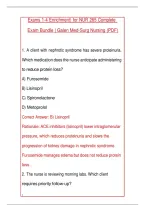
Exams 1-4 Enrichment) for NUR 265 Complete
Exam Bundle | Galen Med-Surg Nursing (PDF)
1. A client with nephrotic syndrome has severe proteinuria.
Which medication does the nurse anticipate administering
to reduce protein loss?
A) Furosemide
B) Lisinopril
C) Spironolactone
D) Metoprolol
Correct Answer: B) Lisinopril
Rationale: ACE inhibitors (lisinopril) lower intraglomerular
pressure, which reduces proteinuria and slows the
progression of kidney damage in nephrotic syndrome.
Furosemide manages edema but does not reduce protein
loss .
2. The nurse is reviewing morning labs. Which client
requires priority follow-up?
1
,A) Temperature of 99.8°F
B) Temperature of 101.4°F
C) Mild fatigue
D) Slight nausea
Correct Answer: B) Temperature of 101.4°F
Rationale: A fever over 101°F in a client, particularly one
on dialysis or immunocompromised, indicates possible
infection and requires immediate assessment and
intervention .
3. A client on hemodialysis reports eating “lots of
sandwiches and chips.” Which statement indicates a need
for further teaching?
A) “I limit my sodium to 5 grams per day.”
B) “I avoid adding salt to my food.”
C) “I read labels on processed foods.”
D) “I avoid potassium-based salt substitutes.”
Correct Answer: A) “I limit my sodium to 5 grams per day.”
*Rationale: Clients on hemodialysis should restrict sodium
2
,to 2-4 grams per day to manage hypertension and fluid
balance. Five grams exceeds the recommended limit .*
4. A client with type 2 diabetes has an HbA1c of 10.2%.
What is the priority discharge goal?
A) HbA1c below 7%
B) Fasting glucose below 200 mg/dL
C) Daily glucose monitoring
D) Correct insulin injection technique
Correct Answer: A) HbA1c below 7%
*Rationale: HbA1c reflects average blood glucose over
2-3 months. The target for most adults is <7% to reduce
the risk of long-term complications .*
5. A client with type 1 diabetes rides a bicycle daily.
Where should the nurse teach the client to administer
morning insulin?
A) Thigh
B) Buttock
3
, C) Abdomen
D) Arm
Correct Answer: C) Abdomen j6 j6 j6
Rationale: The abdomen provides the fastest and most j6 j6 j6 j6 j6 j6 j6
j6 consistent insulin absorption. Extremities used during
j6 j6 j6 j6 j6
j6 exercise (thighs, arms) may absorb insulin faster during
j6 j6 j6 j6 j6 j6 j6
j6 activity, increasing therisk ofhypoglycemia .
j6 j6 j6 j6 j6 j6
6. A client presents with atrial fibrillation, heat intolerance,
j6 j6 j6 j6 j6 j6 j6
j6 and weight loss. Which condition does the nurse suspect?
j6 j6 j6 j6 j6 j6 j6 j6
A) Hypothyroidism
B) Hyperthyroidism
C) Adrenal crisis j6
D) SIADH
Correct Answer: B) Hyperthyroidism
j6 j6 j6
Rationale: Hyperthyroidism causes increased metabolic j6 j6 j6 j6
j6 rate, leading to weight loss, heat intolerance, tachycardia,
j6 j6 j6 j6 j6 j6 j6
j6 and atrial fibrillation. Hypothyroidism presents with weight
j6 j6 j6 j6 j6 j6
gainandcoldintolerance .
j6 j6 j6 j6 j6
4
Exam Bundle | Galen Med-Surg Nursing (PDF)
1. A client with nephrotic syndrome has severe proteinuria.
Which medication does the nurse anticipate administering
to reduce protein loss?
A) Furosemide
B) Lisinopril
C) Spironolactone
D) Metoprolol
Correct Answer: B) Lisinopril
Rationale: ACE inhibitors (lisinopril) lower intraglomerular
pressure, which reduces proteinuria and slows the
progression of kidney damage in nephrotic syndrome.
Furosemide manages edema but does not reduce protein
loss .
2. The nurse is reviewing morning labs. Which client
requires priority follow-up?
1
,A) Temperature of 99.8°F
B) Temperature of 101.4°F
C) Mild fatigue
D) Slight nausea
Correct Answer: B) Temperature of 101.4°F
Rationale: A fever over 101°F in a client, particularly one
on dialysis or immunocompromised, indicates possible
infection and requires immediate assessment and
intervention .
3. A client on hemodialysis reports eating “lots of
sandwiches and chips.” Which statement indicates a need
for further teaching?
A) “I limit my sodium to 5 grams per day.”
B) “I avoid adding salt to my food.”
C) “I read labels on processed foods.”
D) “I avoid potassium-based salt substitutes.”
Correct Answer: A) “I limit my sodium to 5 grams per day.”
*Rationale: Clients on hemodialysis should restrict sodium
2
,to 2-4 grams per day to manage hypertension and fluid
balance. Five grams exceeds the recommended limit .*
4. A client with type 2 diabetes has an HbA1c of 10.2%.
What is the priority discharge goal?
A) HbA1c below 7%
B) Fasting glucose below 200 mg/dL
C) Daily glucose monitoring
D) Correct insulin injection technique
Correct Answer: A) HbA1c below 7%
*Rationale: HbA1c reflects average blood glucose over
2-3 months. The target for most adults is <7% to reduce
the risk of long-term complications .*
5. A client with type 1 diabetes rides a bicycle daily.
Where should the nurse teach the client to administer
morning insulin?
A) Thigh
B) Buttock
3
, C) Abdomen
D) Arm
Correct Answer: C) Abdomen j6 j6 j6
Rationale: The abdomen provides the fastest and most j6 j6 j6 j6 j6 j6 j6
j6 consistent insulin absorption. Extremities used during
j6 j6 j6 j6 j6
j6 exercise (thighs, arms) may absorb insulin faster during
j6 j6 j6 j6 j6 j6 j6
j6 activity, increasing therisk ofhypoglycemia .
j6 j6 j6 j6 j6 j6
6. A client presents with atrial fibrillation, heat intolerance,
j6 j6 j6 j6 j6 j6 j6
j6 and weight loss. Which condition does the nurse suspect?
j6 j6 j6 j6 j6 j6 j6 j6
A) Hypothyroidism
B) Hyperthyroidism
C) Adrenal crisis j6
D) SIADH
Correct Answer: B) Hyperthyroidism
j6 j6 j6
Rationale: Hyperthyroidism causes increased metabolic j6 j6 j6 j6
j6 rate, leading to weight loss, heat intolerance, tachycardia,
j6 j6 j6 j6 j6 j6 j6
j6 and atrial fibrillation. Hypothyroidism presents with weight
j6 j6 j6 j6 j6 j6
gainandcoldintolerance .
j6 j6 j6 j6 j6
4


