
Mary Grace Thurmon Steven Pomarico
BIOL 1202 October 23, 2017
https://geauxsi.microsoftcrmportals.com/sessionsigninwebpage/
ATTENDANCE CODE: 7779
Exam 3 Review
Warm up:
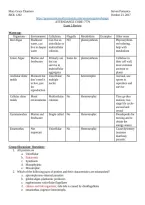
Organisms Environment Cellularity Flagella Metabolism Examples Other notes
Red Algae Shallower Can live as NO photosynthesis Phycoerythrin-
water, can unicellular or red coloring,
live in deeper multicellular help with
water colonies metabolism
Green Algae Marine and Primarly uni Some do photosynthesis Cellulose in
freshwater but can their cell wall;
survive in most common
multicellular ancestor to
aggregates plants
Acellular slime Moisture but Unicellular; No heterotrophic Asexual, use
molds don’t need it multiple spores to
to live, just nuclei reproduce and
for survive
reproduction
Cellular slime Moist Multicellular No Heterotrophic They go thru
molds environments colonies meiosis; two
stage life cycle-
asexual and
sexual
Gymnamoebas Marine and Single celled No Heterotrophic Pseudopodia for
freshwater moving and to
obtain the
energy source
Entamoebas Not Unicellular No Heterotrophic Cause dysentery
important (extreme
diarrhea);
parasitic
Group Discussion: Questions:
1. All protists are
a. Unicellular
b. Eukaryotic
c. Symbionts
d. Monophyletic
e. Mixotrophic
2. Which of the following pairs of protists and their characteristics are mismatched?
a. apicomplexans–internal parasites
b. golden algae–planktonic producers
c. euglenozoans–unicellular flagellates
d. ciliates–red tide organisms; ride tide is caused by dinoflagelletes
e. entamoebas–ingestive heterotrophs
, 3. Which of the following have no flagella?
a. Diplomonads
b. Parabasalids
c. Apicomplexans; have sporozites
d. Euglenids
e. Kinetoplasts
f. Golden Algae
g. Dinoflagellates
4. Match the following examples with the classification:
1. Giardia E a. Brown algae
2. Red tide H b. Apicomplexans
3. Trapanosoma G c. Parabasalids
4. Downy mold D d. Oomycotes
5. Trichomanas vaginalis C e. Diplomonads
6. Plasmodium B f. Apicomplexans
7. Giant Kelp A g. Kinetoplastids
8. Toxoplasma F h. Dinoflagellates
5. Which of the following is mismatched with its shell composition?
a. Foraminifera – CaCO3
b. Radiolarian – Silica
c. Diatoms – CaCO3 ; have silica shells
d. Dinoflagellates – Cellulose
e. Oomycetes – cellulose
6. Which of these do not form aggregated colonies?
a. Dinoflagellates
b. Oomycetes
c. Brown Algae
d. Golden Algae
7. Which of the following do not have distinct pigments?
a. Red Algae
b. Amebozoans
c. Green Algae
d. Brown Algae
8. Fill in the life cycle for the ciliates
9. Fill in
the life
cycle of
the
cellular
slime
molds:
BIOL 1202 October 23, 2017
https://geauxsi.microsoftcrmportals.com/sessionsigninwebpage/
ATTENDANCE CODE: 7779
Exam 3 Review
Warm up:
Organisms Environment Cellularity Flagella Metabolism Examples Other notes
Red Algae Shallower Can live as NO photosynthesis Phycoerythrin-
water, can unicellular or red coloring,
live in deeper multicellular help with
water colonies metabolism
Green Algae Marine and Primarly uni Some do photosynthesis Cellulose in
freshwater but can their cell wall;
survive in most common
multicellular ancestor to
aggregates plants
Acellular slime Moisture but Unicellular; No heterotrophic Asexual, use
molds don’t need it multiple spores to
to live, just nuclei reproduce and
for survive
reproduction
Cellular slime Moist Multicellular No Heterotrophic They go thru
molds environments colonies meiosis; two
stage life cycle-
asexual and
sexual
Gymnamoebas Marine and Single celled No Heterotrophic Pseudopodia for
freshwater moving and to
obtain the
energy source
Entamoebas Not Unicellular No Heterotrophic Cause dysentery
important (extreme
diarrhea);
parasitic
Group Discussion: Questions:
1. All protists are
a. Unicellular
b. Eukaryotic
c. Symbionts
d. Monophyletic
e. Mixotrophic
2. Which of the following pairs of protists and their characteristics are mismatched?
a. apicomplexans–internal parasites
b. golden algae–planktonic producers
c. euglenozoans–unicellular flagellates
d. ciliates–red tide organisms; ride tide is caused by dinoflagelletes
e. entamoebas–ingestive heterotrophs
, 3. Which of the following have no flagella?
a. Diplomonads
b. Parabasalids
c. Apicomplexans; have sporozites
d. Euglenids
e. Kinetoplasts
f. Golden Algae
g. Dinoflagellates
4. Match the following examples with the classification:
1. Giardia E a. Brown algae
2. Red tide H b. Apicomplexans
3. Trapanosoma G c. Parabasalids
4. Downy mold D d. Oomycotes
5. Trichomanas vaginalis C e. Diplomonads
6. Plasmodium B f. Apicomplexans
7. Giant Kelp A g. Kinetoplastids
8. Toxoplasma F h. Dinoflagellates
5. Which of the following is mismatched with its shell composition?
a. Foraminifera – CaCO3
b. Radiolarian – Silica
c. Diatoms – CaCO3 ; have silica shells
d. Dinoflagellates – Cellulose
e. Oomycetes – cellulose
6. Which of these do not form aggregated colonies?
a. Dinoflagellates
b. Oomycetes
c. Brown Algae
d. Golden Algae
7. Which of the following do not have distinct pigments?
a. Red Algae
b. Amebozoans
c. Green Algae
d. Brown Algae
8. Fill in the life cycle for the ciliates
9. Fill in
the life
cycle of
the
cellular
slime
molds:


