
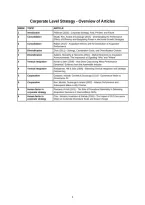
Corporate Level Strategy - Overview of Articles
WEEK TOPIC ARTICLE
1 Introduction Feldman (2020) - Corporate Strategy: Past, Present, and Future
2 Consolidation Moatti, Ren, Anand & Dussauge (2015) - Disentangling the Performance
Effects of Efficiency and Bargaining Power in Horizontal Growth Strategies
2 Consolidation Rabier (2017) - Acquisition Motives and the Distribution of Acquisition
Performance
3 Diversification Zhou (2011) - Synergy, Coordination Costs, and Diversification Choices
3 Diversification Aalbers, McCarthy & Heimeriks (2021) - Market Reactions to Acquisition
Announcements: The Importance of Signaling "Why" and "Where"
4 Vertical integration Novak & Stern (2008) - How Does Outsourcing Affect Performance
Dynamics? Evidence from the Automobile Industry
4 Vertical integration Rothaermel, Hitt & Jobe (2006) - Balancing Vertical Integration and Strategic
Outsourcing
5 Cooperation Castaner, Mulotte, Garrette & Dussauge (2014) - Governance Mode vs.
Governance Fit
5 Cooperation Ren, Mulotte, Dussauge & Anand (2022) - Alliance Performance and
Subsequent Make-or-Ally Choices
6 Human factor in Pavicevic & Keil (2021) - The Role of Procedural Rationality in Debiasing
corporate strategy Acquisition Decisions of Overconfident CEOs
6 Human factor in Chiu, Johnson, Hoskisson & Pathak (2016) - The Impact of CEO Successor
corporate strategy Origin on Corporate Divestiture Scale and Scope Change
1
,Week 1 — Feldman (2020): Corporate Strategy: Past, Present, and
Future
Central question and the domain of corporate strategy
Feldman’s article is a conceptual review of corporate strategy and an agenda for future
research. Its organizing idea is that corporate strategy is fundamentally concerned with
managerial choices about the scope of the firm: which businesses and activities belong inside
the corporation, how managers coordinate the activities that remain inside, how the firm relates
to organizations outside its boundaries, and how corporate scope changes over time. This
domain is distinct from competitive or business-level strategy. Competitive strategy asks how a
business competes in a product market; corporate strategy asks how managers set and
oversee the collection of businesses, resources, relationships, and transactions that make up
the corporation.
The article is especially useful as an umbrella framework for the course because acquisitions,
divestitures, alliances, resource allocation, capability sharing, and resource redeployment are
not isolated decisions. They are connected mechanisms through which managers configure
corporate scope. A strong analysis therefore asks not only whether a particular action creates
value, but also how that action changes the corporation’s future resources, relationships, and
strategic options.
The telescoping framework: three levels of corporate action
Feldman organizes the field into three nested categories: intra-organizational, inter-
organizational, and extra-organizational actions. The framework can be viewed as a telescope
that moves outward from coordination within the corporation, to relationships across firm
boundaries, to transactions that alter those boundaries. One of the article’s main future-research
arguments is that the three levels should be studied together because corporate managers
make these choices as part of one evolving strategy.
Intra-organizational actions: coordination and redeployment of resources among
businesses already inside the firm. Examples include internal capital allocation, sharing
capabilities, cross-subsidization, and moving nonfinancial resources from one business to
another.
Inter-organizational actions: coordination of relationships with organizations outside the
focal firm without necessarily changing ownership boundaries. Alliances and network
relationships are central examples.
Extra-organizational actions: transactions that directly change which businesses or assets
are inside the corporation. Acquisitions expand or reconfigure scope; divestitures contract or
refocus it.
Intra-organizational actions: value creation and resource reconfiguration
A diversified corporation creates corporate-level value only if ownership and management under
one corporate roof add something that separate ownership would not. Dynamic-capabilities
theory offers one explanation: the corporate parent can integrate, build, and reconfigure
competences as environments change. Corporate management is therefore not merely a
passive owner of a portfolio. It can actively move resources toward better opportunities,
combine resources across units, or withdraw resources from declining businesses.
Feldman distinguishes sharing resources at one point in time from redeploying them over time.
Sharing creates intra-temporal economies of scope: the same resource supports several
businesses simultaneously. Redeployment creates inter-temporal economies of scope:
2
,resources are shifted between businesses as opportunities change. The distinction matters
because resources differ in scalability. Some capabilities are close to scale-free and can
support several units with limited congestion. Other resources are non-scale-free, so committing
them to one unit creates an opportunity cost elsewhere. Thus, relatedness alone is not enough;
managers must ask whether the specific resource can truly be shared or whether it must be
reallocated.
Resource redeployment provides a flexibility logic for diversification. A multi-business firm may
have an internal option to move people, technologies, equipment, brands, or other resources
from businesses with deteriorating opportunities toward businesses with more attractive
prospects. Yet internal allocation can also destroy value. Agency theory highlights cross-
subsidization of pet projects, protection of weak units, empire building, and managerial
preferences for growth. Internal capital markets therefore are not inherently superior or inferior
to external markets: their value depends on information, incentives, governance, and
managerial ability.
Inter-organizational actions: relational capabilities and networks
At the inter-organizational level, the relational view explains how value can arise from
combinations of resources held by different firms. Repeated interaction, trust, partner-specific
routines, knowledge exchange, and learning can create relational capabilities that neither
partner could reproduce alone. Corporate value creation can therefore cross legal firm
boundaries. The corporation may deliberately keep a relationship external because the
relationship itself is strategically valuable.
Network theory adds a structural perspective. A firm’s network position can provide information,
technologies, opportunities, and access to future partners. Corporate transactions can also
reshape networks. An acquisition, for example, is not merely the addition of a target’s assets; it
can collapse two previously separate network nodes and change the relationships around both
firms. This is why transaction-level analysis can be incomplete if it ignores ecosystem
consequences.
Extra-organizational actions: acquisitions and divestitures
Acquisitions and divestitures change the formal boundaries of the corporation. In a resource-
reconfiguration perspective, acquisitions bring resources and capabilities inside the firm while
divestitures remove resources that no longer fit the strategy. Divestitures should therefore not
automatically be interpreted as failure. They can be proactive tools for releasing capital,
managerial attention, or nonfinancial resources and repositioning the corporation for future
opportunities.
Agency theory provides a competing explanation. Managers can expand scope for private
benefits such as status, compensation, power, or job security. Overdiversification can dilute
monitoring and keep resources trapped in weak businesses. From this perspective, a divestiture
may correct earlier overexpansion. Feldman’s broader lesson is methodological: identical
observable actions can reflect different mechanisms. An acquisition can be value-creating
reconfiguration or empire building; a divestiture can be strategic renewal or correction of a
mistake. The analysis must identify the mechanism rather than infer motive from the action
itself.
Why the three levels must be connected
Corporate actions operate as a system. An acquisition changes the set of resources that can
later be shared or redeployed internally. An alliance can generate knowledge that later
motivates an acquisition or independent entry. A divestiture can release resources and
3
, managerial attention that make new investments possible. Conversely, a persistent internal
allocation problem can motivate a scope-changing transaction. Treating each deal as an
independent event therefore misses the dynamic path through which corporate scope evolves.
Feldman consequently calls for more research on sequences and portfolios of corporate
transactions. A series of acquisitions, alliances, divestitures, and internal reallocations may
reveal corporate strategy more accurately than any one event. This temporal view also
recognizes that the payoff from one action may appear only after later actions, while an earlier
scope choice can create constraints that shape subsequent decisions.
Future research agenda and limits of existing work
Cross-level integration: future work should connect intra-, inter-, and extra-organizational
actions rather than study them in separate literatures.
Sequences instead of isolated events: corporate strategy unfolds through paths of
transactions and reallocations, so researchers should analyze portfolios and timing of
actions.
Longer time horizons: scope choices and resource reconfiguration often take years to
reveal their consequences, requiring time-series and longitudinal approaches.
Variation across organizations: theories should be compared across firm sizes and public
versus private corporations because governance and resource-allocation processes can
differ.
Closer connection with managerial practice: research should examine how due
diligence, negotiation, integration, synergy estimation, and implementation actually occur
inside firms.
Behavioral corporate strategy: ill-structured corporate decisions create room for cognitive
bias. Managers should diagnose the underlying strategic problem before jumping to a
favored solution such as an acquisition program.
Policy and regulation: scope decisions are embedded in legal and regulatory
environments, leaving room for stronger links between corporate strategy and public policy.
Managerial implications and exam application
For managers, the framework disciplines diagnosis. First ask whether the issue is
primarily internal resource allocation, an external relationship, or a change in firm
boundaries. Then identify the value-creation mechanism and the governance risk. A
proposed acquisition, for example, should not be justified only by saying that the businesses
are related. The analysis should specify which resources can be shared or redeployed,
whether those resources are scalable, how the deal changes external relationships, and
whether managerial incentives could produce overexpansion or cross-subsidization.
For a new exam case, Feldman can be used as a first map. Classify the action, identify
the resource or relationship mechanism, and trace the consequences across the other two
levels. A strong answer recognizes that corporate scope is dynamic: today’s transaction
changes tomorrow’s internal resource allocation, network position, and future acquisition or
divestiture possibilities. The article therefore links the specialized papers in later weeks
without replacing their more specific causal arguments.
Feldman (2020) — exam snapshot
Core question How do managers set and oversee the scope of the
firm?
Framework Intra-organizational, inter-organizational, and extra-
organizational actions.
Value logic Coordinate, share, redeploy, and reconfigure resources
4


