
Business Studies
Management and leadership
Distinguishing between management and leadership
Management refers to the act of getting people together to accomplish desired
goals and objectives using available resources efficiently and effectively.
Leadership refers to the process by which a leader guides, inspires, and influences
the behaviour and work of employees in pursuit of the organisation’s goals.
Clear differences exist between what it means to be a leader and what it means to
be a manager.
Leaders have a broad outlook of an organisation. They focus on the vision and
mission of the business. They consider employees as people first, before
relating to them as employees.
Managers, however, have a narrower view of the organisation. They focus on
the organisation’s immediate goals.
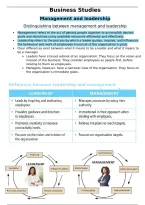
Difference between leadership and management
, Different leadership styles
Democratic leadership style
A democratic leader involves employees in the decision-making process.
The leader realises that there is power within the collective input of individuals.
Application
The leader knows his/her limitations and is open to new ideas/innovative thinking.
The leader requires a different perspective on an issue and experienced employees
could provide valuable information.
The impact
Positive
The leaders do not have to rely on their knowledge/skills to solve complex
problems.
Leaders may invite employees to participate in the decision-making process and
benefit from their experiences/expertise
Employees feel empowered/motivated, resulting in increased productivity levels.
Regular communication between leaders and employees lead to improved decision-
making.
Negative
Input from inexperienced employees could lead to decisions that are not in the best
interest of the organisation.
The leader may not be in the position to take decisions immediately, because key
employees are unable to attend the meeting.
Could be demoralising to employees if a leader does not consider their inputs
before deciding.
The leader could delay making decisions because he/she is waiting for inputs from
employees.
Autocratic leadership style
An autocratic leader does not involve employees in the decision-making process.
Employees are told what to do and must execute the decisions of the leader without
questioning his/her decisions
Application
When a crisis arises within an organisation and requires immediate action on the
part of the leader.
The business appointed inexperienced/new employees that could benefi t from this
type of leadership style.
The impact
Positive
The leader is in a position to make quick decisions, without consulting employees.
The leader has certainty that decisions will be made timeously, without delays/
work gets done on schedule.
There is no uncertainty regarding the source of instructions, which comes directly
from the leader.
Management and leadership
Distinguishing between management and leadership
Management refers to the act of getting people together to accomplish desired
goals and objectives using available resources efficiently and effectively.
Leadership refers to the process by which a leader guides, inspires, and influences
the behaviour and work of employees in pursuit of the organisation’s goals.
Clear differences exist between what it means to be a leader and what it means to
be a manager.
Leaders have a broad outlook of an organisation. They focus on the vision and
mission of the business. They consider employees as people first, before
relating to them as employees.
Managers, however, have a narrower view of the organisation. They focus on
the organisation’s immediate goals.
Difference between leadership and management
, Different leadership styles
Democratic leadership style
A democratic leader involves employees in the decision-making process.
The leader realises that there is power within the collective input of individuals.
Application
The leader knows his/her limitations and is open to new ideas/innovative thinking.
The leader requires a different perspective on an issue and experienced employees
could provide valuable information.
The impact
Positive
The leaders do not have to rely on their knowledge/skills to solve complex
problems.
Leaders may invite employees to participate in the decision-making process and
benefit from their experiences/expertise
Employees feel empowered/motivated, resulting in increased productivity levels.
Regular communication between leaders and employees lead to improved decision-
making.
Negative
Input from inexperienced employees could lead to decisions that are not in the best
interest of the organisation.
The leader may not be in the position to take decisions immediately, because key
employees are unable to attend the meeting.
Could be demoralising to employees if a leader does not consider their inputs
before deciding.
The leader could delay making decisions because he/she is waiting for inputs from
employees.
Autocratic leadership style
An autocratic leader does not involve employees in the decision-making process.
Employees are told what to do and must execute the decisions of the leader without
questioning his/her decisions
Application
When a crisis arises within an organisation and requires immediate action on the
part of the leader.
The business appointed inexperienced/new employees that could benefi t from this
type of leadership style.
The impact
Positive
The leader is in a position to make quick decisions, without consulting employees.
The leader has certainty that decisions will be made timeously, without delays/
work gets done on schedule.
There is no uncertainty regarding the source of instructions, which comes directly
from the leader.


