
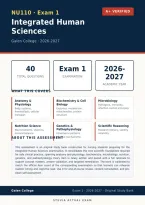
NU110 · Exam 1 A+ VERIFIED
Integrated Human
Sciences
Galen College · 2026-2027
40 Exam 1 2026-
TOTAL QUESTIONS EXAMINATION
2027
ACADEMIC YEAR
W H AT T H I S C OV E R S
Anatomy & Biochemistry & Cell Microbiology
Physiology Biology Pathogens, immunity,
Body systems, Enzymes, metabolism, infection control principles
homeostasis, cellular mitochondria, protein
transport structure
Nutrition Science Genetics & Scientific Reasoning
Macronutrients, vitamins, Pathophysiology Research literacy, validity,
mineral balance Inheritance patterns, reliability
ABOUT THIS A SS E SS M Edisease
N T mechanisms
This assessment is an original study bank constructed for nursing students preparing for the
Integrated Human Sciences examination. It consolidates the core scientific foundations required
for safe clinical practice, spanning anatomy and physiology, biochemistry, microbiology, nutrition,
genetics, and pathophysiology. Every item is newly written and paired with a full rationale to
support concept mastery, answer validation, and targeted remediation. The bank is calibrated to
match the official item count of the corresponding examination so that learners can rehearse
realistic timing and cognitive load. Use it for end-of-course review, content remediation, and pre-
exam self-assessment.
Galen College Exam 1 · 2026-2027 · Original Study Bank
STUVIA ACTUAL EXAM
, NU110 - Integrated Human Sciences Exam 1 | 2026-2027
NU110 - Integrated Human Sciences | Exam 1 | 40 Questions | 2026-2027
Section 1 — Questions 1 to 10
1. A first-semester nursing student is reviewing cellular transport mechanisms. She notes that a particular cell
process moves substances from low to high concentration using ATP. Which transport process is the student
observing?
A. Simple diffusion
B. Active transport
C. Facilitated diffusion
D. Osmosis
Correct Answer: B
Rationale: Active transport moves substances against their concentration gradient (low to high) and requires ATP
expenditure. Simple diffusion, facilitated diffusion, and osmosis are passive processes that move substances down
their gradient without energy input. The sodium-potassium pump is a classic example of this energy-dependent
mechanism.
2. A patient presents with an elevated body temperature after prolonged heat exposure. The nurse explains
that the body activates sweating and cutaneous vasodilation to bring the temperature back to its set point.
Which physiological principle is being demonstrated?
A. Positive feedback
B. Metabolic acidosis
C. Upregulation
D. Negative feedback
Correct Answer: D
Rationale: Negative feedback is the primary homeostatic mechanism that returns a variable toward its normal set
point once it deviates. Sweating and vasodilation counteract the rise in body temperature, opposing the initial stimulus.
This contrasts with positive feedback, which amplifies a response rather than reversing it.
Page 2 | Stuvia Actual Exam | Original Study Bank


