
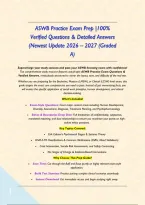
Supercharge your study sessions and pass your ASWB licensing exam with confidence!
This comprehensive study resource features actual-style ASWB Practice Exam Questions &
Verified Answers, meticulously structured to mirror the layout, tone, and difficulty of the real test.
Whether you are preparing for the Bachelors, Masters (LMSW), or Clinical (LCSW) level exam, this
guide targets the exact core competencies you need to pass. Instead of just memorizing facts, you
will master the specific application of social work principles, human development, and ethical
decision-making.
What’s Included:
• Exam-Style Questions: Cover major content areas including Human Development,
Diversity, Assessment, Diagnosis, Treatment Planning, and Psychopharmacology.
• Ethics & Boundaries Deep Dive: Full breakdown of confidentiality, subpoenas,
mandated reporting, and dual relationships to ensure you maximize your points on high-
stakes ethics questions.
Key Topics Covered:
• Erik Erikson’s Psychosocial Stages & Systems Theory
• DSM-5-TR Classifications & Common Medications (SSRIs, Mood Stabilizers)
• Crisis Intervention, Suicide Risk Assessments, and Safety Contracting
• The Stages of Change & Evidence-Based Interventions
Why Choose This Prep Guide?
• Save Time: Cut through the fluff and focus purely on highly relevant exam-style
application.
• Build Test Stamina: Practice parsing complex clinical scenarios seamlessly.
• Instant Download: Get immediate access and begin studying right away.
1
, Social workers should refer clients to other professionals in all of the following instances
EXCEPT when:
A. Professionals' specialized knowledge or expertise is needed to meet the clients' needs.
B. Social workers believe they are not being effective in addressing clients' concerns.
C. Professionals believe that other modalities of treatment may be more effective to resolve
clients' issues.
D. Social workers are not making reasonable progress in addressing clients' problems. -
Answer✅ C
A social worker is working with a second grade child who is having trouble staying in her
seat in the classroom. The social worker, in conjunction with the teacher, indicates that the
immediate objective is that the child "will remain seated after being reminded to do so by
the teacher while in the classroom." The social worker's supervisor, after reviewing the
objective, would judge it to be:
A. Adequate as it addresses the target problem
B. Inadequate as it puts too much responsibility on the teacher
C. Adequate since the teacher was involved in the process
D. Inadequate as it lacks some elements of a measurable objective - Answer✅ D
A social worker may limit a client's self-determination when the clients' actions:
A. Pose a serious and imminent risk to self or others according to the social worker's
judgment.
B. Cause significant family dysfunction which threatens to impact on the psychological well-
being of its members.
C. Result in legal action such as arrests, fines, and/or civil penalties.
D. Violate agency procedures and policies as established by the chief executive officer -
Answer✅ A
During assessment, partialization can be used by a social worker to assist a client with all of
the following EXCEPT:
A. Recognizing the next action to take when intervening in a situation
2
, B. Helping to clarify the specific cause(s) of a problem
C. Identifying issues that need immediate attention
D. Distinguishing areas that require further inquiry - Answer✅ A
According to Erikson, which of the following is seen as the last stage in psychosocial
development?
A. Ego integrity v. Despair
B. Trust v. Mistrust
C. Intimacy v. Isolation
D. Autonomy v. Shame and doubt - Answer✅ A
Psychological abuse is MOST often detected by:
A. Confessions of perpetrators
B. Information supplied by collateral contacts
C. Behavioral characteristics of victims
D. Bruises or marks left by comorbid physical mistreatment - Answer✅ C
A client shows a social worker a list of reasons why she should and should not leave her
abusive husband. She says that she is preparing the list to see if the benefits are greater than
the risks. The client is basing her decision on which of the following theories?
A. Systems
B. Functionalist
C. Harm reduction
D. Social exchange - Answer✅ D
Which of the following is TRUE about human trafficking?
3
, A. Human trafficking involves sexual exploitation.
B. Victims of human trafficking are poor females.
C. Human trafficking occurs in all countries except the United States.
D. Human trafficking is not the same as human smuggling. - Answer✅ D
Role complementarity occurs when:
A. An individual takes on a new role that is appreciated by another.
B. Two individuals act in an expected manner.
C. There is confusion in the role definition of an individual.
D. An individual successfully exits an existing role. - Answer✅ B
A social worker needs to contact a client who has not shown up for services in many
weeks. He calls the number provided, only to get a household Answer✅ing machine. The
social worker leaves a simple message including his name, his agency name, and his contact
information. The social worker's actions were:
A. Unethical because members of the household are now aware of the client's affiliation
with the agency.
B. Ethical since the client provided the phone number upon intake.
C. Ethical as no details about the nature of the call were included in the message.
D. Unethical because the reason for the call should have been fully disclosed. - Answer✅ A
Which is NOT a primary purpose of social work licensure?
A. Create parity with other helping professions to ensure that social workers receive
comparable compensation.
B. Identify standards for the safe professional practice of social work.
4
This comprehensive study resource features actual-style ASWB Practice Exam Questions &
Verified Answers, meticulously structured to mirror the layout, tone, and difficulty of the real test.
Whether you are preparing for the Bachelors, Masters (LMSW), or Clinical (LCSW) level exam, this
guide targets the exact core competencies you need to pass. Instead of just memorizing facts, you
will master the specific application of social work principles, human development, and ethical
decision-making.
What’s Included:
• Exam-Style Questions: Cover major content areas including Human Development,
Diversity, Assessment, Diagnosis, Treatment Planning, and Psychopharmacology.
• Ethics & Boundaries Deep Dive: Full breakdown of confidentiality, subpoenas,
mandated reporting, and dual relationships to ensure you maximize your points on high-
stakes ethics questions.
Key Topics Covered:
• Erik Erikson’s Psychosocial Stages & Systems Theory
• DSM-5-TR Classifications & Common Medications (SSRIs, Mood Stabilizers)
• Crisis Intervention, Suicide Risk Assessments, and Safety Contracting
• The Stages of Change & Evidence-Based Interventions
Why Choose This Prep Guide?
• Save Time: Cut through the fluff and focus purely on highly relevant exam-style
application.
• Build Test Stamina: Practice parsing complex clinical scenarios seamlessly.
• Instant Download: Get immediate access and begin studying right away.
1
, Social workers should refer clients to other professionals in all of the following instances
EXCEPT when:
A. Professionals' specialized knowledge or expertise is needed to meet the clients' needs.
B. Social workers believe they are not being effective in addressing clients' concerns.
C. Professionals believe that other modalities of treatment may be more effective to resolve
clients' issues.
D. Social workers are not making reasonable progress in addressing clients' problems. -
Answer✅ C
A social worker is working with a second grade child who is having trouble staying in her
seat in the classroom. The social worker, in conjunction with the teacher, indicates that the
immediate objective is that the child "will remain seated after being reminded to do so by
the teacher while in the classroom." The social worker's supervisor, after reviewing the
objective, would judge it to be:
A. Adequate as it addresses the target problem
B. Inadequate as it puts too much responsibility on the teacher
C. Adequate since the teacher was involved in the process
D. Inadequate as it lacks some elements of a measurable objective - Answer✅ D
A social worker may limit a client's self-determination when the clients' actions:
A. Pose a serious and imminent risk to self or others according to the social worker's
judgment.
B. Cause significant family dysfunction which threatens to impact on the psychological well-
being of its members.
C. Result in legal action such as arrests, fines, and/or civil penalties.
D. Violate agency procedures and policies as established by the chief executive officer -
Answer✅ A
During assessment, partialization can be used by a social worker to assist a client with all of
the following EXCEPT:
A. Recognizing the next action to take when intervening in a situation
2
, B. Helping to clarify the specific cause(s) of a problem
C. Identifying issues that need immediate attention
D. Distinguishing areas that require further inquiry - Answer✅ A
According to Erikson, which of the following is seen as the last stage in psychosocial
development?
A. Ego integrity v. Despair
B. Trust v. Mistrust
C. Intimacy v. Isolation
D. Autonomy v. Shame and doubt - Answer✅ A
Psychological abuse is MOST often detected by:
A. Confessions of perpetrators
B. Information supplied by collateral contacts
C. Behavioral characteristics of victims
D. Bruises or marks left by comorbid physical mistreatment - Answer✅ C
A client shows a social worker a list of reasons why she should and should not leave her
abusive husband. She says that she is preparing the list to see if the benefits are greater than
the risks. The client is basing her decision on which of the following theories?
A. Systems
B. Functionalist
C. Harm reduction
D. Social exchange - Answer✅ D
Which of the following is TRUE about human trafficking?
3
, A. Human trafficking involves sexual exploitation.
B. Victims of human trafficking are poor females.
C. Human trafficking occurs in all countries except the United States.
D. Human trafficking is not the same as human smuggling. - Answer✅ D
Role complementarity occurs when:
A. An individual takes on a new role that is appreciated by another.
B. Two individuals act in an expected manner.
C. There is confusion in the role definition of an individual.
D. An individual successfully exits an existing role. - Answer✅ B
A social worker needs to contact a client who has not shown up for services in many
weeks. He calls the number provided, only to get a household Answer✅ing machine. The
social worker leaves a simple message including his name, his agency name, and his contact
information. The social worker's actions were:
A. Unethical because members of the household are now aware of the client's affiliation
with the agency.
B. Ethical since the client provided the phone number upon intake.
C. Ethical as no details about the nature of the call were included in the message.
D. Unethical because the reason for the call should have been fully disclosed. - Answer✅ A
Which is NOT a primary purpose of social work licensure?
A. Create parity with other helping professions to ensure that social workers receive
comparable compensation.
B. Identify standards for the safe professional practice of social work.
4


