
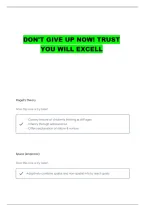
Piaget's Theory
Give this one a try later!
- Convey texture of children's thinking at diff ages
- Infancy through adolescence
- Offers explanation of nature & nurture
Space (empiricist)
Give this one a try later!
Adaptively combine spatial and non-spatial info to reach goals
,poverty of reinforcement
Give this one a try later!
children are simply not reinforced or trained to use language
- would be too hard to do
Children organize into 3 informal theories
Give this one a try later!
1. Theory of physics
2. Theory of psychology
3. Theory of biology
mathematics disabilities
Give this one a try later!
general difficulty in thinking about numbers
IDS characteristics
Give this one a try later!
- Emotional tone
- Pitch pattern
, - Exaggeration (slower, higher, facial expressions)
- Common, not universal
Measuring Intelligence Critics
Give this one a try later!
Ceci and Stenberg
- Intelligence = too complex to measure
- Culturally biased
- Reduction to a IQ score is simplistic & not ethical
Dyslexia
Give this one a try later!
relation between poor phonological recoding skills and reading disability
Measuring Intelligence Advocates
Give this one a try later!
(Gottfredson, Horn, McArdle)
- Better than alternate methods like grades/job success/stand tests
- Valuable for making decision on education level
- Teacher & counselor bias may be greater
Syntactic development
, Give this one a try later!
the learning of the syntax of a language- learning how words and
morphemes are combined
modularity hypothesis
Give this one a try later!
the idea that the human brain contains an innate, self-contained language
module that is separate from other aspects of cognitive functioning
Problem solving
Give this one a try later!
the process of attaining a goal by using a strategy to overcome an obstacle
- Children are active problem solvers
Sensorimotor Stage
Give this one a try later!
in Piaget's theory, the stage (from birth to about 2 years of age) during
which infants know the world mostly in terms of their sensory impressions
and motor activities
Give this one a try later!
- Convey texture of children's thinking at diff ages
- Infancy through adolescence
- Offers explanation of nature & nurture
Space (empiricist)
Give this one a try later!
Adaptively combine spatial and non-spatial info to reach goals
,poverty of reinforcement
Give this one a try later!
children are simply not reinforced or trained to use language
- would be too hard to do
Children organize into 3 informal theories
Give this one a try later!
1. Theory of physics
2. Theory of psychology
3. Theory of biology
mathematics disabilities
Give this one a try later!
general difficulty in thinking about numbers
IDS characteristics
Give this one a try later!
- Emotional tone
- Pitch pattern
, - Exaggeration (slower, higher, facial expressions)
- Common, not universal
Measuring Intelligence Critics
Give this one a try later!
Ceci and Stenberg
- Intelligence = too complex to measure
- Culturally biased
- Reduction to a IQ score is simplistic & not ethical
Dyslexia
Give this one a try later!
relation between poor phonological recoding skills and reading disability
Measuring Intelligence Advocates
Give this one a try later!
(Gottfredson, Horn, McArdle)
- Better than alternate methods like grades/job success/stand tests
- Valuable for making decision on education level
- Teacher & counselor bias may be greater
Syntactic development
, Give this one a try later!
the learning of the syntax of a language- learning how words and
morphemes are combined
modularity hypothesis
Give this one a try later!
the idea that the human brain contains an innate, self-contained language
module that is separate from other aspects of cognitive functioning
Problem solving
Give this one a try later!
the process of attaining a goal by using a strategy to overcome an obstacle
- Children are active problem solvers
Sensorimotor Stage
Give this one a try later!
in Piaget's theory, the stage (from birth to about 2 years of age) during
which infants know the world mostly in terms of their sensory impressions
and motor activities


