
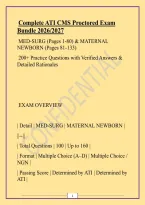
Complete ATI CMS Proctored Exam
Bundle 2026/2027
MED-SURG (Pages 1-80) & MATERNAL
NEWBORN (Pages 81-133)
200+ Practice Questions with Verified Answers &
Detailed Rationales
EXAM OVERVIEW
| Detail | MED-SURG | MATERNAL NEWBORN |
||--||
| Total Questions | 100 | Up to 160 |
| Format | Multiple Choice (A–D) | Multiple Choice /
NGN |
| Passing Score | Determined by ATI | Determined by
ATI |
1
,| Key Domains | Cardiac, Respiratory, Renal,
Endocrine, GI, Neuro, Heme/Onc | Antepartum,
Intrapartum, Postpartum, Newborn |
PART I: MED-SURG CMS PROCTORED EXAM
(QUESTIONS 1-100)
SECTION 1: CARDIOVASCULAR &
VASCULAR DISORDERS
1. A 73-year-old female with hypertension and
hyperlipidemia awakens with substernal chest
pressure rated 7/10 radiating to her jaw with
diaphoresis. ECG shows ST depression in leads V3-
V6. Troponin T is 0.08 ng/mL rising to 0.24 ng/mL 3
2
,hours later. These findings are most consistent with
which diagnosis?
A) Non-ST elevation myocardial infarction
(NSTEMI)
B) Stable angina pectoris
C) Acute pericarditis
D) Aortic dissection
Answer: A
Rationale: ST depression with a rise and fall of
troponin indicates an NSTEMI. Stable angina would
not cause troponin elevation; pericarditis typically
causes diffuse ST elevation; aortic dissection causes
tearing pain with BP differential .
3
, 2. A 64-year-old male is admitted with new-onset
atrial fibrillation with rapid ventricular response
(156/min). He is hemodynamically stable with BP
128/78 but reports lightheadedness and palpitations.
What initial pharmacologic intervention should the
nurse anticipate?
A) IV diltiazem for rate control
B) Immediate synchronized cardioversion
C) IV amiodarone for rhythm control
D) Subcutaneous enoxaparin alone
Answer: A
Rationale: In a hemodynamically stable patient with
RVR, initial priority is rate control with a calcium
channel blocker or beta-blocker. Cardioversion is for
hemodynamic instability; anticoagulation alone does
not address rate .
4
Bundle 2026/2027
MED-SURG (Pages 1-80) & MATERNAL
NEWBORN (Pages 81-133)
200+ Practice Questions with Verified Answers &
Detailed Rationales
EXAM OVERVIEW
| Detail | MED-SURG | MATERNAL NEWBORN |
||--||
| Total Questions | 100 | Up to 160 |
| Format | Multiple Choice (A–D) | Multiple Choice /
NGN |
| Passing Score | Determined by ATI | Determined by
ATI |
1
,| Key Domains | Cardiac, Respiratory, Renal,
Endocrine, GI, Neuro, Heme/Onc | Antepartum,
Intrapartum, Postpartum, Newborn |
PART I: MED-SURG CMS PROCTORED EXAM
(QUESTIONS 1-100)
SECTION 1: CARDIOVASCULAR &
VASCULAR DISORDERS
1. A 73-year-old female with hypertension and
hyperlipidemia awakens with substernal chest
pressure rated 7/10 radiating to her jaw with
diaphoresis. ECG shows ST depression in leads V3-
V6. Troponin T is 0.08 ng/mL rising to 0.24 ng/mL 3
2
,hours later. These findings are most consistent with
which diagnosis?
A) Non-ST elevation myocardial infarction
(NSTEMI)
B) Stable angina pectoris
C) Acute pericarditis
D) Aortic dissection
Answer: A
Rationale: ST depression with a rise and fall of
troponin indicates an NSTEMI. Stable angina would
not cause troponin elevation; pericarditis typically
causes diffuse ST elevation; aortic dissection causes
tearing pain with BP differential .
3
, 2. A 64-year-old male is admitted with new-onset
atrial fibrillation with rapid ventricular response
(156/min). He is hemodynamically stable with BP
128/78 but reports lightheadedness and palpitations.
What initial pharmacologic intervention should the
nurse anticipate?
A) IV diltiazem for rate control
B) Immediate synchronized cardioversion
C) IV amiodarone for rhythm control
D) Subcutaneous enoxaparin alone
Answer: A
Rationale: In a hemodynamically stable patient with
RVR, initial priority is rate control with a calcium
channel blocker or beta-blocker. Cardioversion is for
hemodynamic instability; anticoagulation alone does
not address rate .
4


