
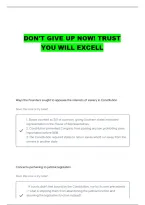
Ways the Founders sought to appease the interests of slavery in Constitution
Give this one a try later!
1. Slaves counted as 3/5 of a person, giving Southern states increased
representation in the House of Representatives.
2. Constitution prevented Congress from passing any law prohibiting slave
importation before 1808.
3. The Constitution required states to return slaves who'd run away from the
owners in another state
Concerns pertaining to judicial legislation
Give this one a try later!
- If courts didn't feel bound by the Constitution, nor by its own precedents
-> what is stopping them from abandoning the judicial function and
assuming the legislative function instead?
, - Federal judges are not accountable to the people and this may have
made them think they could establish policy that legislatures couldn't
Doctrine of implied powers
Give this one a try later!
Powers not stated in the Constitution but that are necessary for Congress
to carry out other, expressly granted powers.
The Supreme Court is only bound by precedent, meaning that once a word
or phrase is explained and applied in a case, that explanation/application
becomes the precedent for all future consideration of similar cases.
However, nothing forces SCOTUS to honor its precedents. The power to
interpret the Constitution is also the power to reinterpret it. SCOTUS also
has the power to expound the Constitution.
Interpret, reinterpret, expound
14th Amendment
Give this one a try later!
Eliminated 3/5 compromise, applied Bill of Rights and all other rights to
freed slaves. Also guaranteed equal protection under the law.
Federalism's role in contributing to the Civil War
Give this one a try later!
Federalism kept the shared sovereignty between national and state
government ambiguous. The Founders felt that ratification of the
Give this one a try later!
1. Slaves counted as 3/5 of a person, giving Southern states increased
representation in the House of Representatives.
2. Constitution prevented Congress from passing any law prohibiting slave
importation before 1808.
3. The Constitution required states to return slaves who'd run away from the
owners in another state
Concerns pertaining to judicial legislation
Give this one a try later!
- If courts didn't feel bound by the Constitution, nor by its own precedents
-> what is stopping them from abandoning the judicial function and
assuming the legislative function instead?
, - Federal judges are not accountable to the people and this may have
made them think they could establish policy that legislatures couldn't
Doctrine of implied powers
Give this one a try later!
Powers not stated in the Constitution but that are necessary for Congress
to carry out other, expressly granted powers.
The Supreme Court is only bound by precedent, meaning that once a word
or phrase is explained and applied in a case, that explanation/application
becomes the precedent for all future consideration of similar cases.
However, nothing forces SCOTUS to honor its precedents. The power to
interpret the Constitution is also the power to reinterpret it. SCOTUS also
has the power to expound the Constitution.
Interpret, reinterpret, expound
14th Amendment
Give this one a try later!
Eliminated 3/5 compromise, applied Bill of Rights and all other rights to
freed slaves. Also guaranteed equal protection under the law.
Federalism's role in contributing to the Civil War
Give this one a try later!
Federalism kept the shared sovereignty between national and state
government ambiguous. The Founders felt that ratification of the


