
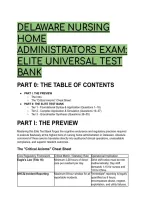
DELAWARE NURSING
HOME
ADMINISTRATORS EXAM:
ELITE UNIVERSAL TEST
BANK
PART 0: THE TABLE OF CONTENTS
● PART I: THE PREVIEW
○ The Intro
○ The "Critical Axioms" Cheat Sheet
● PART II: THE ELITE TEST BANK
○ Tier 1 - Foundational Syntax & Application (Questions 1–18)
○ Tier 2 - Complex Application & Simulation (Questions 19–37)
○ Tier 3 - Grandmaster Synthesis (Questions 38–55)
PART I: THE PREVIEW
Mastering this Elite Test Bank forges the cognitive endurance and regulatory precision required
to execute flawlessly at the highest tiers of nursing home administration in Delaware. Absolute
command of these axioms translates directly into audit-proof clinical operations, unassailable
compliance, and superior resident outcomes.
The "Critical Axioms" Cheat Sheet
Core Regulatory Framework Critical Metric / Statutory Rule Operational Implication
Eagle's Law (Title 16) Minimum 3.28 hours of direct Strict shift ratios must be met
care per resident per day. mathematically; Day shift
demands 1:15 for nurses and
1:8 for CNAs.
DHCQ Incident Reporting Maximum 8-hour window for all "Immediate" reporting is legally
reportable incidents. quantified as 8 hours;
encompasses abuse, neglect,
exploitation, and utility failures.
,Core Regulatory Framework Critical Metric / Statutory Rule Operational Implication
CMS F758 (Psychotropics) PRN psychotropic orders Routine extensions are
strictly expire at 14 days. forbidden; an in-person
physician evaluation is
mandatory to extend therapy.
NHA CEU Mandates 48 hours biennially; 2 hours Failure to meet exact modular
Abuse, 2 hours Infection, 2 hour requirements triggers
hours Ethics. audit failure and license
suspension.
OSHA 300A Transparency Form 300A must be posted Only the summary (300A) is
from February 1 through April posted publicly; the detailed log
30. (300) containing PHI remains
confidential.
Clinical Record Retention 6 years post-discharge. Records must be securely
retained and accessible to
defend against delayed
litigation or CMS audits.
PART II: THE ELITE TEST BANK
Tier 1 - Foundational Syntax & Application
Q1: Under Delaware Title 24 Chapter 52, a candidate seeking licensure as a Nursing Home
Administrator holds a baccalaureate degree in a field other than Health and Human Services or
Business Administration. To obtain Board approval, what is the REQUIRED duration of the
Administrator-In-Training (AIT) program? A) A 6-month program with a 24-week outline B) A
9-month program with a 36-week outline C) A 12-month program with a 52-week outline D) A
2,000-hour program spanning 24 months
● Answer: B (A 9-month program with a 36-week outline)
● Distractor Analysis:
○ A is incorrect: A 6-month program is exclusively reserved for candidates holding a
baccalaureate or graduate degree specifically in Health and Human Services,
Hospital Administration, Nursing, or Business Administration.
○ C is incorrect: A 12-month program is mandated for applicants holding an
associate's degree in any field or a current Delaware RN license without a degree.
○ D is incorrect: This is a legacy requirement from other jurisdictions; Delaware
specifically calibrates AIT duration based on the exact academic degree held by the
applicant.
The Mentor's Analysis: Delaware statutory code directly aligns the length of the AIT program
with the candidate's baseline academic preparation. When evaluating AIT requirements, always
pivot on the applicant's specific degree type. Professional Intuition: Degree specificity dictates
AIT duration; non-specialized baccalaureates require a 9-month (36-week) training
period.
Q2: An active Delaware Nursing Home Administrator is preparing for their biennial license
renewal. According to Delaware Board of Examiners regulations, which specific continuing
education (CE) combination is MANDATORY within the 48-hour requirement? A) 3 hours of
infection prevention, 2 hours of ethics, and 1 hour of abuse/neglect B) 2 hours of patient
, abuse/neglect, 2 hours of infection prevention, and 2 hours of professional ethics C) 4 hours of
resident rights, 2 hours of environmental safety, and 2 hours of ethics D) 6 hours of infection
control and 2 hours of dementia care services
● Answer: B (2 hours of patient abuse/neglect, 2 hours of infection prevention, and 2 hours
of professional ethics)
● Distractor Analysis:
○ A is incorrect: This misallocates the required hours. Delaware strictly requires a
2/2/2 distribution for these specific core competencies.
○ C is incorrect: While resident rights and environmental safety are critical operational
knowledge areas, they are not strictly codified as mandatory minimums in the CE
regulations.
○ D is incorrect: Infection control requires exactly 2 hours, not 6, and dementia care is
not the specific tripartite statutory mandate for NHA biennial renewal.
The Mentor's Analysis: Regulatory bodies mandate specific CE subjects to combat the
highest-risk operational vulnerabilities in long-term care. Delaware isolates abuse, infection, and
ethics as non-negotiable continuing education pillars for Administrators. Professional Intuition:
Memorize the 2/2/2 rule: 2 hours Abuse, 2 hours Infection, 2 hours Ethics for every
biennial NHA renewal.
Q3: Under Delaware 16 Del. C. § 1131, a facility employee engages in a sexual act with a
cognitively intact resident who explicitly provided verbal consent. Based on statutory definitions,
how must the Administrator CLASSIFY this event? A) A consensual relationship requiring a
room change and HR disciplinary action B) Sexual mistreatment, but not abuse due to the
resident's cognitive capacity C) Sexual abuse, because resident consent is never a statutory
defense D) Emotional abuse, as physical harm was not inflicted
● Answer: C (Sexual abuse, because resident consent is never a statutory defense)
● Distractor Analysis:
○ A is incorrect: Classifying this merely as an HR issue fails to recognize the statutory
definition of abuse and violates mandatory reporting laws.
○ B is incorrect: Mistreatment is a lesser finding; the statute explicitly defines any
sexual contact between staff and a resident as sexual abuse.
○ D is incorrect: The act involves sexual contact, which places it strictly under the
sexual abuse definition, regardless of the lack of forceful physical harm.
The Mentor's Analysis: Power dynamics in long-term care render true consent between staff
and residents impossible under the law. 16 Del. C. § 1131 strips away all subjective
interpretations of consent, categorizing any sexual penetration or contact as abuse.
Professional Intuition: Staff-to-resident sexual contact is universally and unequivocally
defined as Sexual Abuse; consent is never a valid defense.
Q4: A resident's attending physician writes a PRN (as needed) order for an antipsychotic
medication to manage acute agitation. According to CMS State Operations Manual Appendix
PP (F758), what is the MAXIMUM duration this order can remain active before requiring a direct
clinical evaluation for renewal? A) 7 days B) 14 days C) 21 days D) 30 days
● Answer: B (14 days)
● Distractor Analysis:
○ A is incorrect: 7 days is a common misconception derived from acute care antibiotic
stop orders, not CMS long-term care psychotropic regulations.
○ C is incorrect: 21 days has no basis in current CMS regulations for PRN
psychotropics.
○ D is incorrect: 30 days was a legacy operational standard for routine medication
HOME
ADMINISTRATORS EXAM:
ELITE UNIVERSAL TEST
BANK
PART 0: THE TABLE OF CONTENTS
● PART I: THE PREVIEW
○ The Intro
○ The "Critical Axioms" Cheat Sheet
● PART II: THE ELITE TEST BANK
○ Tier 1 - Foundational Syntax & Application (Questions 1–18)
○ Tier 2 - Complex Application & Simulation (Questions 19–37)
○ Tier 3 - Grandmaster Synthesis (Questions 38–55)
PART I: THE PREVIEW
Mastering this Elite Test Bank forges the cognitive endurance and regulatory precision required
to execute flawlessly at the highest tiers of nursing home administration in Delaware. Absolute
command of these axioms translates directly into audit-proof clinical operations, unassailable
compliance, and superior resident outcomes.
The "Critical Axioms" Cheat Sheet
Core Regulatory Framework Critical Metric / Statutory Rule Operational Implication
Eagle's Law (Title 16) Minimum 3.28 hours of direct Strict shift ratios must be met
care per resident per day. mathematically; Day shift
demands 1:15 for nurses and
1:8 for CNAs.
DHCQ Incident Reporting Maximum 8-hour window for all "Immediate" reporting is legally
reportable incidents. quantified as 8 hours;
encompasses abuse, neglect,
exploitation, and utility failures.
,Core Regulatory Framework Critical Metric / Statutory Rule Operational Implication
CMS F758 (Psychotropics) PRN psychotropic orders Routine extensions are
strictly expire at 14 days. forbidden; an in-person
physician evaluation is
mandatory to extend therapy.
NHA CEU Mandates 48 hours biennially; 2 hours Failure to meet exact modular
Abuse, 2 hours Infection, 2 hour requirements triggers
hours Ethics. audit failure and license
suspension.
OSHA 300A Transparency Form 300A must be posted Only the summary (300A) is
from February 1 through April posted publicly; the detailed log
30. (300) containing PHI remains
confidential.
Clinical Record Retention 6 years post-discharge. Records must be securely
retained and accessible to
defend against delayed
litigation or CMS audits.
PART II: THE ELITE TEST BANK
Tier 1 - Foundational Syntax & Application
Q1: Under Delaware Title 24 Chapter 52, a candidate seeking licensure as a Nursing Home
Administrator holds a baccalaureate degree in a field other than Health and Human Services or
Business Administration. To obtain Board approval, what is the REQUIRED duration of the
Administrator-In-Training (AIT) program? A) A 6-month program with a 24-week outline B) A
9-month program with a 36-week outline C) A 12-month program with a 52-week outline D) A
2,000-hour program spanning 24 months
● Answer: B (A 9-month program with a 36-week outline)
● Distractor Analysis:
○ A is incorrect: A 6-month program is exclusively reserved for candidates holding a
baccalaureate or graduate degree specifically in Health and Human Services,
Hospital Administration, Nursing, or Business Administration.
○ C is incorrect: A 12-month program is mandated for applicants holding an
associate's degree in any field or a current Delaware RN license without a degree.
○ D is incorrect: This is a legacy requirement from other jurisdictions; Delaware
specifically calibrates AIT duration based on the exact academic degree held by the
applicant.
The Mentor's Analysis: Delaware statutory code directly aligns the length of the AIT program
with the candidate's baseline academic preparation. When evaluating AIT requirements, always
pivot on the applicant's specific degree type. Professional Intuition: Degree specificity dictates
AIT duration; non-specialized baccalaureates require a 9-month (36-week) training
period.
Q2: An active Delaware Nursing Home Administrator is preparing for their biennial license
renewal. According to Delaware Board of Examiners regulations, which specific continuing
education (CE) combination is MANDATORY within the 48-hour requirement? A) 3 hours of
infection prevention, 2 hours of ethics, and 1 hour of abuse/neglect B) 2 hours of patient
, abuse/neglect, 2 hours of infection prevention, and 2 hours of professional ethics C) 4 hours of
resident rights, 2 hours of environmental safety, and 2 hours of ethics D) 6 hours of infection
control and 2 hours of dementia care services
● Answer: B (2 hours of patient abuse/neglect, 2 hours of infection prevention, and 2 hours
of professional ethics)
● Distractor Analysis:
○ A is incorrect: This misallocates the required hours. Delaware strictly requires a
2/2/2 distribution for these specific core competencies.
○ C is incorrect: While resident rights and environmental safety are critical operational
knowledge areas, they are not strictly codified as mandatory minimums in the CE
regulations.
○ D is incorrect: Infection control requires exactly 2 hours, not 6, and dementia care is
not the specific tripartite statutory mandate for NHA biennial renewal.
The Mentor's Analysis: Regulatory bodies mandate specific CE subjects to combat the
highest-risk operational vulnerabilities in long-term care. Delaware isolates abuse, infection, and
ethics as non-negotiable continuing education pillars for Administrators. Professional Intuition:
Memorize the 2/2/2 rule: 2 hours Abuse, 2 hours Infection, 2 hours Ethics for every
biennial NHA renewal.
Q3: Under Delaware 16 Del. C. § 1131, a facility employee engages in a sexual act with a
cognitively intact resident who explicitly provided verbal consent. Based on statutory definitions,
how must the Administrator CLASSIFY this event? A) A consensual relationship requiring a
room change and HR disciplinary action B) Sexual mistreatment, but not abuse due to the
resident's cognitive capacity C) Sexual abuse, because resident consent is never a statutory
defense D) Emotional abuse, as physical harm was not inflicted
● Answer: C (Sexual abuse, because resident consent is never a statutory defense)
● Distractor Analysis:
○ A is incorrect: Classifying this merely as an HR issue fails to recognize the statutory
definition of abuse and violates mandatory reporting laws.
○ B is incorrect: Mistreatment is a lesser finding; the statute explicitly defines any
sexual contact between staff and a resident as sexual abuse.
○ D is incorrect: The act involves sexual contact, which places it strictly under the
sexual abuse definition, regardless of the lack of forceful physical harm.
The Mentor's Analysis: Power dynamics in long-term care render true consent between staff
and residents impossible under the law. 16 Del. C. § 1131 strips away all subjective
interpretations of consent, categorizing any sexual penetration or contact as abuse.
Professional Intuition: Staff-to-resident sexual contact is universally and unequivocally
defined as Sexual Abuse; consent is never a valid defense.
Q4: A resident's attending physician writes a PRN (as needed) order for an antipsychotic
medication to manage acute agitation. According to CMS State Operations Manual Appendix
PP (F758), what is the MAXIMUM duration this order can remain active before requiring a direct
clinical evaluation for renewal? A) 7 days B) 14 days C) 21 days D) 30 days
● Answer: B (14 days)
● Distractor Analysis:
○ A is incorrect: 7 days is a common misconception derived from acute care antibiotic
stop orders, not CMS long-term care psychotropic regulations.
○ C is incorrect: 21 days has no basis in current CMS regulations for PRN
psychotropics.
○ D is incorrect: 30 days was a legacy operational standard for routine medication


