
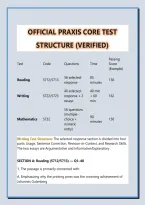
OFFICIAL PRAXIS CORE TEST
STRUCTURE (VERIFIED)
Passing
Test Code Questions Time Score
(Example)
56 selected- 85
Reading 5712/5713 156
response minutes
40 selected- 40 min
Writing 5722/5723 response + 2 + 60 162
essays min
56 questions
(multiple-
90
Mathematics 5732 choice + 150
minutes
numeric
entry)
The selected-response section is divided into four
parts: Usage, Sentence Correction, Revision-in-Context, and Research Skills.
The two essays are Argumentative and Informative/Explanatory .
SECTION A: Reading (5712/5713) — Q1–40
The passage is primarily concerned with:
A. Emphasizing why the printing press was the crowning achievement of
Johannes Gutenberg
,B. Providing background for the intellectual renaissance in European society
C. Placing the invention of the printing press within its proper context in
human history
D. Explaining the mechanisms by which the first printing press operated
The passage describes the printing press as "one of the most
revolutionary inventions known in human history" and then discusses its
impact on European society. The primary concern is placing the invention
within its historical context, not merely praising Gutenberg or explaining
mechanics .
According to the passage, the invention of the printing press produced
improvements in all of the following EXCEPT:
A. The ability of lower-class workers to read
B. Political oppression in Europe
C. The widespread availability of information
D. The consistency of scientific advances
The passage states that the printing press had an impact on
"political, economic, and social structure" but does not suggest it improved
political oppression. In fact, increased literacy and information diffusion
would likely challenge oppression .
The author's main purpose in the passage about meteorology is to:
A. Describe the history and early origins of meteorology
B. Demonstrate how scientists do not always agree
C. Summarize the origins of the Fahrenheit and Celsius temperature scales
D. Explain technical difficulties in producing an accurate thermometer
The passage traces the development of temperature scales from
Fahrenheit's thermometer to Celsius's competing scale and the eventual
reversal of Celsius's scale. The focus is on the origins of these two scales .
, Which of the following examples most strengthens the main point of the
passage about contiguity?
A. Some people are able to experience more than two items contiguously
B. Unexpected pain instinctively provokes fear in most people
C. Aristotle's writing is full of unexplained associations
D. Many Afghan refugees who endured bombings are still frightened by
loud noises
The passage explains contiguity as when two items experienced
together become linked in the mind. The example of Afghan refugees
frightened by loud noises (which were contiguous with bombings) directly
demonstrates this principle .
A student reads slowly, word-by-word, with poor comprehension. The
student most likely needs instruction in:
A. Phonological awareness
B. Phonics and decoding
C. Reading fluency
D. Vocabulary development
Reading fluency involves accuracy, rate, and expression. Slow,
labored reading often impedes comprehension because cognitive resources
are spent on decoding rather than understanding.
Which question best assesses a student's ability to determine the main
idea of an informational text?
A. What is the author's purpose?
B. What is the text mostly about?
C. What is the sequence of events?
D. What is the author's opinion?
STRUCTURE (VERIFIED)
Passing
Test Code Questions Time Score
(Example)
56 selected- 85
Reading 5712/5713 156
response minutes
40 selected- 40 min
Writing 5722/5723 response + 2 + 60 162
essays min
56 questions
(multiple-
90
Mathematics 5732 choice + 150
minutes
numeric
entry)
The selected-response section is divided into four
parts: Usage, Sentence Correction, Revision-in-Context, and Research Skills.
The two essays are Argumentative and Informative/Explanatory .
SECTION A: Reading (5712/5713) — Q1–40
The passage is primarily concerned with:
A. Emphasizing why the printing press was the crowning achievement of
Johannes Gutenberg
,B. Providing background for the intellectual renaissance in European society
C. Placing the invention of the printing press within its proper context in
human history
D. Explaining the mechanisms by which the first printing press operated
The passage describes the printing press as "one of the most
revolutionary inventions known in human history" and then discusses its
impact on European society. The primary concern is placing the invention
within its historical context, not merely praising Gutenberg or explaining
mechanics .
According to the passage, the invention of the printing press produced
improvements in all of the following EXCEPT:
A. The ability of lower-class workers to read
B. Political oppression in Europe
C. The widespread availability of information
D. The consistency of scientific advances
The passage states that the printing press had an impact on
"political, economic, and social structure" but does not suggest it improved
political oppression. In fact, increased literacy and information diffusion
would likely challenge oppression .
The author's main purpose in the passage about meteorology is to:
A. Describe the history and early origins of meteorology
B. Demonstrate how scientists do not always agree
C. Summarize the origins of the Fahrenheit and Celsius temperature scales
D. Explain technical difficulties in producing an accurate thermometer
The passage traces the development of temperature scales from
Fahrenheit's thermometer to Celsius's competing scale and the eventual
reversal of Celsius's scale. The focus is on the origins of these two scales .
, Which of the following examples most strengthens the main point of the
passage about contiguity?
A. Some people are able to experience more than two items contiguously
B. Unexpected pain instinctively provokes fear in most people
C. Aristotle's writing is full of unexplained associations
D. Many Afghan refugees who endured bombings are still frightened by
loud noises
The passage explains contiguity as when two items experienced
together become linked in the mind. The example of Afghan refugees
frightened by loud noises (which were contiguous with bombings) directly
demonstrates this principle .
A student reads slowly, word-by-word, with poor comprehension. The
student most likely needs instruction in:
A. Phonological awareness
B. Phonics and decoding
C. Reading fluency
D. Vocabulary development
Reading fluency involves accuracy, rate, and expression. Slow,
labored reading often impedes comprehension because cognitive resources
are spent on decoding rather than understanding.
Which question best assesses a student's ability to determine the main
idea of an informational text?
A. What is the author's purpose?
B. What is the text mostly about?
C. What is the sequence of events?
D. What is the author's opinion?


