
PORTAGE LEARNING CHEM 104
GENERAL CHEMISTRY II PRACTICE
QUESTIONS
SECTION 1: CHEMICAL KINETICS (Module 1)
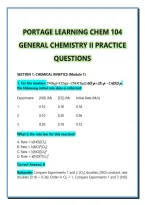
1. For the reaction 2NO(g)+Cl2(g)→2NOCl(g)2NO(g)+Cl2(g)→2NOCl(g),
the following initial rate data is collected:
Experiment [NO] (M) [Cl2] (M) Initial Rate (M/s)
1 0.10 0.10 0.18
2 0.10 0.20 0.36
3 0.20 0.10 0.72
What is the rate law for this reaction?
A. Rate = k[NO][Cl₂]
B. Rate = k[NO]²[Cl₂]
C. Rate = k[NO][Cl₂]²
D. Rate = k[NO]²[Cl₂]²
Correct Answer: B
Rationale: Compare Experiments 1 and 2: [Cl₂] doubles, [NO] constant, rate
doubles (0.18 → 0.36). Order in Cl₂ = 1. Compare Experiments 1 and 3: [NO]
,doubles, [Cl₂] constant, rate quadruples (0.18 → 0.72). Order in NO = 2. Rate
law: Rate = k[NO]²[Cl₂] .
2. The rate law for a reaction is found to be Rate = k[A]²[B]. If the
concentration of A is tripled while B remains constant, by what factor
does the rate increase?
A. 3
B. 6
C. 9
D. 27
Correct Answer: C
Rationale: Since rate depends on [A]², tripling [A] means (3)² = 9-fold
increase in rate. The order in B is irrelevant since [B] is constant .
3. A reaction is zero order with respect to reactant X. Which statement
is TRUE?
A. The rate increases as [X] increases
B. The rate decreases as [X] decreases
C. The rate is independent of [X]
D. The rate is proportional to [X]²
Correct Answer: C
Rationale: Zero order means rate = k[X]⁰ = k. Rate is constant regardless of
[X]. Common misconception: students often think "zero order" means no
reaction occurs .
, 4. For a first-order reaction, the half-life is 25 minutes. What
percentage of the original reactant remains after 75 minutes?
A. 12.5%
B. 25%
C. 33.3%
D. 50%
Correct Answer: A
Rationale: 75 minutes = 3 half-lives (75/25 = 3). After n half-lives, fraction
remaining = (1/2)ⁿ. (1/2)³ = 1/8 = 0.125 = 12.5% .
5. The following rate data was obtained for the hypothetical reaction:
A+B→X+Y
Experiment # [A] [B] rate
1 0.50 0.50 2.0
2 1.00 0.50 8.0
3 1.00 1.00 64.0
Determine the reaction order with respect to [A].
A. 0
B. 1
C. 2
D. 3
Correct Answer: C
GENERAL CHEMISTRY II PRACTICE
QUESTIONS
SECTION 1: CHEMICAL KINETICS (Module 1)
1. For the reaction 2NO(g)+Cl2(g)→2NOCl(g)2NO(g)+Cl2(g)→2NOCl(g),
the following initial rate data is collected:
Experiment [NO] (M) [Cl2] (M) Initial Rate (M/s)
1 0.10 0.10 0.18
2 0.10 0.20 0.36
3 0.20 0.10 0.72
What is the rate law for this reaction?
A. Rate = k[NO][Cl₂]
B. Rate = k[NO]²[Cl₂]
C. Rate = k[NO][Cl₂]²
D. Rate = k[NO]²[Cl₂]²
Correct Answer: B
Rationale: Compare Experiments 1 and 2: [Cl₂] doubles, [NO] constant, rate
doubles (0.18 → 0.36). Order in Cl₂ = 1. Compare Experiments 1 and 3: [NO]
,doubles, [Cl₂] constant, rate quadruples (0.18 → 0.72). Order in NO = 2. Rate
law: Rate = k[NO]²[Cl₂] .
2. The rate law for a reaction is found to be Rate = k[A]²[B]. If the
concentration of A is tripled while B remains constant, by what factor
does the rate increase?
A. 3
B. 6
C. 9
D. 27
Correct Answer: C
Rationale: Since rate depends on [A]², tripling [A] means (3)² = 9-fold
increase in rate. The order in B is irrelevant since [B] is constant .
3. A reaction is zero order with respect to reactant X. Which statement
is TRUE?
A. The rate increases as [X] increases
B. The rate decreases as [X] decreases
C. The rate is independent of [X]
D. The rate is proportional to [X]²
Correct Answer: C
Rationale: Zero order means rate = k[X]⁰ = k. Rate is constant regardless of
[X]. Common misconception: students often think "zero order" means no
reaction occurs .
, 4. For a first-order reaction, the half-life is 25 minutes. What
percentage of the original reactant remains after 75 minutes?
A. 12.5%
B. 25%
C. 33.3%
D. 50%
Correct Answer: A
Rationale: 75 minutes = 3 half-lives (75/25 = 3). After n half-lives, fraction
remaining = (1/2)ⁿ. (1/2)³ = 1/8 = 0.125 = 12.5% .
5. The following rate data was obtained for the hypothetical reaction:
A+B→X+Y
Experiment # [A] [B] rate
1 0.50 0.50 2.0
2 1.00 0.50 8.0
3 1.00 1.00 64.0
Determine the reaction order with respect to [A].
A. 0
B. 1
C. 2
D. 3
Correct Answer: C


