
PTA Board Exam Study Guide - Practice Questions & Verified Answers
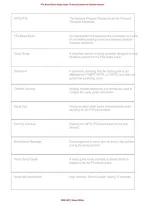
NPTE-PTA The National Physical Therapy Exam for Physical
Therapist Assistants.
PTA Board Exam An examination that assesses the knowledge and skills
of candidates seeking to become licensed physical
therapist assistants.
Study Guide A simplified version of study materials designed to help
students prepare for the PTA board exam.
Disclaimer A statement clarifying that the study guide is not
affiliated with FSBPT, NPTE, or CAPTE and does not
guarantee a passing score.
Credible Sources Multiple reliable references and individuals used to
compile the study guide information.
Study Tips Advice to utilize other books simultaneously while
studying for the PTA board exam.
First Try Success Passing the NPTE-PTA board exam on the first
attempt.
Motivational Message Encouragement to never give up and to stay positive
during the study process.
Public Study Guide A study guide made available to assist others in
preparing for the PTA board exam.
Anaerobic metabolism High Intensity, Short Duration, lasting 15 seconds.
2026-2027 | Stuvia Edition
, PTA Board Exam Study Guide - Practice Questions & Verified Answers
Anaerobic Glycolysis High Intensity, Short Duration, lasting 30-40 seconds.
Aerobic metabolism Low Intensity, Long Duration, exemplified by a
marathon.
Type 1 fibers Slow, Red, Aerobic, Tonic, and resistant to fatigue.
Type 2 fibers Fast, White, Anaerobic, Phasic, and quick to fatigue.
Frontal (Coronal) Plane Divides the body into front and back, with motions
including AB/AD, RD/UD, Inversion/Eversion.
Sagittal Plane Divides the body into left and right, with motions
including Flex/Ext, DF/PF.
Transverse Plane Divides the body into top and bottom, with motions
including IR/ER, Horiz AB/AD.
Osteoarthritis (OA) Wear and tear condition characterized by slow
progression and asymmetrical joint involvement.
Rheumatoid Arthritis (RA) Autoimmune condition characterized by rapid
progression and symmetrical joint involvement.
TMJ Temporomandibular joint, with closed pack position
being mouth closed and teeth clenched.
2026-2027 | Stuvia Edition
, PTA Board Exam Study Guide - Practice Questions & Verified Answers
Capsular pattern of TMJ Limited mouth opening.
MMT Scale Functional assessment of muscle strength.
Open mouth ROM Normal range is 35-50 mm.
Lateral deviation ROM Normal range is 8-12 mm.
Protrusion ROM Normal range is 3-10 mm.
Herberden nodes Nodes found at the distal interphalangeal joints (DIP).
Bouchard nodes Nodes found at the proximal interphalangeal joints
(PIP).
Swan neck deformity PIP hyperextended and DIP flexed.
Boutonniere deformity PIP flexed and DIP hyperextended.
Dupuytren's contracture Thickening of the palm causing contracture of tendons.
2026-2027 | Stuvia Edition
, PTA Board Exam Study Guide - Practice Questions & Verified Answers
Genu valgum Condition where knees angle in and touch each other
when standing straight.
Blood test confirmation Used to confirm the diagnosis of RA.
Functional ROM Range of motion necessary for daily activities.
Weak Functional ROM Limited range that may affect daily activities.
Non Functional ROM Range of motion that does not allow for normal
activities.
Cervical-Lordotic A curvature of the cervical spine that is convex
anteriorly.
Thoracic-Kyphotic A curvature of the thoracic spine that is convex
posteriorly.
Lumbar-Lordotic A curvature of the lumbar spine that is convex
anteriorly.
PPT Posterior Pelvic Tilt: Tight hamstrings and abdominal
muscles.
APT Anterior Pelvic Tilt: Tight hip flexors and erector spinae.
2026-2027 | Stuvia Edition
NPTE-PTA The National Physical Therapy Exam for Physical
Therapist Assistants.
PTA Board Exam An examination that assesses the knowledge and skills
of candidates seeking to become licensed physical
therapist assistants.
Study Guide A simplified version of study materials designed to help
students prepare for the PTA board exam.
Disclaimer A statement clarifying that the study guide is not
affiliated with FSBPT, NPTE, or CAPTE and does not
guarantee a passing score.
Credible Sources Multiple reliable references and individuals used to
compile the study guide information.
Study Tips Advice to utilize other books simultaneously while
studying for the PTA board exam.
First Try Success Passing the NPTE-PTA board exam on the first
attempt.
Motivational Message Encouragement to never give up and to stay positive
during the study process.
Public Study Guide A study guide made available to assist others in
preparing for the PTA board exam.
Anaerobic metabolism High Intensity, Short Duration, lasting 15 seconds.
2026-2027 | Stuvia Edition
, PTA Board Exam Study Guide - Practice Questions & Verified Answers
Anaerobic Glycolysis High Intensity, Short Duration, lasting 30-40 seconds.
Aerobic metabolism Low Intensity, Long Duration, exemplified by a
marathon.
Type 1 fibers Slow, Red, Aerobic, Tonic, and resistant to fatigue.
Type 2 fibers Fast, White, Anaerobic, Phasic, and quick to fatigue.
Frontal (Coronal) Plane Divides the body into front and back, with motions
including AB/AD, RD/UD, Inversion/Eversion.
Sagittal Plane Divides the body into left and right, with motions
including Flex/Ext, DF/PF.
Transverse Plane Divides the body into top and bottom, with motions
including IR/ER, Horiz AB/AD.
Osteoarthritis (OA) Wear and tear condition characterized by slow
progression and asymmetrical joint involvement.
Rheumatoid Arthritis (RA) Autoimmune condition characterized by rapid
progression and symmetrical joint involvement.
TMJ Temporomandibular joint, with closed pack position
being mouth closed and teeth clenched.
2026-2027 | Stuvia Edition
, PTA Board Exam Study Guide - Practice Questions & Verified Answers
Capsular pattern of TMJ Limited mouth opening.
MMT Scale Functional assessment of muscle strength.
Open mouth ROM Normal range is 35-50 mm.
Lateral deviation ROM Normal range is 8-12 mm.
Protrusion ROM Normal range is 3-10 mm.
Herberden nodes Nodes found at the distal interphalangeal joints (DIP).
Bouchard nodes Nodes found at the proximal interphalangeal joints
(PIP).
Swan neck deformity PIP hyperextended and DIP flexed.
Boutonniere deformity PIP flexed and DIP hyperextended.
Dupuytren's contracture Thickening of the palm causing contracture of tendons.
2026-2027 | Stuvia Edition
, PTA Board Exam Study Guide - Practice Questions & Verified Answers
Genu valgum Condition where knees angle in and touch each other
when standing straight.
Blood test confirmation Used to confirm the diagnosis of RA.
Functional ROM Range of motion necessary for daily activities.
Weak Functional ROM Limited range that may affect daily activities.
Non Functional ROM Range of motion that does not allow for normal
activities.
Cervical-Lordotic A curvature of the cervical spine that is convex
anteriorly.
Thoracic-Kyphotic A curvature of the thoracic spine that is convex
posteriorly.
Lumbar-Lordotic A curvature of the lumbar spine that is convex
anteriorly.
PPT Posterior Pelvic Tilt: Tight hamstrings and abdominal
muscles.
APT Anterior Pelvic Tilt: Tight hip flexors and erector spinae.
2026-2027 | Stuvia Edition


