
[STUDY GUIDE] • HIGH-YIELD PRACTICE & REVIEW EDITION
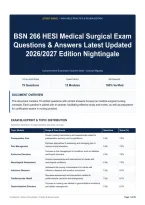
BSN 266 HESI Medical Surgical Exam
Questions & Answers Latest Updated
2026/2027 Edition Nightingale
Comprehensive Examination Question Bank • Concept Mapping
TOTAL QUESTIONS EXAM TOPICS RATIONALES
79 Questions 15 Modules 100% Verified
DOCUMENT OVERVIEW
This document contains 79 verified questions with correct answers focused on medical-surgical nursing
concepts. Each question is paired with an answer, facilitating effective study and review, as well as preparation
for certification exams in nursing practice.
EXAM BLUEPRINT & TOPIC DISTRIBUTION
Systematic breakdown of subject domains and exam coverage.
Topic Module Scope & Core Focus Questions Share (%)
Covers nursing interventions and assessments related to
Postoperative Care postoperative recovery and complications. 6 Qs 7.6%
Explores approaches to assessing and managing pain in
Pain Management various clinical scenarios. 6 Qs 7.6%
Focuses on the management of conditions such as diabetes
Endocrine Disorders and thyroid disorders. 6 Qs 7.6%
Involves assessments and interventions for clients with
Neurological Assessment neurological conditions. 6 Qs 7.6%
Addresses the nursing considerations for clients with
Infectious Diseases infectious diseases and isolation procedures. 5 Qs 6.3%
Discusses assessment and interventions related to
Cardiovascular Health cardiovascular concerns and emergencies. 5 Qs 6.3%
Focuses on nursing care related to gastrointestinal conditions
Gastrointestinal Disorders and dietary management. 5 Qs 6.3%
Confidential • Student Study Edition • Practice & Review Guide Page 1 of 29
,STUDENT STUDY & MASTERY EDITION PRACTICE & REVIEW GUIDE
Covers nursing actions and assessments for patients with
Respiratory Care respiratory issues. 5 Qs 6.3%
Involves nursing considerations for patients with renal
Renal Health disorders and dialysis needs. 5 Qs 6.3%
Explores management and nursing interventions for skin
Dermatological Conditions disorders. 5 Qs 6.3%
Focuses on assessment and interventions for clients with
Musculoskeletal Disorders musculoskeletal conditions. 5 Qs 6.3%
Addresses the nursing management of fluid and electrolyte
Fluid and Electrolyte Balance imbalances. 5 Qs 6.3%
Covers critical nursing interventions in emergency department
Emergency Situations settings. 5 Qs 6.3%
Focuses on nursing strategies for effective patient education
Patient Education and health promotion. 5 Qs 6.3%
Discusses nursing care considerations for patients with
Chronic Conditions chronic illnesses. 5 Qs 6.3%
Total Exam Coverage 15 Integrated Topic Modules 79 Qs 100.0%
Confidential • Student Study Edition • Practice & Review Guide Page 2 of 29
, STUDENT STUDY & MASTERY EDITION PRACTICE & REVIEW GUIDE
TOPIC 1: POSTOPERATIVE CARE
6 Questions • 7.6% of Exam • Covers nursing interventions and assessments related to postoperative recovery and complications.
QUESTION 1
Client is recovering from a transurethral prostatectomy. Which activity should be
limited until after the first postoperative visit with the healthcare provider?
Answer: Drink 3L.
QUESTION 2
An adult client who had a gastric bypass surgery 2 weeks ago, is admitted with
possible anastomosis leakage.
The client's abdomen is tender to touch, and the vital signs are temperature 101 F (38 3
C). heart rate 130 beats/minute, Respiratory rate 26 breaths/minute, and blood pressure
100/50 mmHg.
Which intervention is most important for the nurse to include in the client's plan of
care?
a. Encourage regular turning.
b. Monitor skin for breakdown.
c. Strict IV fluid replacement
d. Assess wound drainage daily
Answer: C. Strict IV fluid replacement.
QUESTION 3
The nurse is caring for a client in the post anesthesia care unit (PACU) who underwent
a thoracotomy two hours ago. The nurse observes the following vital signs; heart rate
140 beats/minute, respirations 26 breaths/minute, and blood pressure 140/90 mmHg.
Which intervention is most important for the nurse to implement?
a. Apply oxygen at 10 L via non-rebreather mask and monitor pulse oximeter.
b. Medicate for pain and monitor vital signs according to protocol.
c. Administer intravenous fluid bolus as prescribed by the healthcare provider.
d. Encourage the client to splint the incision with a pillow to cough and deep breathe
Answer: B. Medicate for pain and monitor vital signs according to protocol.
Confidential • Student Study Edition • Practice & Review Guide Page 3 of 29
BSN 266 HESI Medical Surgical Exam
Questions & Answers Latest Updated
2026/2027 Edition Nightingale
Comprehensive Examination Question Bank • Concept Mapping
TOTAL QUESTIONS EXAM TOPICS RATIONALES
79 Questions 15 Modules 100% Verified
DOCUMENT OVERVIEW
This document contains 79 verified questions with correct answers focused on medical-surgical nursing
concepts. Each question is paired with an answer, facilitating effective study and review, as well as preparation
for certification exams in nursing practice.
EXAM BLUEPRINT & TOPIC DISTRIBUTION
Systematic breakdown of subject domains and exam coverage.
Topic Module Scope & Core Focus Questions Share (%)
Covers nursing interventions and assessments related to
Postoperative Care postoperative recovery and complications. 6 Qs 7.6%
Explores approaches to assessing and managing pain in
Pain Management various clinical scenarios. 6 Qs 7.6%
Focuses on the management of conditions such as diabetes
Endocrine Disorders and thyroid disorders. 6 Qs 7.6%
Involves assessments and interventions for clients with
Neurological Assessment neurological conditions. 6 Qs 7.6%
Addresses the nursing considerations for clients with
Infectious Diseases infectious diseases and isolation procedures. 5 Qs 6.3%
Discusses assessment and interventions related to
Cardiovascular Health cardiovascular concerns and emergencies. 5 Qs 6.3%
Focuses on nursing care related to gastrointestinal conditions
Gastrointestinal Disorders and dietary management. 5 Qs 6.3%
Confidential • Student Study Edition • Practice & Review Guide Page 1 of 29
,STUDENT STUDY & MASTERY EDITION PRACTICE & REVIEW GUIDE
Covers nursing actions and assessments for patients with
Respiratory Care respiratory issues. 5 Qs 6.3%
Involves nursing considerations for patients with renal
Renal Health disorders and dialysis needs. 5 Qs 6.3%
Explores management and nursing interventions for skin
Dermatological Conditions disorders. 5 Qs 6.3%
Focuses on assessment and interventions for clients with
Musculoskeletal Disorders musculoskeletal conditions. 5 Qs 6.3%
Addresses the nursing management of fluid and electrolyte
Fluid and Electrolyte Balance imbalances. 5 Qs 6.3%
Covers critical nursing interventions in emergency department
Emergency Situations settings. 5 Qs 6.3%
Focuses on nursing strategies for effective patient education
Patient Education and health promotion. 5 Qs 6.3%
Discusses nursing care considerations for patients with
Chronic Conditions chronic illnesses. 5 Qs 6.3%
Total Exam Coverage 15 Integrated Topic Modules 79 Qs 100.0%
Confidential • Student Study Edition • Practice & Review Guide Page 2 of 29
, STUDENT STUDY & MASTERY EDITION PRACTICE & REVIEW GUIDE
TOPIC 1: POSTOPERATIVE CARE
6 Questions • 7.6% of Exam • Covers nursing interventions and assessments related to postoperative recovery and complications.
QUESTION 1
Client is recovering from a transurethral prostatectomy. Which activity should be
limited until after the first postoperative visit with the healthcare provider?
Answer: Drink 3L.
QUESTION 2
An adult client who had a gastric bypass surgery 2 weeks ago, is admitted with
possible anastomosis leakage.
The client's abdomen is tender to touch, and the vital signs are temperature 101 F (38 3
C). heart rate 130 beats/minute, Respiratory rate 26 breaths/minute, and blood pressure
100/50 mmHg.
Which intervention is most important for the nurse to include in the client's plan of
care?
a. Encourage regular turning.
b. Monitor skin for breakdown.
c. Strict IV fluid replacement
d. Assess wound drainage daily
Answer: C. Strict IV fluid replacement.
QUESTION 3
The nurse is caring for a client in the post anesthesia care unit (PACU) who underwent
a thoracotomy two hours ago. The nurse observes the following vital signs; heart rate
140 beats/minute, respirations 26 breaths/minute, and blood pressure 140/90 mmHg.
Which intervention is most important for the nurse to implement?
a. Apply oxygen at 10 L via non-rebreather mask and monitor pulse oximeter.
b. Medicate for pain and monitor vital signs according to protocol.
c. Administer intravenous fluid bolus as prescribed by the healthcare provider.
d. Encourage the client to splint the incision with a pillow to cough and deep breathe
Answer: B. Medicate for pain and monitor vital signs according to protocol.
Confidential • Student Study Edition • Practice & Review Guide Page 3 of 29


