
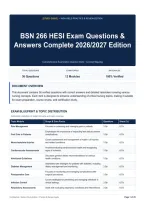
[STUDY GUIDE] • HIGH-YIELD PRACTICE & REVIEW EDITION
BSN 266 HESI Exam Questions &
Answers Complete 2026/2027 Edition
Comprehensive Examination Question Bank • Concept Mapping
TOTAL QUESTIONS EXAM TOPICS RATIONALES
36 Questions 12 Modules 100% Verified
DOCUMENT OVERVIEW
This document contains 36 verified questions with correct answers and detailed rationales covering various
nursing concepts. Each item is designed to enhance understanding of critical nursing topics, making it suitable
for exam preparation, course review, and certification study.
EXAM BLUEPRINT & TOPIC DISTRIBUTION
Systematic breakdown of subject domains and exam coverage.
Topic Module Scope & Core Focus Questions Share (%)
Pain Management Focuses on assessing and managing pain in patients. 3 Qs 8.3%
Emphasizes the importance of inspecting feet daily to prevent
Foot Care in Patients complications. 3 Qs 8.3%
Covers assessment and management of rotator cuff injuries
Musculoskeletal Injuries and related conditions. 3 Qs 8.3%
Involves evaluating cardiovascular health and recognizing
Cardiovascular Assessments signs of ischemia. 3 Qs 8.3%
Discusses general dietary recommendations for various
Nutritional Guidelines health conditions. 3 Qs 8.3%
Addresses care strategies for patients with diabetes, including
Diabetes Management dietary management and monitoring. 3 Qs 8.3%
Focuses on monitoring and managing complications after
Postoperative Care surgical procedures. 3 Qs 8.3%
Covers strategies for preventing and managing infections in
Infection Control clinical settings. 3 Qs 8.3%
Respiratory Assessments Deals with evaluating respiratory conditions and interventions. 3 Qs 8.3%
Confidential • Student Study Edition • Practice & Review Guide Page 1 of 25
,STUDENT STUDY & MASTERY EDITION PRACTICE & REVIEW GUIDE
Covers urgent care situations and appropriate nursing
Acute Care Scenarios actions. 3 Qs 8.3%
Fluid and Electrolyte Discusses assessments and interventions related to fluid
Management balance and electrolyte levels. 3 Qs 8.3%
Focuses on recognizing and managing neurological
Neurological Assessments conditions and complications. 3 Qs 8.3%
Total Exam Coverage 12 Integrated Topic Modules 36 Qs 100.0%
Confidential • Student Study Edition • Practice & Review Guide Page 2 of 25
, STUDENT STUDY & MASTERY EDITION PRACTICE & REVIEW GUIDE
TOPIC 1: PAIN MANAGEMENT
3 Questions • 8.3% of Exam • Focuses on assessing and managing pain in patients.
QUESTION 1
NGN (1/4): A 68-year-old male with a history of bilateral total hip arthroplasty 2 years
ago presents to the emergency department by ambulance. The client reports he simply
slipped today and did not feel lightheaded or dizzy before the fall. The client reports he
returned home from the store and was putting his groceries away he dropped a can and
bent over to pick it up he lost his balance and fell face forward, hitting his head on the
wall and his left shoulder on the floor reports pain mainly in his shoulder; however, he
also notes pain in his right knee. Additionally, the client reports he feels nauseated and
tired.
Nurses Note 1820: Client is resting, grimacing, vital signs assessed, reports intense
pain and inability to move his left arm. He is guarded, shoulder swollen, and bruising
are preent left arm is cool to touch. Collarbone appears out of alignment.
1820 flow sheet: temp 98.1 °F, HR 88, RR 18, BP 136/
Answer: B. left arm that is cool to touch
Coolness may indicate impaired circulation or neurovascular compromise. This is a priority finding bc
delayed intervention could lead to tissue ischemia or permanent damage.
C. Decreased range of motion
Limited range of motion suggests possible joint, muscle or nerve injury. Assessing this further is essential to
prevent worsening function an to plan appropriate intervention.
E. Bone misalignment
Bone misalignment of the collarbone indicates a likely fracture dislocation. Prompt evaluation is required to
reduce pain, restore function, and prevent neurovascular compromise.
G. Intense pain reported by client
Severe pain can indicate serious injuries such as fractures or soft tissue damage. It warrants prompt
assessment and intervention to manage pain and prevent complications.
H. Nausea and fatigue reported by the client
These are symptoms that could signal head trauma, internal injury, or early shock. Further evaluation is
necessary to rule out potential serious complications from the fall.
QUESTION 2
NGN (3/4)
Based on the client's condition, the priority need will be to address ______. In addition,
he will need interventions to prevent ________.
A. Mobility
B. Swelling
Confidential • Student Study Edition • Practice & Review Guide Page 3 of 25
BSN 266 HESI Exam Questions &
Answers Complete 2026/2027 Edition
Comprehensive Examination Question Bank • Concept Mapping
TOTAL QUESTIONS EXAM TOPICS RATIONALES
36 Questions 12 Modules 100% Verified
DOCUMENT OVERVIEW
This document contains 36 verified questions with correct answers and detailed rationales covering various
nursing concepts. Each item is designed to enhance understanding of critical nursing topics, making it suitable
for exam preparation, course review, and certification study.
EXAM BLUEPRINT & TOPIC DISTRIBUTION
Systematic breakdown of subject domains and exam coverage.
Topic Module Scope & Core Focus Questions Share (%)
Pain Management Focuses on assessing and managing pain in patients. 3 Qs 8.3%
Emphasizes the importance of inspecting feet daily to prevent
Foot Care in Patients complications. 3 Qs 8.3%
Covers assessment and management of rotator cuff injuries
Musculoskeletal Injuries and related conditions. 3 Qs 8.3%
Involves evaluating cardiovascular health and recognizing
Cardiovascular Assessments signs of ischemia. 3 Qs 8.3%
Discusses general dietary recommendations for various
Nutritional Guidelines health conditions. 3 Qs 8.3%
Addresses care strategies for patients with diabetes, including
Diabetes Management dietary management and monitoring. 3 Qs 8.3%
Focuses on monitoring and managing complications after
Postoperative Care surgical procedures. 3 Qs 8.3%
Covers strategies for preventing and managing infections in
Infection Control clinical settings. 3 Qs 8.3%
Respiratory Assessments Deals with evaluating respiratory conditions and interventions. 3 Qs 8.3%
Confidential • Student Study Edition • Practice & Review Guide Page 1 of 25
,STUDENT STUDY & MASTERY EDITION PRACTICE & REVIEW GUIDE
Covers urgent care situations and appropriate nursing
Acute Care Scenarios actions. 3 Qs 8.3%
Fluid and Electrolyte Discusses assessments and interventions related to fluid
Management balance and electrolyte levels. 3 Qs 8.3%
Focuses on recognizing and managing neurological
Neurological Assessments conditions and complications. 3 Qs 8.3%
Total Exam Coverage 12 Integrated Topic Modules 36 Qs 100.0%
Confidential • Student Study Edition • Practice & Review Guide Page 2 of 25
, STUDENT STUDY & MASTERY EDITION PRACTICE & REVIEW GUIDE
TOPIC 1: PAIN MANAGEMENT
3 Questions • 8.3% of Exam • Focuses on assessing and managing pain in patients.
QUESTION 1
NGN (1/4): A 68-year-old male with a history of bilateral total hip arthroplasty 2 years
ago presents to the emergency department by ambulance. The client reports he simply
slipped today and did not feel lightheaded or dizzy before the fall. The client reports he
returned home from the store and was putting his groceries away he dropped a can and
bent over to pick it up he lost his balance and fell face forward, hitting his head on the
wall and his left shoulder on the floor reports pain mainly in his shoulder; however, he
also notes pain in his right knee. Additionally, the client reports he feels nauseated and
tired.
Nurses Note 1820: Client is resting, grimacing, vital signs assessed, reports intense
pain and inability to move his left arm. He is guarded, shoulder swollen, and bruising
are preent left arm is cool to touch. Collarbone appears out of alignment.
1820 flow sheet: temp 98.1 °F, HR 88, RR 18, BP 136/
Answer: B. left arm that is cool to touch
Coolness may indicate impaired circulation or neurovascular compromise. This is a priority finding bc
delayed intervention could lead to tissue ischemia or permanent damage.
C. Decreased range of motion
Limited range of motion suggests possible joint, muscle or nerve injury. Assessing this further is essential to
prevent worsening function an to plan appropriate intervention.
E. Bone misalignment
Bone misalignment of the collarbone indicates a likely fracture dislocation. Prompt evaluation is required to
reduce pain, restore function, and prevent neurovascular compromise.
G. Intense pain reported by client
Severe pain can indicate serious injuries such as fractures or soft tissue damage. It warrants prompt
assessment and intervention to manage pain and prevent complications.
H. Nausea and fatigue reported by the client
These are symptoms that could signal head trauma, internal injury, or early shock. Further evaluation is
necessary to rule out potential serious complications from the fall.
QUESTION 2
NGN (3/4)
Based on the client's condition, the priority need will be to address ______. In addition,
he will need interventions to prevent ________.
A. Mobility
B. Swelling
Confidential • Student Study Edition • Practice & Review Guide Page 3 of 25


