
[STUDY GUIDE] • HIGH-YIELD PRACTICE & REVIEW EDITION
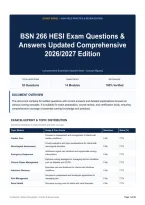
BSN 266 HESI Exam Questions &
Answers Updated Comprehensive
2026/2027 Edition
Comprehensive Examination Question Bank • Concept Mapping
TOTAL QUESTIONS EXAM TOPICS RATIONALES
52 Questions 14 Modules 100% Verified
DOCUMENT OVERVIEW
This document contains 52 verified questions with correct answers and detailed explanations focused on
various nursing concepts. It is suitable for exam preparation, course review, and certification study, ensuring
comprehensive coverage of essential nursing knowledge and practices.
EXAM BLUEPRINT & TOPIC DISTRIBUTION
Systematic breakdown of subject domains and exam coverage.
Topic Module Scope & Core Focus Questions Share (%)
Focuses on assessment and management of clients with
Cardiac Care cardiac conditions. 4 Qs 7.7%
Covers evaluation and care considerations for clients with
Neurological Assessment neurological disorders. 4 Qs 7.7%
Addresses urgent care situations and appropriate nursing
Emergency Responses interventions. 4 Qs 7.7%
Explores nursing strategies for managing chronic conditions
Chronic Illness Management such as diabetes and COPD. 4 Qs 7.7%
Examines care and treatment for clients with infectious
Infectious Diseases conditions. 4 Qs 7.7%
Focuses on assessment and therapeutic approaches to
Pain Management managing pain. 4 Qs 7.7%
Renal Health Discusses nursing care for clients with renal disorders. 4 Qs 7.7%
Confidential • Student Study Edition • Practice & Review Guide Page 1 of 28
,STUDENT STUDY & MASTERY EDITION PRACTICE & REVIEW GUIDE
Covers nursing considerations for clients with endocrine
Endocrine Disorders system disorders. 4 Qs 7.7%
Surgical Care Details preoperative and postoperative care protocols. 4 Qs 7.7%
Focuses on assessment and interventions for clients with
Respiratory Care respiratory conditions. 4 Qs 7.7%
Explores principles of maintaining skin integrity and managing
Skin Integrity and Wound Care wounds. 3 Qs 5.8%
Covers nursing interventions for clients with gastrointestinal
Gastrointestinal Health disorders. 3 Qs 5.8%
Discusses assessment and care for clients with
Musculoskeletal Disorders musculoskeletal issues. 3 Qs 5.8%
Focuses on managing fluid and electrolyte imbalances in
Fluid and Electrolyte Balance various conditions. 3 Qs 5.8%
Total Exam Coverage 14 Integrated Topic Modules 52 Qs 100.0%
Confidential • Student Study Edition • Practice & Review Guide Page 2 of 28
, STUDENT STUDY & MASTERY EDITION PRACTICE & REVIEW GUIDE
TOPIC 1: CARDIAC CARE
4 Questions • 7.7% of Exam • Focuses on assessment and management of clients with cardiac conditions.
QUESTION 1
A client who underwent cardiac stent placement four days ago arrives to the
emergency department reporting a sudden onset of chest pressure and shortness of
breath. Which action should the nurse take next?
a. Listen for extra heart sounds, murmurs, and rhythm with the bell of the stethoscope.
b. Evaluate upper and lower extremities for perfusion, pulse volume, and pitting edema.
c. Verify troponin level assessments are scheduled every 3-6 hours for a series of three.
d. Obtain a 12- lead electrocardiogram and begin continuous cardiac monitoring.
Answer: D.
QUESTION 2
A client presents to the emergency department reporting chest pain that is radiation to
the left arm, shortness of breath, and diaphoresis. Which medication should the nurse
anticipate being prescribed by the healthcare provider?
a. Fentanyl.
b. Hydromorphone.
c. Oxycodone.
d. Morphine.
Answer: D
Explanation: Morphine is commonly used to treat chest pain associated with myocardial infarction (heart
attack) as it provides pain relief, reduces anxiety, and has a vasodilatory effect that can improve blood flow to
the heart. The other medications listed are not typically the first choice for managing chest pain related to a
heart attack.
Confidential • Student Study Edition • Practice & Review Guide Page 3 of 28
BSN 266 HESI Exam Questions &
Answers Updated Comprehensive
2026/2027 Edition
Comprehensive Examination Question Bank • Concept Mapping
TOTAL QUESTIONS EXAM TOPICS RATIONALES
52 Questions 14 Modules 100% Verified
DOCUMENT OVERVIEW
This document contains 52 verified questions with correct answers and detailed explanations focused on
various nursing concepts. It is suitable for exam preparation, course review, and certification study, ensuring
comprehensive coverage of essential nursing knowledge and practices.
EXAM BLUEPRINT & TOPIC DISTRIBUTION
Systematic breakdown of subject domains and exam coverage.
Topic Module Scope & Core Focus Questions Share (%)
Focuses on assessment and management of clients with
Cardiac Care cardiac conditions. 4 Qs 7.7%
Covers evaluation and care considerations for clients with
Neurological Assessment neurological disorders. 4 Qs 7.7%
Addresses urgent care situations and appropriate nursing
Emergency Responses interventions. 4 Qs 7.7%
Explores nursing strategies for managing chronic conditions
Chronic Illness Management such as diabetes and COPD. 4 Qs 7.7%
Examines care and treatment for clients with infectious
Infectious Diseases conditions. 4 Qs 7.7%
Focuses on assessment and therapeutic approaches to
Pain Management managing pain. 4 Qs 7.7%
Renal Health Discusses nursing care for clients with renal disorders. 4 Qs 7.7%
Confidential • Student Study Edition • Practice & Review Guide Page 1 of 28
,STUDENT STUDY & MASTERY EDITION PRACTICE & REVIEW GUIDE
Covers nursing considerations for clients with endocrine
Endocrine Disorders system disorders. 4 Qs 7.7%
Surgical Care Details preoperative and postoperative care protocols. 4 Qs 7.7%
Focuses on assessment and interventions for clients with
Respiratory Care respiratory conditions. 4 Qs 7.7%
Explores principles of maintaining skin integrity and managing
Skin Integrity and Wound Care wounds. 3 Qs 5.8%
Covers nursing interventions for clients with gastrointestinal
Gastrointestinal Health disorders. 3 Qs 5.8%
Discusses assessment and care for clients with
Musculoskeletal Disorders musculoskeletal issues. 3 Qs 5.8%
Focuses on managing fluid and electrolyte imbalances in
Fluid and Electrolyte Balance various conditions. 3 Qs 5.8%
Total Exam Coverage 14 Integrated Topic Modules 52 Qs 100.0%
Confidential • Student Study Edition • Practice & Review Guide Page 2 of 28
, STUDENT STUDY & MASTERY EDITION PRACTICE & REVIEW GUIDE
TOPIC 1: CARDIAC CARE
4 Questions • 7.7% of Exam • Focuses on assessment and management of clients with cardiac conditions.
QUESTION 1
A client who underwent cardiac stent placement four days ago arrives to the
emergency department reporting a sudden onset of chest pressure and shortness of
breath. Which action should the nurse take next?
a. Listen for extra heart sounds, murmurs, and rhythm with the bell of the stethoscope.
b. Evaluate upper and lower extremities for perfusion, pulse volume, and pitting edema.
c. Verify troponin level assessments are scheduled every 3-6 hours for a series of three.
d. Obtain a 12- lead electrocardiogram and begin continuous cardiac monitoring.
Answer: D.
QUESTION 2
A client presents to the emergency department reporting chest pain that is radiation to
the left arm, shortness of breath, and diaphoresis. Which medication should the nurse
anticipate being prescribed by the healthcare provider?
a. Fentanyl.
b. Hydromorphone.
c. Oxycodone.
d. Morphine.
Answer: D
Explanation: Morphine is commonly used to treat chest pain associated with myocardial infarction (heart
attack) as it provides pain relief, reduces anxiety, and has a vasodilatory effect that can improve blood flow to
the heart. The other medications listed are not typically the first choice for managing chest pain related to a
heart attack.
Confidential • Student Study Edition • Practice & Review Guide Page 3 of 28


