
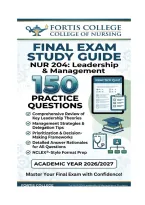
,NUR 204 Leadership and Management Final
Exam Study Guide & 150 Practice Questions
Fortis College 2026/2027
1. A nurse manager inspires staff by articulating a compelling vision for the unit, encourages
creative thinking, and provides individualized support to each team member. This manager is
demonstrating which leadership style?
A. Transactional leadership
B. Transformational leadership
C. Laissez-faire leadership
D. Bureaucratic leadership
Correct Answer: B. Transformational leadership
Rationale: Transformational leadership involves inspiring followers with a vision, providing
intellectual stimulation, and offering individualized consideration. Transactional leadership
focuses on exchanges and rewards. Laissez-faire is hands-off. Bureaucratic emphasizes rules and
procedures.
2. Which leadership theory suggests that leaders are born with specific innate characteristics
such as intelligence, confidence, and sociability?
,A. Behavioral theory
B. Contingency theory
C. Trait theory
D. Situational theory
Correct Answer: C. Trait theory
Rationale: Trait theory posits that leaders possess certain innate traits like confidence,
intelligence, integrity, and sociability that make them effective. Behavioral theory focuses on
what leaders do, not innate traits.
3. A nurse manager adapts her leadership style based on the readiness level of her staff
members, providing more direction to new nurses and delegating more to experienced nurses.
This is an example of:
A. Transformational leadership
B. Situational leadership (Hersey-Blanchard)
C. Transactional leadership
D. Servant leadership
, Correct Answer: B. Situational leadership (Hersey-Blanchard)
Rationale: Situational leadership (Hersey-Blanchard) adapts leadership style to follower
readiness, using telling, selling, participating, or delegating approaches as appropriate.
4. In an emergency code situation, the charge nurse makes rapid decisions without consulting
the team and gives specific orders to each member. This demonstrates:
A. Democratic leadership
B. Laissez-faire leadership
C. Autocratic leadership
D. Servant leadership
Correct Answer: C. Autocratic leadership
Rationale: Autocratic leadership involves centralized decision-making with little input from
followers, which is effective in emergency situations requiring quick, decisive action. Democratic
leadership seeks input, which is too slow in emergencies.
Exam Study Guide & 150 Practice Questions
Fortis College 2026/2027
1. A nurse manager inspires staff by articulating a compelling vision for the unit, encourages
creative thinking, and provides individualized support to each team member. This manager is
demonstrating which leadership style?
A. Transactional leadership
B. Transformational leadership
C. Laissez-faire leadership
D. Bureaucratic leadership
Correct Answer: B. Transformational leadership
Rationale: Transformational leadership involves inspiring followers with a vision, providing
intellectual stimulation, and offering individualized consideration. Transactional leadership
focuses on exchanges and rewards. Laissez-faire is hands-off. Bureaucratic emphasizes rules and
procedures.
2. Which leadership theory suggests that leaders are born with specific innate characteristics
such as intelligence, confidence, and sociability?
,A. Behavioral theory
B. Contingency theory
C. Trait theory
D. Situational theory
Correct Answer: C. Trait theory
Rationale: Trait theory posits that leaders possess certain innate traits like confidence,
intelligence, integrity, and sociability that make them effective. Behavioral theory focuses on
what leaders do, not innate traits.
3. A nurse manager adapts her leadership style based on the readiness level of her staff
members, providing more direction to new nurses and delegating more to experienced nurses.
This is an example of:
A. Transformational leadership
B. Situational leadership (Hersey-Blanchard)
C. Transactional leadership
D. Servant leadership
, Correct Answer: B. Situational leadership (Hersey-Blanchard)
Rationale: Situational leadership (Hersey-Blanchard) adapts leadership style to follower
readiness, using telling, selling, participating, or delegating approaches as appropriate.
4. In an emergency code situation, the charge nurse makes rapid decisions without consulting
the team and gives specific orders to each member. This demonstrates:
A. Democratic leadership
B. Laissez-faire leadership
C. Autocratic leadership
D. Servant leadership
Correct Answer: C. Autocratic leadership
Rationale: Autocratic leadership involves centralized decision-making with little input from
followers, which is effective in emergency situations requiring quick, decisive action. Democratic
leadership seeks input, which is too slow in emergencies.


