
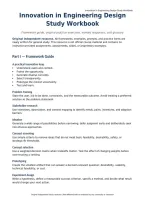
Innovation in Engineering Design Study Workbook
Innovation in Engineering Design
Study Workbook
Framework guide, original practice exercises, worked responses, and glossary
Original independent resource. All frameworks, examples, prompts, and practice items are
newly written for general study. This resource is not official course material and contains no
instructor-provided assignments, assessments, slides, or proprietary examples.
Part I — Framework Guide
A practical innovation loop
Understand users and context.
Frame the opportunity.
Generate diverse concepts.
Select transparently.
Prototype the riskiest uncertainty.
Test and learn.
Problem framing
State the user, job to be done, constraints, and the measurable outcome. Avoid treating a preferred
solution as the problem statement.
Stakeholder research
Use interviews, observation, and context mapping to identify needs, pains, incentives, and adoption
barriers.
Ideation
Generate a wide range of possibilities before narrowing; defer judgment early and deliberately seek
non-obvious approaches.
Concept screening
Use simple criteria to remove ideas that do not meet basic feasibility, desirability, safety, or
strategic-fit thresholds.
Concept selection
Use a weighted decision matrix when tradeoffs matter. Test the effect of changing weights before
over-trusting a ranking.
Prototyping
Create the smallest artifact that can answer a decision-relevant question: desirability, usability,
technical feasibility, or cost.
Experiment design
Write a hypothesis, define a measurable success criterion, specify a method, and decide what result
would change your next action.
Original independent study resource | Not affiliated with or endorsed by any university or instructor
, Innovation in Engineering Design Study Workbook
Value proposition
Connect a specific user need to a credible benefit and identify why the proposed approach is
meaningfully different.
Business case
Translate the concept into benefits, costs, risks, assumptions, and a recommendation—without
disguising uncertain estimates as facts.
Innovation portfolio
Balance incremental improvements, adjacent opportunities, and more exploratory bets based on
strategic value and uncertainty.
Concept-evaluation criteria
Criterion Question to ask
Would a clearly defined user or customer value the
Desirability
outcome?
Can the organization build, integrate, and operate it
Technical feasibility
with realistic capability and time?
Do benefits plausibly justify lifecycle costs and
Economic viability
investment risk?
Does the concept satisfy applicable safety, privacy,
Safety and compliance
security, accessibility, and regulatory needs?
Does it advance a relevant capability, market,
Strategic fit
mission, or competitive position?
Can it work beyond a single prototype, location, or
Scalability
unusually supportive customer?
Original independent study resource | Not affiliated with or endorsed by any university or instructor
Innovation in Engineering Design
Study Workbook
Framework guide, original practice exercises, worked responses, and glossary
Original independent resource. All frameworks, examples, prompts, and practice items are
newly written for general study. This resource is not official course material and contains no
instructor-provided assignments, assessments, slides, or proprietary examples.
Part I — Framework Guide
A practical innovation loop
Understand users and context.
Frame the opportunity.
Generate diverse concepts.
Select transparently.
Prototype the riskiest uncertainty.
Test and learn.
Problem framing
State the user, job to be done, constraints, and the measurable outcome. Avoid treating a preferred
solution as the problem statement.
Stakeholder research
Use interviews, observation, and context mapping to identify needs, pains, incentives, and adoption
barriers.
Ideation
Generate a wide range of possibilities before narrowing; defer judgment early and deliberately seek
non-obvious approaches.
Concept screening
Use simple criteria to remove ideas that do not meet basic feasibility, desirability, safety, or
strategic-fit thresholds.
Concept selection
Use a weighted decision matrix when tradeoffs matter. Test the effect of changing weights before
over-trusting a ranking.
Prototyping
Create the smallest artifact that can answer a decision-relevant question: desirability, usability,
technical feasibility, or cost.
Experiment design
Write a hypothesis, define a measurable success criterion, specify a method, and decide what result
would change your next action.
Original independent study resource | Not affiliated with or endorsed by any university or instructor
, Innovation in Engineering Design Study Workbook
Value proposition
Connect a specific user need to a credible benefit and identify why the proposed approach is
meaningfully different.
Business case
Translate the concept into benefits, costs, risks, assumptions, and a recommendation—without
disguising uncertain estimates as facts.
Innovation portfolio
Balance incremental improvements, adjacent opportunities, and more exploratory bets based on
strategic value and uncertainty.
Concept-evaluation criteria
Criterion Question to ask
Would a clearly defined user or customer value the
Desirability
outcome?
Can the organization build, integrate, and operate it
Technical feasibility
with realistic capability and time?
Do benefits plausibly justify lifecycle costs and
Economic viability
investment risk?
Does the concept satisfy applicable safety, privacy,
Safety and compliance
security, accessibility, and regulatory needs?
Does it advance a relevant capability, market,
Strategic fit
mission, or competitive position?
Can it work beyond a single prototype, location, or
Scalability
unusually supportive customer?
Original independent study resource | Not affiliated with or endorsed by any university or instructor


