
Microbiology Final - Jersey College Exam Prep, Practice Questions & Verified Answers
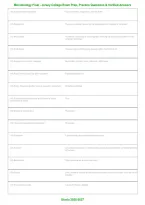
(18) Symptoms of endocarditis Fever and chills, weight loss, muscle ache
(18) Septicemia The toxic condition caused by the multiplication of bacteria in the blood.
(18) Microbemia In infection caused by a microorganism entering the circulatory system through
lymphatic drainage.
(18) Strep throat Causes a rare, inflammatory disease called rheumatic fever
(18) Examples of zoonotic diseases Brucellosis, undulant fever, tularemia, rabbit fever
(18) Rabbit fever caused by which bacteria? Francisella tularensis
(18) Rocky Mountain spotted fever is caused by bacterium: Rickettsia rickettsia
(18) Cytomegalovirus infections are caused by which Five
human herpes virus?
(18) Malaria is caused by a: Protozoan
(18) How is toxoplasmosis categorized? Protozoan
(18) Gangrene A complication of necrosis related to wounds
(18) Zoonotic Any infectious disease or infection that can be transmitted from vertebrate animals
to humans
(18) Bacteremia When bacteria are found in the blood
(18) Sepsis Toxic condition caused by the spread of bacteria or bacterial toxins from the site of
infection
(18) Trypanosoma Cruzi Cause of Chagas' disease
Stuvia 2026-2027
, Microbiology Final - Jersey College Exam Prep, Practice Questions & Verified Answers
(18) Dry gangrene often occurs in persons with impaired peripheral blood flow
(18) Internal gangrene (white gangrene) generally contracted after surgery or trauma
(18) Wet gangrene occurs in organs lined by mucous membranes such as the mouth, lower intestinal
tract, lungs, and cervix
(18) Gas gangrene caused by bacteria that produce gas within the infected tissue. Toxins produced will
cause necrosis; if untreated the condition is fatal.
(18) Principles of Viral Hemorrhagic Fever (VHF) group of febrile illnesses ranging in severity from relatively mild to life-threatening.
Caused by four distinct viral families: Arenaviridae, Filoviridae, Bunyaviridae, and
Flaviviridae. All VHFs characterized by fever, overall vascular system damage, and
bleeding disorders that can lead to high fever, shock, and death. Although
distributed over much of the world, many VHFs are present in geographically limited
areas and risk of infection is restricted to those areas.
(18) Systemic Mycosis fungal infections capable of affecting all internal organs. Persons with a competent
immune system may be asymptomatic or show only minor symptoms. Immune-
compromised patients (including persons with HIV, cancer, or neutropenia, organ
transplant recipients, patients recovering from pancreatitis or splenectomy, those
with diabetes, the very old, and the very young) are at high risk for infection.
Treatment may include adjusting immune-suppressing medications or administering
antifungal medications.
(18) Visceral leishmaniasis serious form; fatal if untreated.
(18) Cutaneous leishmaniasis common form; sore forms at fly-bite site; long healing period (few months to a year).
(18) Diffuse cutaneous leishmaniasis widespread skin lesions; difficult to treat.
(18) Mucocutaneous leishmaniasis skin ulcers that spread and can cause tissue damage to the nose and mouth.
(16) Who first observed microbes on the teeth? Van Leeuwenhoek
(16) What causes peptic ulcers? Helicobacter pylori
(16) What is another word for Bacillary dysentery? Shingellosis, transmitted by fecal-oral route
(16) How many known forms of gastroenteritis is caused Five
by E.Coli?
Stuvia 2026-2027
(18) Symptoms of endocarditis Fever and chills, weight loss, muscle ache
(18) Septicemia The toxic condition caused by the multiplication of bacteria in the blood.
(18) Microbemia In infection caused by a microorganism entering the circulatory system through
lymphatic drainage.
(18) Strep throat Causes a rare, inflammatory disease called rheumatic fever
(18) Examples of zoonotic diseases Brucellosis, undulant fever, tularemia, rabbit fever
(18) Rabbit fever caused by which bacteria? Francisella tularensis
(18) Rocky Mountain spotted fever is caused by bacterium: Rickettsia rickettsia
(18) Cytomegalovirus infections are caused by which Five
human herpes virus?
(18) Malaria is caused by a: Protozoan
(18) How is toxoplasmosis categorized? Protozoan
(18) Gangrene A complication of necrosis related to wounds
(18) Zoonotic Any infectious disease or infection that can be transmitted from vertebrate animals
to humans
(18) Bacteremia When bacteria are found in the blood
(18) Sepsis Toxic condition caused by the spread of bacteria or bacterial toxins from the site of
infection
(18) Trypanosoma Cruzi Cause of Chagas' disease
Stuvia 2026-2027
, Microbiology Final - Jersey College Exam Prep, Practice Questions & Verified Answers
(18) Dry gangrene often occurs in persons with impaired peripheral blood flow
(18) Internal gangrene (white gangrene) generally contracted after surgery or trauma
(18) Wet gangrene occurs in organs lined by mucous membranes such as the mouth, lower intestinal
tract, lungs, and cervix
(18) Gas gangrene caused by bacteria that produce gas within the infected tissue. Toxins produced will
cause necrosis; if untreated the condition is fatal.
(18) Principles of Viral Hemorrhagic Fever (VHF) group of febrile illnesses ranging in severity from relatively mild to life-threatening.
Caused by four distinct viral families: Arenaviridae, Filoviridae, Bunyaviridae, and
Flaviviridae. All VHFs characterized by fever, overall vascular system damage, and
bleeding disorders that can lead to high fever, shock, and death. Although
distributed over much of the world, many VHFs are present in geographically limited
areas and risk of infection is restricted to those areas.
(18) Systemic Mycosis fungal infections capable of affecting all internal organs. Persons with a competent
immune system may be asymptomatic or show only minor symptoms. Immune-
compromised patients (including persons with HIV, cancer, or neutropenia, organ
transplant recipients, patients recovering from pancreatitis or splenectomy, those
with diabetes, the very old, and the very young) are at high risk for infection.
Treatment may include adjusting immune-suppressing medications or administering
antifungal medications.
(18) Visceral leishmaniasis serious form; fatal if untreated.
(18) Cutaneous leishmaniasis common form; sore forms at fly-bite site; long healing period (few months to a year).
(18) Diffuse cutaneous leishmaniasis widespread skin lesions; difficult to treat.
(18) Mucocutaneous leishmaniasis skin ulcers that spread and can cause tissue damage to the nose and mouth.
(16) Who first observed microbes on the teeth? Van Leeuwenhoek
(16) What causes peptic ulcers? Helicobacter pylori
(16) What is another word for Bacillary dysentery? Shingellosis, transmitted by fecal-oral route
(16) How many known forms of gastroenteritis is caused Five
by E.Coli?
Stuvia 2026-2027


