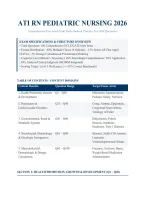
ATI RN PEDIATRIC NURSING 2026
Comprehensive Proctored Exam Study Guide & Practice Test (100 Questions)
EXAM SPECIFICATIONS & STRUCTURE OVERVIEW
• Total Questions: 100 Comprehensive NCLEX/ATI-Style Items
• Format Distribution: ~80% Multiple Choice (4 Options), ~15% Select All That Apply
(SATA), ~5% Dosage Calculation & Prioritization/Ordering
• Cognitive Level (Bloom's Taxonomy): 20% Knowledge/Comprehension | 50% Application
| 30% Analysis/Clinical Judgment (NCJMM Integrated)
• Scoring Target: Level 3 Proficiency (>= 85% Correct Benchmark)
TABLE OF CONTENTS / CONTENT DOMAINS
Content Domain Question Range Target Focus Areas
1. Health Promotion, Growth Q1 – Q20 Milestones, Immunizations,
& Development Pediatric Safety, Nutrition
2. Respiratory & Q21 – Q40 Croup, Asthma, Epiglottitis,
Cardiovascular Disorders Congenital Heart Defects,
Tetralogy of Fallot
3. Gastrointestinal, Renal & Q41 – Q60 Dehydration, Pyloric
Metabolic Systems Stenosis, Nephrotic
Syndrome, Type 1 Diabetes
4. Neurological, Hematologic Q61 – Q80 Seizures, Sickle Cell Anemia,
& Oncologic Emergencies Leukemia,
Ventriculoperitoneal Shunts
5. Musculoskeletal, Q81 – Q100 Fractures, Scoliosis, Burns,
Dermatologic & Dosage Weight-Based Medication
Calculations Administration
SECTION 1: HEALTH PROMOTION, GROWTH & DEVELOPMENT (Q1 – Q20)
,Question 1: A nurse is conducting a 6-month-old well-child evaluation. Which gross motor
milestone should the nurse expect the infant to exhibit?
A. Walking independently while holding furniture
B. Sitting unsupported with a straight back
C. Rolling from back to front and front to back
D. Building a tower of two wooden blocks
[Domain: Health Promotion | Cognitive Level: Comprehension | NCJMM: Recognize
Cues]
Correct Answer: C. Rolling from back to front and front to back
Rationale: At 6 months, infants typically roll completely from back to front and front to back.
Sitting unsupported occurs around 8 months. Walking holding furniture (cruising) occurs at 9–
10 months. Building a block tower occurs between 12–15 months.
Question 2: A nurse is providing anticipatory guidance to the parent of a 12-month-old infant.
Which immunizations should the nurse prepare to administer?
A. Rotavirus and Hepatitis B
B. MMR, Varicella, and Hepatitis A
C. DTaP and IPV only
D. Meningococcal and Human Papillomavirus
[Domain: Health Promotion | Cognitive Level: Knowledge | NCJMM: Generate
Solutions]
Correct Answer: B. MMR, Varicella, and Hepatitis A
Rationale: The 12-to-15-month schedule includes MMR, Varicella, Hib, PCV13, and
Hepatitis A. Rotavirus is completed by 6 months. HPV is administered at age 11–12.
Question 3: A 4-year-old child is scheduled for a diagnostic procedure. Which age-appropriate
preparation strategy should the nurse utilize?
A. Explain the procedure using medical terms and anatomical charts 2 days prior
B. Role-play the procedure using a doll and medical equipment immediately before
C. Provide a written pamphlet for the child to read prior to the appointment
D. Avoid discussing the procedure until after it is completed to prevent anxiety
[Domain: Health Promotion | Cognitive Level: Application | NCJMM: Take Action]
Correct Answer: B. Role-play the procedure using a doll and medical equipment
immediately before
Rationale: Preschoolers (3–5 years) are in Piaget's preoperational stage and benefit from
hands-on medical play with dolls right before procedures. Complex pamphlets or anatomical
, charts are appropriate for school-age or adolescents.
Question 4: A nurse is evaluating the fine motor skills of an 18-month-old toddler. Which action
should the nurse expect the toddler to perform successfully?
A. Copying a circle with a crayon
B. Tying shoelaces in a double knot
C. Turning pages of a book two or three at a time
D. Using safety scissors to cut paper
[Domain: Health Promotion | Cognitive Level: Comprehension | NCJMM: Recognize
Cues]
Correct Answer: C. Turning pages of a book two or three at a time
Rationale: An 18-month-old can turn book pages 2-3 at a time and build a tower of 3-4
blocks. Copying circles occurs around age 3, and cutting with scissors occurs at age 4.
Question 5: A nurse is assessing a 2-month-old infant. Which physical assessment finding
requires immediate clinical intervention?
A. Posterior fontanel measuring 1 cm and soft
B. Complete closure of the anterior fontanel
C. Symmetric Moro reflex response
D. Head lag present when pulled to a sitting position
[Domain: Health Promotion | Cognitive Level: Analysis | NCJMM: Analyze Cues]
Correct Answer: B. Complete closure of the anterior fontanel
Rationale: The anterior fontanel normally closes between 12 and 18 months. Premature
closure (craniosynostosis) restricts brain growth and requires surgical evaluation. Posterior
fontanel closes by 2–3 months.
Question 6: A nurse is teaching car safety to parents of a newborn. Which instruction regarding
rear-facing car seats is accurate according to current guidelines?
A. Keep the infant rear-facing in the back seat until at least 2 years of age or until reaching
height/weight limits
B. Place the car seat in the front passenger seat if the airbag is activated
C. Secure the harness chest clip low over the abdomen
D. Position the harness straps 2 inches above the shoulder level
[Domain: Health Promotion | Cognitive Level: Application | NCJMM: Take Action]
Correct Answer: A. Keep the infant rear-facing in the back seat until at least 2 years of
, age or until reaching height/weight limits
Rationale: Infants should remain in rear-facing seats in the back seat until age 2 or until
reaching maximum height/weight limits. Harness chest clips must be positioned at armpit
level, not over the abdomen.
Question 7: A nurse is assessing a 9-month-old infant during a routine checkup. Which
developmental finding indicates a potential developmental delay?
A. Inability to speak 4–6 clear words
B. Absence of crude pincer grasp
C. Presence of the Moro reflex
D. Inability to stand completely unassisted
[Domain: Health Promotion | Cognitive Level: Analysis | NCJMM: Analyze Cues]
Correct Answer: C. Presence of the Moro reflex
Rationale: The Moro reflex typically disappears by 4 to 6 months of age. Persistence beyond
6 months indicates potential neurological impairment. Crude pincer grasp develops around 8–
9 months.
Question 8: A parent asks the nurse about introducing solid foods to a 5-month-old infant.
Which recommendation by the nurse is correct?
A. Introduce cow's milk as the main source of nutrition
B. Introduce single-ingredient iron-fortified cereal one at a time, spaced 5–7 days apart
C. Mix fruit juice into the infant's feeding bottle
D. Offer honey to sweeten homemade baby food
[Domain: Health Promotion | Cognitive Level: Application | NCJMM: Generate
Solutions]
Correct Answer: B. Introduce single-ingredient iron-fortified cereal one at a time,
spaced 5–7 days apart
Rationale: Single-ingredient foods spaced 5–7 days apart allow identification of food
allergies. Honey must be avoided under 1 year due to infant botulism risk. Whole cow's milk
is avoided until 12 months.
Comprehensive Proctored Exam Study Guide & Practice Test (100 Questions)
EXAM SPECIFICATIONS & STRUCTURE OVERVIEW
• Total Questions: 100 Comprehensive NCLEX/ATI-Style Items
• Format Distribution: ~80% Multiple Choice (4 Options), ~15% Select All That Apply
(SATA), ~5% Dosage Calculation & Prioritization/Ordering
• Cognitive Level (Bloom's Taxonomy): 20% Knowledge/Comprehension | 50% Application
| 30% Analysis/Clinical Judgment (NCJMM Integrated)
• Scoring Target: Level 3 Proficiency (>= 85% Correct Benchmark)
TABLE OF CONTENTS / CONTENT DOMAINS
Content Domain Question Range Target Focus Areas
1. Health Promotion, Growth Q1 – Q20 Milestones, Immunizations,
& Development Pediatric Safety, Nutrition
2. Respiratory & Q21 – Q40 Croup, Asthma, Epiglottitis,
Cardiovascular Disorders Congenital Heart Defects,
Tetralogy of Fallot
3. Gastrointestinal, Renal & Q41 – Q60 Dehydration, Pyloric
Metabolic Systems Stenosis, Nephrotic
Syndrome, Type 1 Diabetes
4. Neurological, Hematologic Q61 – Q80 Seizures, Sickle Cell Anemia,
& Oncologic Emergencies Leukemia,
Ventriculoperitoneal Shunts
5. Musculoskeletal, Q81 – Q100 Fractures, Scoliosis, Burns,
Dermatologic & Dosage Weight-Based Medication
Calculations Administration
SECTION 1: HEALTH PROMOTION, GROWTH & DEVELOPMENT (Q1 – Q20)
,Question 1: A nurse is conducting a 6-month-old well-child evaluation. Which gross motor
milestone should the nurse expect the infant to exhibit?
A. Walking independently while holding furniture
B. Sitting unsupported with a straight back
C. Rolling from back to front and front to back
D. Building a tower of two wooden blocks
[Domain: Health Promotion | Cognitive Level: Comprehension | NCJMM: Recognize
Cues]
Correct Answer: C. Rolling from back to front and front to back
Rationale: At 6 months, infants typically roll completely from back to front and front to back.
Sitting unsupported occurs around 8 months. Walking holding furniture (cruising) occurs at 9–
10 months. Building a block tower occurs between 12–15 months.
Question 2: A nurse is providing anticipatory guidance to the parent of a 12-month-old infant.
Which immunizations should the nurse prepare to administer?
A. Rotavirus and Hepatitis B
B. MMR, Varicella, and Hepatitis A
C. DTaP and IPV only
D. Meningococcal and Human Papillomavirus
[Domain: Health Promotion | Cognitive Level: Knowledge | NCJMM: Generate
Solutions]
Correct Answer: B. MMR, Varicella, and Hepatitis A
Rationale: The 12-to-15-month schedule includes MMR, Varicella, Hib, PCV13, and
Hepatitis A. Rotavirus is completed by 6 months. HPV is administered at age 11–12.
Question 3: A 4-year-old child is scheduled for a diagnostic procedure. Which age-appropriate
preparation strategy should the nurse utilize?
A. Explain the procedure using medical terms and anatomical charts 2 days prior
B. Role-play the procedure using a doll and medical equipment immediately before
C. Provide a written pamphlet for the child to read prior to the appointment
D. Avoid discussing the procedure until after it is completed to prevent anxiety
[Domain: Health Promotion | Cognitive Level: Application | NCJMM: Take Action]
Correct Answer: B. Role-play the procedure using a doll and medical equipment
immediately before
Rationale: Preschoolers (3–5 years) are in Piaget's preoperational stage and benefit from
hands-on medical play with dolls right before procedures. Complex pamphlets or anatomical
, charts are appropriate for school-age or adolescents.
Question 4: A nurse is evaluating the fine motor skills of an 18-month-old toddler. Which action
should the nurse expect the toddler to perform successfully?
A. Copying a circle with a crayon
B. Tying shoelaces in a double knot
C. Turning pages of a book two or three at a time
D. Using safety scissors to cut paper
[Domain: Health Promotion | Cognitive Level: Comprehension | NCJMM: Recognize
Cues]
Correct Answer: C. Turning pages of a book two or three at a time
Rationale: An 18-month-old can turn book pages 2-3 at a time and build a tower of 3-4
blocks. Copying circles occurs around age 3, and cutting with scissors occurs at age 4.
Question 5: A nurse is assessing a 2-month-old infant. Which physical assessment finding
requires immediate clinical intervention?
A. Posterior fontanel measuring 1 cm and soft
B. Complete closure of the anterior fontanel
C. Symmetric Moro reflex response
D. Head lag present when pulled to a sitting position
[Domain: Health Promotion | Cognitive Level: Analysis | NCJMM: Analyze Cues]
Correct Answer: B. Complete closure of the anterior fontanel
Rationale: The anterior fontanel normally closes between 12 and 18 months. Premature
closure (craniosynostosis) restricts brain growth and requires surgical evaluation. Posterior
fontanel closes by 2–3 months.
Question 6: A nurse is teaching car safety to parents of a newborn. Which instruction regarding
rear-facing car seats is accurate according to current guidelines?
A. Keep the infant rear-facing in the back seat until at least 2 years of age or until reaching
height/weight limits
B. Place the car seat in the front passenger seat if the airbag is activated
C. Secure the harness chest clip low over the abdomen
D. Position the harness straps 2 inches above the shoulder level
[Domain: Health Promotion | Cognitive Level: Application | NCJMM: Take Action]
Correct Answer: A. Keep the infant rear-facing in the back seat until at least 2 years of
, age or until reaching height/weight limits
Rationale: Infants should remain in rear-facing seats in the back seat until age 2 or until
reaching maximum height/weight limits. Harness chest clips must be positioned at armpit
level, not over the abdomen.
Question 7: A nurse is assessing a 9-month-old infant during a routine checkup. Which
developmental finding indicates a potential developmental delay?
A. Inability to speak 4–6 clear words
B. Absence of crude pincer grasp
C. Presence of the Moro reflex
D. Inability to stand completely unassisted
[Domain: Health Promotion | Cognitive Level: Analysis | NCJMM: Analyze Cues]
Correct Answer: C. Presence of the Moro reflex
Rationale: The Moro reflex typically disappears by 4 to 6 months of age. Persistence beyond
6 months indicates potential neurological impairment. Crude pincer grasp develops around 8–
9 months.
Question 8: A parent asks the nurse about introducing solid foods to a 5-month-old infant.
Which recommendation by the nurse is correct?
A. Introduce cow's milk as the main source of nutrition
B. Introduce single-ingredient iron-fortified cereal one at a time, spaced 5–7 days apart
C. Mix fruit juice into the infant's feeding bottle
D. Offer honey to sweeten homemade baby food
[Domain: Health Promotion | Cognitive Level: Application | NCJMM: Generate
Solutions]
Correct Answer: B. Introduce single-ingredient iron-fortified cereal one at a time,
spaced 5–7 days apart
Rationale: Single-ingredient foods spaced 5–7 days apart allow identification of food
allergies. Honey must be avoided under 1 year due to infant botulism risk. Whole cow's milk
is avoided until 12 months.