
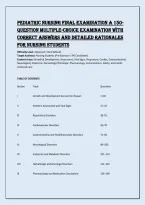
PEDIATRIC NURSING FINAL EXAMINATION A 150-
Question Multiple-Choice Examination with
Correct Answers and Detailed Rationales
for Nursing Students
Difficulty Level: Advanced / Hard (Mixed)
Target Audience: Nursing Students (Pre-licensure / RN Candidates)
Content Areas: Growth & Development, Assessment, Vital Signs, Respiratory, Cardiac, Gastrointestinal,
Neurological, Endocrine, Hematologic/Oncologic, Pharmacology, Immunizations, Safety, and Family-
Centered Care
TABLE OF CONTENTS
Section Topic Questions
I Growth and Development Across the Lifespan 1–20
II Pediatric Assessment and Vital Signs 21–35
III Respiratory Disorders 36–55
IV Cardiovascular Disorders 56–70
V Gastrointestinal and Fluid/Electrolyte Disorders 71–85
VI Neurological Disorders 86–100
VII Endocrine and Metabolic Disorders 101–110
VIII Hematologic and Oncologic Disorders 111–125
IX Pharmacology and Medication Calculations 126–140
,Section Topic Questions
X Immunizations and Infectious Diseases 141–150
SECTION I: GROWTH AND DEVELOPMENT ACROSS THE LIFESPAN (Questions 1–20)
🟢 1. A nurse is assessing a 4-month-old infant during a well-child visit. Which developmental milestone
should the nurse expect the infant to have achieved?
A. Sitting without support
B. Rolling from back to abdomen
C. Pincer grasp
D. Walking with assistance
🔴🔴 Correct Answer: B
Rationale: At 4 months, infants typically begin rolling from back to abdomen. Sitting without support
occurs around 6–8 months, pincer grasp develops around 9–10 months, and walking with assistance
occurs around 12–15 months. This is consistent with standard pediatric growth and development
milestones.
🟢 2. A nurse is providing anticipatory guidance to the parents of a 12-month-old infant. Which fine
motor skill should the nurse expect the infant to have achieved?
A. Building a tower of four blocks
B. Using a neat pincer grasp
C. Holding a crayon with a mature grasp
D. Turning pages of a book one at a time
🔴🔴 Correct Answer: B
Rationale: By 12 months, infants typically develop a neat pincer grasp. Building towers, holding crayons
with a mature grasp, and turning pages one at a time develop later, around 18–24 months.
🟢 3. A nurse is evaluating the psychosocial development of a 4-year-old child according to Erikson.
Which crisis is the child primarily facing?
A. Autonomy versus shame and doubt
B. Initiative versus guilt
C. Industry versus inferiority
D. Identity versus role confusion
🔴🔴 Correct Answer: B
,Rationale: According to Erikson, preschoolers (3–5 years) face the crisis of initiative versus guilt.
Autonomy versus shame and doubt is typical of toddlers (1–3 years), industry versus inferiority of
school-age children (6–12 years), and identity versus role confusion of adolescents.
🟢 4. A nurse is assessing a 9-month-old infant during a well-child visit. Which gross motor skill should
the nurse expect the infant to be able to perform?
A. Sitting without support
B. Creeping on hands and knees
C. Walking independently
D. Standing on one foot
🔴🔴 Correct Answer: B
Rationale: By 9 months, infants typically creep on hands and knees. Sitting without support occurs
around 6–8 months, walking independently around 12–15 months, and standing on one foot much later.
🟢 5. A nurse is assessing a 2-year-old toddler. Which finding would be of greatest concern?
A. The anterior fontanel is still open
B. The child has a vocabulary of 10 words
C. The child can walk up stairs with assistance
D. The child can scribble spontaneously
🔴🔴 Correct Answer: B
Rationale: By age 2, toddlers typically have a vocabulary of 50 or more words and can combine two
words. A vocabulary of only 10 words would be concerning for language delay. The anterior fontanel
typically closes by 12–18 months; if still open at 2 years, this would also be abnormal.
🟢 6. According to Piaget's theory of cognitive development, a 7-year-old child is in which stage, and
what is the hallmark task the nurse should incorporate into teaching?
A. Concrete operational stage — using logical reasoning about concrete objects and conservation
B. Formal operational stage — using abstract and hypothetical reasoning
C. Sensorimotor stage — learning through reflexes and object permanence
D. Preoperational stage — using magical thinking and egocentrism
🔴🔴 Correct Answer: A
Rationale: A 7-year-old is in Piaget's concrete operational stage (approximately ages 7–11),
characterized by logical thought about tangible objects, conservation, reversibility, and classification.
Teaching should use concrete examples, demonstrations, and visual aids.
, 🟢 7. A nurse is providing anticipatory guidance to the parents of a 2-year-old toddler. Which
psychosocial developmental conflict, according to Erikson, should the nurse emphasize?
A. Autonomy vs. Shame and Doubt
B. Initiative vs. Guilt
C. Industry vs. Inferiority
D. Trust vs. Mistrust
🔴🔴 Correct Answer: A
Rationale: Erikson's toddler stage (1–3 years) is Autonomy vs. Shame and Doubt, in which children
assert independence through self-feeding, dressing, and toileting. Parents should offer safe choices and
avoid criticism to foster autonomy.
🟢 8. A 4-month-old infant is brought to the well-child clinic. The parents ask what motor milestones
they should expect in the next 2 months. Which response by the nurse is most accurate?
A. By 6 months, the infant should roll from abdomen to back and sit with minimal support.
B. By 6 months, the infant should stand while holding onto furniture.
C. By 6 months, the infant should walk independently across the room.
D. By 6 months, the infant should be crawling on hands and knees.
🔴🔴 Correct Answer: A
Rationale: Rolling front-to-back typically emerges around 4–5 months and sitting with minimal support
by 6 months, consistent with Gesell and CDC developmental milestones. Crawling on hands and knees
usually appears around 9 months, pulling to stand around 9–11 months, and independent walking
around 12–15 months.
🟢 9. A nurse is assessing a 6-month-old infant. Which finding should the nurse report as abnormal?
A. The infant can hold a bottle independently
B. The infant has a positive Moro reflex
C. The infant can sit with support
D. The infant babbles with consonant sounds
🔴🔴 Correct Answer: B
Rationale: The Moro reflex is a primitive reflex that should disappear by 3–4 months of age. Persistence
of the Moro reflex at 6 months is abnormal and may indicate neurological dysfunction. The other
findings are appropriate for a 6-month-old infant.
🟢 10. A nurse is assessing a 15-month-old toddler. Which language milestone should the nurse expect
the toddler to have achieved?
Question Multiple-Choice Examination with
Correct Answers and Detailed Rationales
for Nursing Students
Difficulty Level: Advanced / Hard (Mixed)
Target Audience: Nursing Students (Pre-licensure / RN Candidates)
Content Areas: Growth & Development, Assessment, Vital Signs, Respiratory, Cardiac, Gastrointestinal,
Neurological, Endocrine, Hematologic/Oncologic, Pharmacology, Immunizations, Safety, and Family-
Centered Care
TABLE OF CONTENTS
Section Topic Questions
I Growth and Development Across the Lifespan 1–20
II Pediatric Assessment and Vital Signs 21–35
III Respiratory Disorders 36–55
IV Cardiovascular Disorders 56–70
V Gastrointestinal and Fluid/Electrolyte Disorders 71–85
VI Neurological Disorders 86–100
VII Endocrine and Metabolic Disorders 101–110
VIII Hematologic and Oncologic Disorders 111–125
IX Pharmacology and Medication Calculations 126–140
,Section Topic Questions
X Immunizations and Infectious Diseases 141–150
SECTION I: GROWTH AND DEVELOPMENT ACROSS THE LIFESPAN (Questions 1–20)
🟢 1. A nurse is assessing a 4-month-old infant during a well-child visit. Which developmental milestone
should the nurse expect the infant to have achieved?
A. Sitting without support
B. Rolling from back to abdomen
C. Pincer grasp
D. Walking with assistance
🔴🔴 Correct Answer: B
Rationale: At 4 months, infants typically begin rolling from back to abdomen. Sitting without support
occurs around 6–8 months, pincer grasp develops around 9–10 months, and walking with assistance
occurs around 12–15 months. This is consistent with standard pediatric growth and development
milestones.
🟢 2. A nurse is providing anticipatory guidance to the parents of a 12-month-old infant. Which fine
motor skill should the nurse expect the infant to have achieved?
A. Building a tower of four blocks
B. Using a neat pincer grasp
C. Holding a crayon with a mature grasp
D. Turning pages of a book one at a time
🔴🔴 Correct Answer: B
Rationale: By 12 months, infants typically develop a neat pincer grasp. Building towers, holding crayons
with a mature grasp, and turning pages one at a time develop later, around 18–24 months.
🟢 3. A nurse is evaluating the psychosocial development of a 4-year-old child according to Erikson.
Which crisis is the child primarily facing?
A. Autonomy versus shame and doubt
B. Initiative versus guilt
C. Industry versus inferiority
D. Identity versus role confusion
🔴🔴 Correct Answer: B
,Rationale: According to Erikson, preschoolers (3–5 years) face the crisis of initiative versus guilt.
Autonomy versus shame and doubt is typical of toddlers (1–3 years), industry versus inferiority of
school-age children (6–12 years), and identity versus role confusion of adolescents.
🟢 4. A nurse is assessing a 9-month-old infant during a well-child visit. Which gross motor skill should
the nurse expect the infant to be able to perform?
A. Sitting without support
B. Creeping on hands and knees
C. Walking independently
D. Standing on one foot
🔴🔴 Correct Answer: B
Rationale: By 9 months, infants typically creep on hands and knees. Sitting without support occurs
around 6–8 months, walking independently around 12–15 months, and standing on one foot much later.
🟢 5. A nurse is assessing a 2-year-old toddler. Which finding would be of greatest concern?
A. The anterior fontanel is still open
B. The child has a vocabulary of 10 words
C. The child can walk up stairs with assistance
D. The child can scribble spontaneously
🔴🔴 Correct Answer: B
Rationale: By age 2, toddlers typically have a vocabulary of 50 or more words and can combine two
words. A vocabulary of only 10 words would be concerning for language delay. The anterior fontanel
typically closes by 12–18 months; if still open at 2 years, this would also be abnormal.
🟢 6. According to Piaget's theory of cognitive development, a 7-year-old child is in which stage, and
what is the hallmark task the nurse should incorporate into teaching?
A. Concrete operational stage — using logical reasoning about concrete objects and conservation
B. Formal operational stage — using abstract and hypothetical reasoning
C. Sensorimotor stage — learning through reflexes and object permanence
D. Preoperational stage — using magical thinking and egocentrism
🔴🔴 Correct Answer: A
Rationale: A 7-year-old is in Piaget's concrete operational stage (approximately ages 7–11),
characterized by logical thought about tangible objects, conservation, reversibility, and classification.
Teaching should use concrete examples, demonstrations, and visual aids.
, 🟢 7. A nurse is providing anticipatory guidance to the parents of a 2-year-old toddler. Which
psychosocial developmental conflict, according to Erikson, should the nurse emphasize?
A. Autonomy vs. Shame and Doubt
B. Initiative vs. Guilt
C. Industry vs. Inferiority
D. Trust vs. Mistrust
🔴🔴 Correct Answer: A
Rationale: Erikson's toddler stage (1–3 years) is Autonomy vs. Shame and Doubt, in which children
assert independence through self-feeding, dressing, and toileting. Parents should offer safe choices and
avoid criticism to foster autonomy.
🟢 8. A 4-month-old infant is brought to the well-child clinic. The parents ask what motor milestones
they should expect in the next 2 months. Which response by the nurse is most accurate?
A. By 6 months, the infant should roll from abdomen to back and sit with minimal support.
B. By 6 months, the infant should stand while holding onto furniture.
C. By 6 months, the infant should walk independently across the room.
D. By 6 months, the infant should be crawling on hands and knees.
🔴🔴 Correct Answer: A
Rationale: Rolling front-to-back typically emerges around 4–5 months and sitting with minimal support
by 6 months, consistent with Gesell and CDC developmental milestones. Crawling on hands and knees
usually appears around 9 months, pulling to stand around 9–11 months, and independent walking
around 12–15 months.
🟢 9. A nurse is assessing a 6-month-old infant. Which finding should the nurse report as abnormal?
A. The infant can hold a bottle independently
B. The infant has a positive Moro reflex
C. The infant can sit with support
D. The infant babbles with consonant sounds
🔴🔴 Correct Answer: B
Rationale: The Moro reflex is a primitive reflex that should disappear by 3–4 months of age. Persistence
of the Moro reflex at 6 months is abnormal and may indicate neurological dysfunction. The other
findings are appropriate for a 6-month-old infant.
🟢 10. A nurse is assessing a 15-month-old toddler. Which language milestone should the nurse expect
the toddler to have achieved?


