
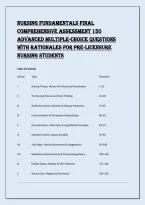
Nursing Fundamentals Final
Comprehensive Assessment 150
Advanced Multiple-Choice Questions
with Rationales for Pre-Licensure
Nursing Students
Table of Contents
Section Topic Questions
I Nursing Theory, History & Professional Foundations 1–15
II The Nursing Process & Critical Thinking 16–30
III Health Promotion, Wellness & Disease Prevention 31–45
IV Communication & Therapeutic Relationships 46–58
V Documentation, Informatics & Legal/Ethical Principles 59–75
VI Infection Control, Asepsis & Safety 76–92
VII Vital Signs, Physical Assessment & Oxygenation 93–108
VIII Medication Administration & Pharmacology Basics 109–126
IX Patient Safety, Mobility & Fall Prevention 127–138
X Wound Care, Hygiene & Elimination 139–150
,SECTION I: Nursing Theory, History & Professional Foundations (Questions 1–15)
🟢 Question 1
A nurse is explaining the history of nursing to a group of student nurses. Which historical figure is
credited with establishing the first nursing school based on formal education and sanitation principles?
A. Clara Barton
B. Florence Nightingale
C. Dorothea Dix
D. Lillian Wald
🔴🔴 Correct Answer: B. Florence Nightingale
Rationale: Florence Nightingale established the Nightingale Training School for Nurses at St. Thomas'
Hospital in London in 1860, which was the first secular nursing school based on formal education rather
than religious apprenticeship. Her emphasis on sanitation, ventilation, and hygiene during the Crimean
War dramatically reduced mortality rates from 60% to 1%. Clara Barton founded the American Red
Cross, Dorothea Dix advocated for the mentally ill, and Lillian Wald established the Henry Street
Settlement.
🟢 Question 2
A nurse is caring for a patient in the ICU who is being monitored for a possible cerebral aneurysm
following a loss of consciousness in the emergency room. The nurse anticipates preparing the patient for
ordered diagnostic tests. This nurse's knowledge of the diagnostic procedures for this condition reflects
which aspect of nursing?
A. The art of nursing
B. The science of nursing
C. The caring aspect of nursing
D. The holistic approach to nursing
🔴🔴 Correct Answer: B. The science of nursing
Rationale: The science of nursing encompasses the knowledge base derived from formal education,
research, and evidence-based practice that enables nurses to understand pathophysiology, anticipate
diagnostic procedures, and make clinical judgments. The art of nursing refers to the compassionate,
skillful delivery of care, while the caring aspect focuses on the nurse-patient relationship.
🟢 Question 3
The four major metaparadigm concepts in nursing theory are:
A. Person, Environment, Nurse, Health
B. Nurse, Person, Environment, Cure
C. Primitive, Modern, Future, Past
D. Assessment, Planning, Implementation, Evaluation
,🔴🔴 Correct Answer: A. Person, Environment, Nurse, Health
Rationale: The four metaparadigm concepts that form the foundation of nursing theory are Person (the
recipient of care), Environment (internal and external factors), Health (the state of well-being), and
Nursing (the actions and care provided). Option B incorrectly substitutes "Cure" for "Health," and
options C and D are not recognized nursing metaparadigm concepts.
🟢 Question 4
A nurse is caring for a patient who is anxious about an upcoming procedure. The nurse sits with the
patient, holds their hand, and explains the procedure in simple terms. This action best demonstrates
which nursing theorist's concepts?
A. Dorothea Orem's Self-Care Deficit Theory
B. Jean Watson's Theory of Human Caring
C. Madeleine Leininger's Transcultural Nursing
D. Imogene King's Theory of Goal Attainment
🔴🔴 Correct Answer: B. Jean Watson's Theory of Human Caring
Rationale: Jean Watson's Theory of Human Caring emphasizes the nurse-patient relationship, presence,
and the "caring moment." The nurse's actions of sitting with the patient, providing physical comfort, and
offering therapeutic communication reflect Watson's carative factors.
🟢 Question 5
A nurse is explaining the four broad aims of nursing practice to a group of nursing students. Which
examples of nursing interventions reflect the goal to "restore health"? Select all that apply.
A. A nurse counsels adolescents in a drug rehabilitation program
B. A nurse performs ROM exercises for a patient on bedrest
C. A nurse shows a diabetic patient how to inject insulin
D. A nurse recommends a yoga class for a busy executive
E. A nurse provides hospice care for a patient with end-stage cancer
F. A nurse teaches a nutrition class at a local high school
🔴🔴 Correct Answer: A, B, and C
Rationale: The goal to "restore health" involves interventions that help patients return to their optimal
level of functioning. Counseling in rehabilitation (A), performing ROM exercises (B), and teaching insulin
injection (C) all aim to restore or improve health status. Options D and F focus on health
promotion/prevention, while option E focuses on facilitating coping with end-of-life.
🟢 Question 6
Which nurse who was influential in the development of nursing in North America is regarded as the
founder of American nursing?
, A. Clara Barton
B. Lillian Wald
C. Lavinia Dock
D. Florence Nightingale
🔴🔴 Correct Answer: D. Florence Nightingale
Rationale: Florence Nightingale is universally regarded as the founder of modern nursing. While Clara
Barton founded the American Red Cross and Lillian Wald established public health nursing in the United
States, Nightingale's work established the foundation for professional nursing education and practice
worldwide.
🟢 Question 7
World War II had a tremendous effect on the nursing profession. Which development occurred during
this period?
A. The role of the nurse was broadened
B. There was a decreased emphasis on education
C. Nursing was practiced mainly in hospital settings
D. There was an overabundance of nurses
🔴🔴 Correct Answer: A. The role of the nurse was broadened
Rationale: World War II significantly expanded the scope of nursing practice as nurses took on greater
responsibilities in military and civilian healthcare settings due to physician shortages. This period also led
to increased educational requirements and specialization within nursing.
🟢 Question 8
A nurse is formulating a clinical question in PICO format. What does the letter "P" represent?
A. Comparison to another similar treatment
B. Clearly defined, focused literature review
C. Specific identification of the desired outcome
D. Explicit descriptions of the population of interest
🔴🔴 Correct Answer: D. Explicit descriptions of the population of interest
Rationale: PICO is a framework for formulating clinical questions in evidence-based practice. The letters
stand for: P (Population of interest), I (Intervention), C (Comparison), and O (Outcome). The "P"
specifically identifies the population or patient group being studied.
🟢 Question 9
A nurse is providing care to a patient from a different cultural background. The nurse takes time to learn
about the patient's cultural beliefs and incorporates them into the care plan. This demonstrates:
Comprehensive Assessment 150
Advanced Multiple-Choice Questions
with Rationales for Pre-Licensure
Nursing Students
Table of Contents
Section Topic Questions
I Nursing Theory, History & Professional Foundations 1–15
II The Nursing Process & Critical Thinking 16–30
III Health Promotion, Wellness & Disease Prevention 31–45
IV Communication & Therapeutic Relationships 46–58
V Documentation, Informatics & Legal/Ethical Principles 59–75
VI Infection Control, Asepsis & Safety 76–92
VII Vital Signs, Physical Assessment & Oxygenation 93–108
VIII Medication Administration & Pharmacology Basics 109–126
IX Patient Safety, Mobility & Fall Prevention 127–138
X Wound Care, Hygiene & Elimination 139–150
,SECTION I: Nursing Theory, History & Professional Foundations (Questions 1–15)
🟢 Question 1
A nurse is explaining the history of nursing to a group of student nurses. Which historical figure is
credited with establishing the first nursing school based on formal education and sanitation principles?
A. Clara Barton
B. Florence Nightingale
C. Dorothea Dix
D. Lillian Wald
🔴🔴 Correct Answer: B. Florence Nightingale
Rationale: Florence Nightingale established the Nightingale Training School for Nurses at St. Thomas'
Hospital in London in 1860, which was the first secular nursing school based on formal education rather
than religious apprenticeship. Her emphasis on sanitation, ventilation, and hygiene during the Crimean
War dramatically reduced mortality rates from 60% to 1%. Clara Barton founded the American Red
Cross, Dorothea Dix advocated for the mentally ill, and Lillian Wald established the Henry Street
Settlement.
🟢 Question 2
A nurse is caring for a patient in the ICU who is being monitored for a possible cerebral aneurysm
following a loss of consciousness in the emergency room. The nurse anticipates preparing the patient for
ordered diagnostic tests. This nurse's knowledge of the diagnostic procedures for this condition reflects
which aspect of nursing?
A. The art of nursing
B. The science of nursing
C. The caring aspect of nursing
D. The holistic approach to nursing
🔴🔴 Correct Answer: B. The science of nursing
Rationale: The science of nursing encompasses the knowledge base derived from formal education,
research, and evidence-based practice that enables nurses to understand pathophysiology, anticipate
diagnostic procedures, and make clinical judgments. The art of nursing refers to the compassionate,
skillful delivery of care, while the caring aspect focuses on the nurse-patient relationship.
🟢 Question 3
The four major metaparadigm concepts in nursing theory are:
A. Person, Environment, Nurse, Health
B. Nurse, Person, Environment, Cure
C. Primitive, Modern, Future, Past
D. Assessment, Planning, Implementation, Evaluation
,🔴🔴 Correct Answer: A. Person, Environment, Nurse, Health
Rationale: The four metaparadigm concepts that form the foundation of nursing theory are Person (the
recipient of care), Environment (internal and external factors), Health (the state of well-being), and
Nursing (the actions and care provided). Option B incorrectly substitutes "Cure" for "Health," and
options C and D are not recognized nursing metaparadigm concepts.
🟢 Question 4
A nurse is caring for a patient who is anxious about an upcoming procedure. The nurse sits with the
patient, holds their hand, and explains the procedure in simple terms. This action best demonstrates
which nursing theorist's concepts?
A. Dorothea Orem's Self-Care Deficit Theory
B. Jean Watson's Theory of Human Caring
C. Madeleine Leininger's Transcultural Nursing
D. Imogene King's Theory of Goal Attainment
🔴🔴 Correct Answer: B. Jean Watson's Theory of Human Caring
Rationale: Jean Watson's Theory of Human Caring emphasizes the nurse-patient relationship, presence,
and the "caring moment." The nurse's actions of sitting with the patient, providing physical comfort, and
offering therapeutic communication reflect Watson's carative factors.
🟢 Question 5
A nurse is explaining the four broad aims of nursing practice to a group of nursing students. Which
examples of nursing interventions reflect the goal to "restore health"? Select all that apply.
A. A nurse counsels adolescents in a drug rehabilitation program
B. A nurse performs ROM exercises for a patient on bedrest
C. A nurse shows a diabetic patient how to inject insulin
D. A nurse recommends a yoga class for a busy executive
E. A nurse provides hospice care for a patient with end-stage cancer
F. A nurse teaches a nutrition class at a local high school
🔴🔴 Correct Answer: A, B, and C
Rationale: The goal to "restore health" involves interventions that help patients return to their optimal
level of functioning. Counseling in rehabilitation (A), performing ROM exercises (B), and teaching insulin
injection (C) all aim to restore or improve health status. Options D and F focus on health
promotion/prevention, while option E focuses on facilitating coping with end-of-life.
🟢 Question 6
Which nurse who was influential in the development of nursing in North America is regarded as the
founder of American nursing?
, A. Clara Barton
B. Lillian Wald
C. Lavinia Dock
D. Florence Nightingale
🔴🔴 Correct Answer: D. Florence Nightingale
Rationale: Florence Nightingale is universally regarded as the founder of modern nursing. While Clara
Barton founded the American Red Cross and Lillian Wald established public health nursing in the United
States, Nightingale's work established the foundation for professional nursing education and practice
worldwide.
🟢 Question 7
World War II had a tremendous effect on the nursing profession. Which development occurred during
this period?
A. The role of the nurse was broadened
B. There was a decreased emphasis on education
C. Nursing was practiced mainly in hospital settings
D. There was an overabundance of nurses
🔴🔴 Correct Answer: A. The role of the nurse was broadened
Rationale: World War II significantly expanded the scope of nursing practice as nurses took on greater
responsibilities in military and civilian healthcare settings due to physician shortages. This period also led
to increased educational requirements and specialization within nursing.
🟢 Question 8
A nurse is formulating a clinical question in PICO format. What does the letter "P" represent?
A. Comparison to another similar treatment
B. Clearly defined, focused literature review
C. Specific identification of the desired outcome
D. Explicit descriptions of the population of interest
🔴🔴 Correct Answer: D. Explicit descriptions of the population of interest
Rationale: PICO is a framework for formulating clinical questions in evidence-based practice. The letters
stand for: P (Population of interest), I (Intervention), C (Comparison), and O (Outcome). The "P"
specifically identifies the population or patient group being studied.
🟢 Question 9
A nurse is providing care to a patient from a different cultural background. The nurse takes time to learn
about the patient's cultural beliefs and incorporates them into the care plan. This demonstrates:


