
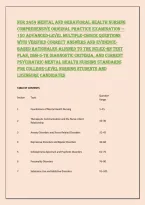
NUR 2459 MENTAL AND BEHAVIORAL HEALTH NURSING
COMPREHENSIVE ORIGINAL PRACTICE EXAMINATION —
150 ADVANCED-LEVEL MULTIPLE-CHOICE QUESTIONS
WITH VERIFIED CORRECT ANSWERS AND EVIDENCE-
BASED RATIONALES ALIGNED TO THE NCLEX-RN TEST
PLAN, DSM-5-TR DIAGNOSTIC CRITERIA, AND CURRENT
PSYCHIATRIC-MENTAL HEALTH NURSING STANDARDS
FOR COLLEGE-LEVEL NURSING STUDENTS AND
LICENSURE CANDIDATES
TABLE OF CONTENTS
Question
Section Topic
Range
1 Foundations of Mental Health Nursing 1–15
Therapeutic Communication and the Nurse–Client
2 16–30
Relationship
3 Anxiety Disorders and Stress-Related Disorders 31–45
4 Depressive Disorders and Bipolar Disorders 46–60
5 Schizophrenia Spectrum and Psychotic Disorders 61–75
6 Personality Disorders 76–90
7 Substance Use and Addictive Disorders 91–105
, Question
Section Topic
Range
8 Eating Disorders 106–115
9 Psychopharmacology 116–130
10 Crisis Intervention and Suicide Prevention 131–140
11 Legal and Ethical Issues in Mental Health Nursing 141–150
SECTION 1: FOUNDATIONS OF MENTAL HEALTH NURSING (Questions 1–15)
🟢 1. A nurse is assessing a newly admitted client's mental health status. Which factor should the nurse
identify as having the most positive impact on the client's mental health?
A. Total self-reliance without dependence on others
B. The ability to effectively manage stress and adapt to change
C. A family history of mental illness
D. Avoidance of all interpersonal conflict
🔴🔴 Correct Answer: B
Rationale: Individual factors influencing mental health include biologic makeup, autonomy,
independence, self-esteem, capacity for growth, vitality, ability to find meaning in life, emotional
resilience, sense of belonging, reality orientation, and coping or stress management abilities. Effective
stress management is a core indicator of positive mental health. Total self-reliance is not possible, and a
positive social factor is access to adequate resources. A family history of mental illness may have a
negative impact on mental health.
🟢 2. Which statement best reflects the contemporary World Health Organization (WHO) definition of
mental health?
A. Mental health is the absence of any diagnosable psychiatric disorder.
B. Mental health is a state of well-being in which an individual realizes their potential, copes with normal
stressors, works productively, and contributes to community.
C. Mental health is achieved only when a person reports consistently positive emotions and life
satisfaction.
D. Mental health is determined entirely by neurochemical balance and is independent of social factors.
🔴🔴 Correct Answer: B
,Rationale: The WHO definition conceptualizes mental health as a state of well-being involving self-
realization, productive work, coping capacity, and community contribution — not merely the absence of
illness. Options A, C, and D reflect narrow medicalized or hedonistic models that the NUR 2459
curriculum explicitly rejects in favor of a holistic, recovery-oriented framework.
🟢 3. A client is brought to the emergency department by police after stating, "I am going to jump off the
bridge tonight because the voices told me my family will be safer without me." The client denies any
medical complaint and asks to leave. Which legal criterion most directly justifies involuntary
commitment in this scenario?
A. Presence of a diagnosed mental illness alone
B. Danger to self as evidenced by a specific, lethal plan with intent and access to means
C. Inability to afford outpatient psychiatric care
D. Non-adherence to prescribed psychiatric medications in the past 30 days
🔴🔴 Correct Answer: B
Rationale: Involuntary commitment requires imminent danger to self or others, grave disability, or
inability to care for basic needs due to mental illness. A specific suicidal plan with intent, lethality, and
means clearly meets the danger-to-self criterion. A diagnosis alone, financial status, or medication non-
adherence are insufficient legal grounds for commitment under mental health statutes.
🟢 4. The nurse is assessing the factors contributing to the well-being of a newly admitted client. Which of
the following would the nurse identify as having a positive impact on the individual's mental health?
A. Not needing others for companionship
B. The ability to effectively manage stress
C. A family history of mental illness
D. Striving for total self-reliance
🔴🔴 Correct Answer: B
Rationale: Individual factors influencing mental health include biologic makeup, autonomy,
independence, self-esteem, capacity for growth, vitality, ability to find meaning in life, emotional
resilience or hardiness, sense of belonging, reality orientation, and coping or stress management
abilities. Interpersonal factors such as intimacy and a balance of separateness and connectedness are
both needed for good mental health, and therefore a healthy person would need others for
companionship.
🟢 5. A nurse is explaining the concept of homeostasis to a client. Which statement best describes
homeostasis?
A. Complete absence of anxiety
B. Stable internal balance despite external changes
C. Conscious coping strategies only
D. Emotional regulation without physical changes
🔴🔴 Correct Answer: B
, Rationale: Homeostasis is the body's ability to maintain internal stability through adaptive responses,
not merely emotional or cognitive control. It involves physiological and psychological adjustments to
maintain equilibrium; it does not require eliminating stressors or suppressing responses.
🟢 6. A patient experiencing acute stress shows tachycardia and increased blood pressure. Which system
is primarily activated?
A. Parasympathetic nervous system
B. Endocrine feedback loop
C. Sympathetic nervous system
D. Immune suppression pathway
🔴🔴 Correct Answer: C
Rationale: Acute stress activates the sympathetic nervous system, producing fight-or-flight responses
like tachycardia and hypertension. The parasympathetic nervous system is responsible for rest-and-
digest functions.
🟢 7. Which stress stage is characterized by initial activation of defense mechanisms?
A. Resistance
B. Exhaustion
C. Alarm
D. Recovery
🔴🔴 Correct Answer: C
Rationale: The alarm stage initiates physiological defense responses through sympathetic and hormonal
activation, as described in Selye's General Adaptation Syndrome. This is the first stage of the stress
response.
🟢 8. A nurse identifies coping as which of the following?
A. Automatic physiological reflexes
B. Learned responses to manage stress
C. Genetic resistance to stress
D. Temporary emotional reactions
🔴🔴 Correct Answer: B
Rationale: Coping refers to learned responses to manage stress. It is not purely automatic or genetic,
and it involves both conscious and unconscious strategies developed over time.
🟢 9. Which of the following statements about mental illness are true? (Select all that apply.)
A. Mental illness causes significant distress, impaired functioning, or both.
B. Mental illness is only due to social/cultural factors.
C. Social/cultural factors that relate to mental illness include excessive dependency on or withdrawal
from relationships.
COMPREHENSIVE ORIGINAL PRACTICE EXAMINATION —
150 ADVANCED-LEVEL MULTIPLE-CHOICE QUESTIONS
WITH VERIFIED CORRECT ANSWERS AND EVIDENCE-
BASED RATIONALES ALIGNED TO THE NCLEX-RN TEST
PLAN, DSM-5-TR DIAGNOSTIC CRITERIA, AND CURRENT
PSYCHIATRIC-MENTAL HEALTH NURSING STANDARDS
FOR COLLEGE-LEVEL NURSING STUDENTS AND
LICENSURE CANDIDATES
TABLE OF CONTENTS
Question
Section Topic
Range
1 Foundations of Mental Health Nursing 1–15
Therapeutic Communication and the Nurse–Client
2 16–30
Relationship
3 Anxiety Disorders and Stress-Related Disorders 31–45
4 Depressive Disorders and Bipolar Disorders 46–60
5 Schizophrenia Spectrum and Psychotic Disorders 61–75
6 Personality Disorders 76–90
7 Substance Use and Addictive Disorders 91–105
, Question
Section Topic
Range
8 Eating Disorders 106–115
9 Psychopharmacology 116–130
10 Crisis Intervention and Suicide Prevention 131–140
11 Legal and Ethical Issues in Mental Health Nursing 141–150
SECTION 1: FOUNDATIONS OF MENTAL HEALTH NURSING (Questions 1–15)
🟢 1. A nurse is assessing a newly admitted client's mental health status. Which factor should the nurse
identify as having the most positive impact on the client's mental health?
A. Total self-reliance without dependence on others
B. The ability to effectively manage stress and adapt to change
C. A family history of mental illness
D. Avoidance of all interpersonal conflict
🔴🔴 Correct Answer: B
Rationale: Individual factors influencing mental health include biologic makeup, autonomy,
independence, self-esteem, capacity for growth, vitality, ability to find meaning in life, emotional
resilience, sense of belonging, reality orientation, and coping or stress management abilities. Effective
stress management is a core indicator of positive mental health. Total self-reliance is not possible, and a
positive social factor is access to adequate resources. A family history of mental illness may have a
negative impact on mental health.
🟢 2. Which statement best reflects the contemporary World Health Organization (WHO) definition of
mental health?
A. Mental health is the absence of any diagnosable psychiatric disorder.
B. Mental health is a state of well-being in which an individual realizes their potential, copes with normal
stressors, works productively, and contributes to community.
C. Mental health is achieved only when a person reports consistently positive emotions and life
satisfaction.
D. Mental health is determined entirely by neurochemical balance and is independent of social factors.
🔴🔴 Correct Answer: B
,Rationale: The WHO definition conceptualizes mental health as a state of well-being involving self-
realization, productive work, coping capacity, and community contribution — not merely the absence of
illness. Options A, C, and D reflect narrow medicalized or hedonistic models that the NUR 2459
curriculum explicitly rejects in favor of a holistic, recovery-oriented framework.
🟢 3. A client is brought to the emergency department by police after stating, "I am going to jump off the
bridge tonight because the voices told me my family will be safer without me." The client denies any
medical complaint and asks to leave. Which legal criterion most directly justifies involuntary
commitment in this scenario?
A. Presence of a diagnosed mental illness alone
B. Danger to self as evidenced by a specific, lethal plan with intent and access to means
C. Inability to afford outpatient psychiatric care
D. Non-adherence to prescribed psychiatric medications in the past 30 days
🔴🔴 Correct Answer: B
Rationale: Involuntary commitment requires imminent danger to self or others, grave disability, or
inability to care for basic needs due to mental illness. A specific suicidal plan with intent, lethality, and
means clearly meets the danger-to-self criterion. A diagnosis alone, financial status, or medication non-
adherence are insufficient legal grounds for commitment under mental health statutes.
🟢 4. The nurse is assessing the factors contributing to the well-being of a newly admitted client. Which of
the following would the nurse identify as having a positive impact on the individual's mental health?
A. Not needing others for companionship
B. The ability to effectively manage stress
C. A family history of mental illness
D. Striving for total self-reliance
🔴🔴 Correct Answer: B
Rationale: Individual factors influencing mental health include biologic makeup, autonomy,
independence, self-esteem, capacity for growth, vitality, ability to find meaning in life, emotional
resilience or hardiness, sense of belonging, reality orientation, and coping or stress management
abilities. Interpersonal factors such as intimacy and a balance of separateness and connectedness are
both needed for good mental health, and therefore a healthy person would need others for
companionship.
🟢 5. A nurse is explaining the concept of homeostasis to a client. Which statement best describes
homeostasis?
A. Complete absence of anxiety
B. Stable internal balance despite external changes
C. Conscious coping strategies only
D. Emotional regulation without physical changes
🔴🔴 Correct Answer: B
, Rationale: Homeostasis is the body's ability to maintain internal stability through adaptive responses,
not merely emotional or cognitive control. It involves physiological and psychological adjustments to
maintain equilibrium; it does not require eliminating stressors or suppressing responses.
🟢 6. A patient experiencing acute stress shows tachycardia and increased blood pressure. Which system
is primarily activated?
A. Parasympathetic nervous system
B. Endocrine feedback loop
C. Sympathetic nervous system
D. Immune suppression pathway
🔴🔴 Correct Answer: C
Rationale: Acute stress activates the sympathetic nervous system, producing fight-or-flight responses
like tachycardia and hypertension. The parasympathetic nervous system is responsible for rest-and-
digest functions.
🟢 7. Which stress stage is characterized by initial activation of defense mechanisms?
A. Resistance
B. Exhaustion
C. Alarm
D. Recovery
🔴🔴 Correct Answer: C
Rationale: The alarm stage initiates physiological defense responses through sympathetic and hormonal
activation, as described in Selye's General Adaptation Syndrome. This is the first stage of the stress
response.
🟢 8. A nurse identifies coping as which of the following?
A. Automatic physiological reflexes
B. Learned responses to manage stress
C. Genetic resistance to stress
D. Temporary emotional reactions
🔴🔴 Correct Answer: B
Rationale: Coping refers to learned responses to manage stress. It is not purely automatic or genetic,
and it involves both conscious and unconscious strategies developed over time.
🟢 9. Which of the following statements about mental illness are true? (Select all that apply.)
A. Mental illness causes significant distress, impaired functioning, or both.
B. Mental illness is only due to social/cultural factors.
C. Social/cultural factors that relate to mental illness include excessive dependency on or withdrawal
from relationships.


