
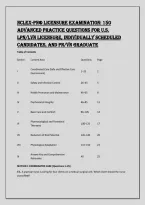
NCLEX-PN® Licensure Examination: 150
Advanced Practice Questions for U.S.
LPN/LVN Licensure, Individually Scheduled
Candidates, and PN/VN Graduate
Table of Contents
Section Content Area Questions Page
Coordinated Care (Safe and Effective Care
I 1–25 2
Environment)
II Safety and Infection Control 26–45 5
III Health Promotion and Maintenance 46–65 8
IV Psychosocial Integrity 66–85 11
V Basic Care and Comfort 86–105 14
Pharmacological and Parenteral
VI 106–125 17
Therapies
VII Reduction of Risk Potential 126–140 20
VIII Physiological Adaptation 141–150 23
Answer Key and Comprehensive
IX All 25
Rationales
SECTION I: COORDINATED CARE (Questions 1–25)
🟢 1. A practical nurse is caring for four clients on a medical-surgical unit. Which client should the nurse
assess first?
,A. A client with diabetes requesting a snack
B. A client who had a colonoscopy 2 hours ago reporting bloating
C. A client with a new onset of confusion and a heart rate of 118/min
D. A client requesting assistance with ambulation to the bathroom
🔴🔴 Correct Answer: C
Rationale: New-onset confusion with tachycardia may indicate hypoxia, hypoglycemia, sepsis, or a
cerebrovascular event. This is the most acute change and requires immediate assessment. Options A, B,
and D are routine needs that can be safely delayed. Prioritization follows Maslow's hierarchy and the
ABC framework—physiological stability takes precedence.
🟢 2. The LPN is delegating tasks to unlicensed assistive personnel (UAP). Which task is most appropriate
for the LPN to delegate?
A. Administering a PRN pain medication
B. Emptying a urinary drainage bag and recording output
C. Assessing a client's surgical incision for signs of infection
D. Teaching a client about a new low-sodium diet
🔴🔴 Correct Answer: B
Rationale: UAPs may perform tasks that do not require nursing judgment or assessment. Emptying and
recording drainage output is a routine, non-invasive task within UAP scope. Medication administration
(A), assessment (C), and teaching (D) all require the LPN's professional knowledge and are not delegable.
🟢 3. A practical nurse is reviewing a client's advance directive. The client states, "I want my daughter to
make all medical decisions for me if I cannot." Which document should the nurse verify is in the chart?
A. Living will
B. Durable power of attorney for health care
C. Do-not-resuscitate (DNR) order
D. Organ donation consent
🔴🔴 Correct Answer: B
Rationale: A durable power of attorney for health care designates a surrogate decision-maker when the
client loses capacity. A living will specifies treatments the client does or does not want but does not
designate a decision-maker. A DNR order addresses resuscitation only.
🟢 4. The nurse is preparing to administer a blood transfusion. Which action should the LPN take first?
A. Obtain the client's vital signs
B. Verify the blood product with a second nurse
C. Explain the procedure to the client
D. Insert an 18-gauge IV catheter
🔴🔴 Correct Answer: A
,Rationale: Baseline vital signs must be obtained before beginning the transfusion to serve as a
comparison if a transfusion reaction occurs. Verification (B) and client education (C) are also important,
but establishing a baseline is the priority first step.
🟢 5. A practical nurse is caring for a client who speaks limited English. Which action best ensures
informed consent?
A. Ask a family member to translate
B. Use a certified medical interpreter
C. Provide written materials in the client's language only
D. Proceed with the procedure based on the physician's explanation
🔴🔴 Correct Answer: B
Rationale: Federal law requires the use of qualified medical interpreters for clients with limited English
proficiency. Family members may not accurately convey medical information and may withhold bad
news. Written materials alone do not confirm understanding.
🟢 6. The LPN is assigned to care for a client who practices Jehovah's Witness faith. The client has a
hemoglobin of 6.8 g/dL and refuses blood transfusion. What is the nurse's priority action?
A. Administer the blood as ordered
B. Notify the provider and document the client's refusal
C. Ask the family to convince the client to accept the transfusion
D. Discharge the client against medical advice
🔴🔴 Correct Answer: B
Rationale: The client has the right to refuse any treatment based on religious beliefs. The nurse must
respect this right, notify the provider, and document the refusal. Administering blood against the client's
wishes constitutes battery.
🟢 7. A practical nurse observes a colleague administering medication without scanning the client's
wristband. What is the most appropriate initial action?
A. Report the colleague to the state board of nursing
B. Speak privately with the colleague about the concern
C. Ignore the behavior as it is not the nurse's responsibility
D. Document the incident in the client's medical record
🔴🔴 Correct Answer: B
Rationale: The nurse should first address the issue directly with the colleague in a private, non-
confrontational manner. If the behavior continues or poses immediate client harm, the nurse should
escalate through the chain of command. Reporting to the board is premature.
🟢 8. The LPN is reviewing a medication order that reads "MS 4 mg IV push q4h prn." Which action should
the nurse take?
, A. Administer the medication as ordered
B. Clarify the order with the prescribing provider
C. Ask another nurse to interpret the order
D. Hold the medication and document the refusal
🔴🔴 Correct Answer: B
Rationale: "MS" is a dangerous abbreviation that can mean morphine sulfate or magnesium sulfate. The
Joint Commission prohibits this abbreviation. The nurse must clarify the order before administration.
🟢 9. A practical nurse is working in a long-term care facility. Which client should the nurse see first?
A. A client who has not had a bowel movement in 2 days
B. A client with a new onset of drooling and difficulty swallowing
C. A client requesting pain medication for chronic arthritis
D. A client who is due for a routine blood glucose check
🔴🔴 Correct Answer: B
Rationale: New-onset drooling and difficulty swallowing may indicate a stroke, airway compromise, or
neurological emergency. This requires immediate assessment. The other clients have non-urgent needs.
🟢 10. The LPN is preparing to administer a medication via a nasogastric (NG) tube. Which action is
correct?
A. Administer the medication with the client in a supine position
B. Verify tube placement by auscultating air into the stomach
C. Flush the tube with 15–30 mL of water before and after medication
D. Mix all medications together and administer as a single bolus
🔴🔴 Correct Answer: C
Rationale: Flushing the NG tube before and after medication administration ensures patency and
prevents clogging. Tube placement should be verified by pH testing or X-ray, not auscultation. The client
should be in a semi-Fowler's position.
🟢 11. A practical nurse is caring for a client who is scheduled for surgery. The client asks, "What is a living
will?" Which response by the nurse is most appropriate?
A. "It tells the doctor what medications you can receive."
B. "It is a legal document that states what treatments you want if you become terminally ill."
C. "It allows your family to make decisions for you."
D. "It is the same as a do-not-resuscitate order."
🔴🔴 Correct Answer: B
Rationale: A living will is an advance directive that specifies the medical treatments a client wants or
does not want if they become unable to communicate and are terminally ill. It is distinct from a DNR
order and from a health care proxy.
Advanced Practice Questions for U.S.
LPN/LVN Licensure, Individually Scheduled
Candidates, and PN/VN Graduate
Table of Contents
Section Content Area Questions Page
Coordinated Care (Safe and Effective Care
I 1–25 2
Environment)
II Safety and Infection Control 26–45 5
III Health Promotion and Maintenance 46–65 8
IV Psychosocial Integrity 66–85 11
V Basic Care and Comfort 86–105 14
Pharmacological and Parenteral
VI 106–125 17
Therapies
VII Reduction of Risk Potential 126–140 20
VIII Physiological Adaptation 141–150 23
Answer Key and Comprehensive
IX All 25
Rationales
SECTION I: COORDINATED CARE (Questions 1–25)
🟢 1. A practical nurse is caring for four clients on a medical-surgical unit. Which client should the nurse
assess first?
,A. A client with diabetes requesting a snack
B. A client who had a colonoscopy 2 hours ago reporting bloating
C. A client with a new onset of confusion and a heart rate of 118/min
D. A client requesting assistance with ambulation to the bathroom
🔴🔴 Correct Answer: C
Rationale: New-onset confusion with tachycardia may indicate hypoxia, hypoglycemia, sepsis, or a
cerebrovascular event. This is the most acute change and requires immediate assessment. Options A, B,
and D are routine needs that can be safely delayed. Prioritization follows Maslow's hierarchy and the
ABC framework—physiological stability takes precedence.
🟢 2. The LPN is delegating tasks to unlicensed assistive personnel (UAP). Which task is most appropriate
for the LPN to delegate?
A. Administering a PRN pain medication
B. Emptying a urinary drainage bag and recording output
C. Assessing a client's surgical incision for signs of infection
D. Teaching a client about a new low-sodium diet
🔴🔴 Correct Answer: B
Rationale: UAPs may perform tasks that do not require nursing judgment or assessment. Emptying and
recording drainage output is a routine, non-invasive task within UAP scope. Medication administration
(A), assessment (C), and teaching (D) all require the LPN's professional knowledge and are not delegable.
🟢 3. A practical nurse is reviewing a client's advance directive. The client states, "I want my daughter to
make all medical decisions for me if I cannot." Which document should the nurse verify is in the chart?
A. Living will
B. Durable power of attorney for health care
C. Do-not-resuscitate (DNR) order
D. Organ donation consent
🔴🔴 Correct Answer: B
Rationale: A durable power of attorney for health care designates a surrogate decision-maker when the
client loses capacity. A living will specifies treatments the client does or does not want but does not
designate a decision-maker. A DNR order addresses resuscitation only.
🟢 4. The nurse is preparing to administer a blood transfusion. Which action should the LPN take first?
A. Obtain the client's vital signs
B. Verify the blood product with a second nurse
C. Explain the procedure to the client
D. Insert an 18-gauge IV catheter
🔴🔴 Correct Answer: A
,Rationale: Baseline vital signs must be obtained before beginning the transfusion to serve as a
comparison if a transfusion reaction occurs. Verification (B) and client education (C) are also important,
but establishing a baseline is the priority first step.
🟢 5. A practical nurse is caring for a client who speaks limited English. Which action best ensures
informed consent?
A. Ask a family member to translate
B. Use a certified medical interpreter
C. Provide written materials in the client's language only
D. Proceed with the procedure based on the physician's explanation
🔴🔴 Correct Answer: B
Rationale: Federal law requires the use of qualified medical interpreters for clients with limited English
proficiency. Family members may not accurately convey medical information and may withhold bad
news. Written materials alone do not confirm understanding.
🟢 6. The LPN is assigned to care for a client who practices Jehovah's Witness faith. The client has a
hemoglobin of 6.8 g/dL and refuses blood transfusion. What is the nurse's priority action?
A. Administer the blood as ordered
B. Notify the provider and document the client's refusal
C. Ask the family to convince the client to accept the transfusion
D. Discharge the client against medical advice
🔴🔴 Correct Answer: B
Rationale: The client has the right to refuse any treatment based on religious beliefs. The nurse must
respect this right, notify the provider, and document the refusal. Administering blood against the client's
wishes constitutes battery.
🟢 7. A practical nurse observes a colleague administering medication without scanning the client's
wristband. What is the most appropriate initial action?
A. Report the colleague to the state board of nursing
B. Speak privately with the colleague about the concern
C. Ignore the behavior as it is not the nurse's responsibility
D. Document the incident in the client's medical record
🔴🔴 Correct Answer: B
Rationale: The nurse should first address the issue directly with the colleague in a private, non-
confrontational manner. If the behavior continues or poses immediate client harm, the nurse should
escalate through the chain of command. Reporting to the board is premature.
🟢 8. The LPN is reviewing a medication order that reads "MS 4 mg IV push q4h prn." Which action should
the nurse take?
, A. Administer the medication as ordered
B. Clarify the order with the prescribing provider
C. Ask another nurse to interpret the order
D. Hold the medication and document the refusal
🔴🔴 Correct Answer: B
Rationale: "MS" is a dangerous abbreviation that can mean morphine sulfate or magnesium sulfate. The
Joint Commission prohibits this abbreviation. The nurse must clarify the order before administration.
🟢 9. A practical nurse is working in a long-term care facility. Which client should the nurse see first?
A. A client who has not had a bowel movement in 2 days
B. A client with a new onset of drooling and difficulty swallowing
C. A client requesting pain medication for chronic arthritis
D. A client who is due for a routine blood glucose check
🔴🔴 Correct Answer: B
Rationale: New-onset drooling and difficulty swallowing may indicate a stroke, airway compromise, or
neurological emergency. This requires immediate assessment. The other clients have non-urgent needs.
🟢 10. The LPN is preparing to administer a medication via a nasogastric (NG) tube. Which action is
correct?
A. Administer the medication with the client in a supine position
B. Verify tube placement by auscultating air into the stomach
C. Flush the tube with 15–30 mL of water before and after medication
D. Mix all medications together and administer as a single bolus
🔴🔴 Correct Answer: C
Rationale: Flushing the NG tube before and after medication administration ensures patency and
prevents clogging. Tube placement should be verified by pH testing or X-ray, not auscultation. The client
should be in a semi-Fowler's position.
🟢 11. A practical nurse is caring for a client who is scheduled for surgery. The client asks, "What is a living
will?" Which response by the nurse is most appropriate?
A. "It tells the doctor what medications you can receive."
B. "It is a legal document that states what treatments you want if you become terminally ill."
C. "It allows your family to make decisions for you."
D. "It is the same as a do-not-resuscitate order."
🔴🔴 Correct Answer: B
Rationale: A living will is an advance directive that specifies the medical treatments a client wants or
does not want if they become unable to communicate and are terminally ill. It is distinct from a DNR
order and from a health care proxy.


