
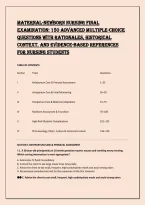
MATERNAL-NEWBORN NURSING FINAL
EXAMINATION: 150 ADVANCED MULTIPLE-CHOICE
QUESTIONS WITH RATIONALES, HISTORICAL
CONTEXT, AND EVIDENCE-BASED REFERENCES
FOR NURSING STUDENTS
TABLE OF CONTENTS
Section Topic Questions
I Antepartum Care & Prenatal Assessment 1–25
II Intrapartum Care & Fetal Monitoring 26–50
III Postpartum Care & Maternal Adaptation 51–75
IV Newborn Assessment & Transition 76–100
V High-Risk Obstetric Complications 101–125
VI Pharmacology, Ethics, Culture & Historical Context 126–150
SECTION I: ANTEPARTUM CARE & PRENATAL ASSESSMENT
🟢 1. A 28-year-old primigravida at 10 weeks gestation reports nausea and vomiting every morning.
Which nursing intervention is most appropriate?
A. Administer IV fluids immediately
B. Instruct the client to eat large meals three times daily
C. Advise the client to eat small, frequent, high-carbohydrate meals and avoid strong odors
D. Recommend complete bed rest for the remainder of the first trimester
🔴🔴 C. Advise the client to eat small, frequent, high-carbohydrate meals and avoid strong odors
,Rationale: Small, frequent meals help prevent an empty stomach, which worsens nausea. High-
carbohydrate, low-fat foods are best tolerated in early pregnancy. Avoiding strong odors reduces
triggers. Large meals and bed rest are not first-line interventions for uncomplicated morning sickness.
🟢 2. A nurse is assessing a client at 36 weeks gestation who reports sudden, painless, bright red
vaginal bleeding. Which condition does the nurse suspect?
A. Abruptio placentae
B. Preterm labor
C. Placenta previa
D. Ectopic pregnancy
🔴🔴 C. Placenta previa
Rationale: Placenta previa presents with sudden, painless, bright red vaginal bleeding because the
placenta is implanted over or near the cervical os. Abruptio placentae typically presents with painful,
dark bleeding and uterine rigidity. Ectopic pregnancy occurs before viability.
🟢 3. A client at 32 weeks gestation is diagnosed with preeclampsia. Which finding is most consistent
with this diagnosis?
A. Blood pressure of 128/82 mmHg on one occasion
B. Proteinuria of trace on dipstick
C. Blood pressure ≥140/90 mmHg on two occasions 4 hours apart with proteinuria ≥300 mg/24 hours
D. Mild dependent edema of the ankles
🔴🔴 C. Blood pressure ≥140/90 mmHg on two occasions 4 hours apart with proteinuria ≥300 mg/24
hours
Rationale: Preeclampsia is defined as a BP ≥140/90 mmHg on two occasions at least 4 hours apart after
20 weeks gestation, accompanied by proteinuria ≥300 mg in 24 hours. Mild ankle edema is common in
normal pregnancy and is not diagnostic.
🟢 4. During a routine prenatal visit, a client at 16 weeks' gestation asks why she must continue to take
a prenatal vitamin with iron. Which response by the nurse is best?
A. "Iron prevents fetal neural-tube defects."
B. "Iron supports your 50% increase in blood volume."
C. "Iron decreases your risk of gestational diabetes."
D. "Iron helps your baby gain more weight in the third trimester."
🔴🔴 B. "Iron supports your 50% increase in blood volume."
,Rationale: Maternal plasma volume expands approximately 40–50%; iron is required for new RBC
synthesis. Folate (not iron) prevents neural tube defects. Iron does not influence gestational diabetes
risk or fetal weight gain.
🟢 5. A nurse is teaching a group of pregnant women about expected cardiovascular changes during
pregnancy. Which statement indicates correct understanding?
A. "My blood pressure will increase significantly."
B. "My heart rate will decrease."
C. "My blood volume will increase by about 40–50%."
D. "My cardiac output will decrease."
🔴🔴 C. "My blood volume will increase by about 40–50%."
Rationale: Plasma volume increases by 40–50% during pregnancy to meet the demands of the
uteroplacental unit. Blood pressure typically remains stable or slightly decreases. Heart rate increases by
10–15 beats/min. Cardiac output increases by 30–50%.
🟢 6. A pregnant client at 28 weeks' gestation reports decreased fetal movement over the last 12 hours.
What is the nurse's priority action?
A. Reassure the client that fetal movement decreases in the third trimester
B. Instruct the client to drink cold water and lie on her left side, then count fetal movements
C. Schedule an immediate cesarean section
D. Tell the client to return in one week for a routine check
🔴🔴 B. Instruct the client to drink cold water and lie on her left side, then count fetal movements
Rationale: Decreased fetal movement requires immediate evaluation. Drinking cold water and lying on
the left side can stimulate fetal activity. If movement does not increase, further assessment (nonstress
test, biophysical profile) is indicated.
🟢 7. A nurse is performing a prenatal assessment on a client at 12 weeks gestation. Which finding
should be reported to the healthcare provider?
A. Fetal heart rate of 150 beats per minute
B. Uterine size consistent with 12 weeks
C. Blood pressure of 150/95 mmHg
D. Mild breast tenderness
🔴🔴 C. Blood pressure of 150/95 mmHg
Rationale: A blood pressure of 150/95 mmHg at 12 weeks gestation is abnormal and may indicate
chronic hypertension or early preeclampsia. Normal fetal heart rate at 12 weeks is 120–160 bpm.
, Uterine size at 12 weeks should be at the symphysis pubis. Breast tenderness is a normal pregnancy
change.
🟢 8. A client at 24 weeks gestation is scheduled for a glucose tolerance test. Which instruction should
the nurse provide?
A. "You must fast for 12 hours before the test."
B. "You will drink a glucose solution and your blood will be drawn one hour later."
C. "You should avoid carbohydrates for three days before the test."
D. "The test requires a 24-hour urine collection."
🔴🔴 B. "You will drink a glucose solution and your blood will be drawn one hour later."
Rationale: The one-hour glucose challenge test involves drinking a 50-g glucose solution and having
blood drawn one hour later. No fasting is required for the initial screening. A 3-hour glucose tolerance
test is performed if the screening is abnormal.
🟢 9. A nurse is assessing a client at 34 weeks gestation who reports severe headache and visual
disturbances. The client's blood pressure is 168/110 mmHg. What is the priority nursing action?
A. Administer acetaminophen for headache
B. Notify the healthcare provider immediately
C. Instruct the client to rest in a dark room
D. Document the findings and reassess in one hour
🔴🔴 B. Notify the healthcare provider immediately
Rationale: Severe headache and visual disturbances with a blood pressure of 168/110 mmHg indicate
severe preeclampsia, a obstetric emergency. Immediate provider notification is required for evaluation
and potential magnesium sulfate administration.
🟢 10. A pregnant client asks the nurse about the purpose of the quad screen. Which response is most
accurate?
A. "It diagnoses chromosomal abnormalities definitively."
B. "It screens for neural tube defects, Down syndrome, and trisomy 18."
C. "It determines the baby's gender."
D. "It assesses fetal lung maturity."
🔴🔴 B. "It screens for neural tube defects, Down syndrome, and trisomy 18."
Rationale: The quad screen measures AFP, hCG, estriol, and inhibin A to assess risk for neural tube
defects, Down syndrome, and trisomy 18. It is a screening tool, not diagnostic. Diagnostic testing
requires amniocentesis or chorionic villus sampling.
EXAMINATION: 150 ADVANCED MULTIPLE-CHOICE
QUESTIONS WITH RATIONALES, HISTORICAL
CONTEXT, AND EVIDENCE-BASED REFERENCES
FOR NURSING STUDENTS
TABLE OF CONTENTS
Section Topic Questions
I Antepartum Care & Prenatal Assessment 1–25
II Intrapartum Care & Fetal Monitoring 26–50
III Postpartum Care & Maternal Adaptation 51–75
IV Newborn Assessment & Transition 76–100
V High-Risk Obstetric Complications 101–125
VI Pharmacology, Ethics, Culture & Historical Context 126–150
SECTION I: ANTEPARTUM CARE & PRENATAL ASSESSMENT
🟢 1. A 28-year-old primigravida at 10 weeks gestation reports nausea and vomiting every morning.
Which nursing intervention is most appropriate?
A. Administer IV fluids immediately
B. Instruct the client to eat large meals three times daily
C. Advise the client to eat small, frequent, high-carbohydrate meals and avoid strong odors
D. Recommend complete bed rest for the remainder of the first trimester
🔴🔴 C. Advise the client to eat small, frequent, high-carbohydrate meals and avoid strong odors
,Rationale: Small, frequent meals help prevent an empty stomach, which worsens nausea. High-
carbohydrate, low-fat foods are best tolerated in early pregnancy. Avoiding strong odors reduces
triggers. Large meals and bed rest are not first-line interventions for uncomplicated morning sickness.
🟢 2. A nurse is assessing a client at 36 weeks gestation who reports sudden, painless, bright red
vaginal bleeding. Which condition does the nurse suspect?
A. Abruptio placentae
B. Preterm labor
C. Placenta previa
D. Ectopic pregnancy
🔴🔴 C. Placenta previa
Rationale: Placenta previa presents with sudden, painless, bright red vaginal bleeding because the
placenta is implanted over or near the cervical os. Abruptio placentae typically presents with painful,
dark bleeding and uterine rigidity. Ectopic pregnancy occurs before viability.
🟢 3. A client at 32 weeks gestation is diagnosed with preeclampsia. Which finding is most consistent
with this diagnosis?
A. Blood pressure of 128/82 mmHg on one occasion
B. Proteinuria of trace on dipstick
C. Blood pressure ≥140/90 mmHg on two occasions 4 hours apart with proteinuria ≥300 mg/24 hours
D. Mild dependent edema of the ankles
🔴🔴 C. Blood pressure ≥140/90 mmHg on two occasions 4 hours apart with proteinuria ≥300 mg/24
hours
Rationale: Preeclampsia is defined as a BP ≥140/90 mmHg on two occasions at least 4 hours apart after
20 weeks gestation, accompanied by proteinuria ≥300 mg in 24 hours. Mild ankle edema is common in
normal pregnancy and is not diagnostic.
🟢 4. During a routine prenatal visit, a client at 16 weeks' gestation asks why she must continue to take
a prenatal vitamin with iron. Which response by the nurse is best?
A. "Iron prevents fetal neural-tube defects."
B. "Iron supports your 50% increase in blood volume."
C. "Iron decreases your risk of gestational diabetes."
D. "Iron helps your baby gain more weight in the third trimester."
🔴🔴 B. "Iron supports your 50% increase in blood volume."
,Rationale: Maternal plasma volume expands approximately 40–50%; iron is required for new RBC
synthesis. Folate (not iron) prevents neural tube defects. Iron does not influence gestational diabetes
risk or fetal weight gain.
🟢 5. A nurse is teaching a group of pregnant women about expected cardiovascular changes during
pregnancy. Which statement indicates correct understanding?
A. "My blood pressure will increase significantly."
B. "My heart rate will decrease."
C. "My blood volume will increase by about 40–50%."
D. "My cardiac output will decrease."
🔴🔴 C. "My blood volume will increase by about 40–50%."
Rationale: Plasma volume increases by 40–50% during pregnancy to meet the demands of the
uteroplacental unit. Blood pressure typically remains stable or slightly decreases. Heart rate increases by
10–15 beats/min. Cardiac output increases by 30–50%.
🟢 6. A pregnant client at 28 weeks' gestation reports decreased fetal movement over the last 12 hours.
What is the nurse's priority action?
A. Reassure the client that fetal movement decreases in the third trimester
B. Instruct the client to drink cold water and lie on her left side, then count fetal movements
C. Schedule an immediate cesarean section
D. Tell the client to return in one week for a routine check
🔴🔴 B. Instruct the client to drink cold water and lie on her left side, then count fetal movements
Rationale: Decreased fetal movement requires immediate evaluation. Drinking cold water and lying on
the left side can stimulate fetal activity. If movement does not increase, further assessment (nonstress
test, biophysical profile) is indicated.
🟢 7. A nurse is performing a prenatal assessment on a client at 12 weeks gestation. Which finding
should be reported to the healthcare provider?
A. Fetal heart rate of 150 beats per minute
B. Uterine size consistent with 12 weeks
C. Blood pressure of 150/95 mmHg
D. Mild breast tenderness
🔴🔴 C. Blood pressure of 150/95 mmHg
Rationale: A blood pressure of 150/95 mmHg at 12 weeks gestation is abnormal and may indicate
chronic hypertension or early preeclampsia. Normal fetal heart rate at 12 weeks is 120–160 bpm.
, Uterine size at 12 weeks should be at the symphysis pubis. Breast tenderness is a normal pregnancy
change.
🟢 8. A client at 24 weeks gestation is scheduled for a glucose tolerance test. Which instruction should
the nurse provide?
A. "You must fast for 12 hours before the test."
B. "You will drink a glucose solution and your blood will be drawn one hour later."
C. "You should avoid carbohydrates for three days before the test."
D. "The test requires a 24-hour urine collection."
🔴🔴 B. "You will drink a glucose solution and your blood will be drawn one hour later."
Rationale: The one-hour glucose challenge test involves drinking a 50-g glucose solution and having
blood drawn one hour later. No fasting is required for the initial screening. A 3-hour glucose tolerance
test is performed if the screening is abnormal.
🟢 9. A nurse is assessing a client at 34 weeks gestation who reports severe headache and visual
disturbances. The client's blood pressure is 168/110 mmHg. What is the priority nursing action?
A. Administer acetaminophen for headache
B. Notify the healthcare provider immediately
C. Instruct the client to rest in a dark room
D. Document the findings and reassess in one hour
🔴🔴 B. Notify the healthcare provider immediately
Rationale: Severe headache and visual disturbances with a blood pressure of 168/110 mmHg indicate
severe preeclampsia, a obstetric emergency. Immediate provider notification is required for evaluation
and potential magnesium sulfate administration.
🟢 10. A pregnant client asks the nurse about the purpose of the quad screen. Which response is most
accurate?
A. "It diagnoses chromosomal abnormalities definitively."
B. "It screens for neural tube defects, Down syndrome, and trisomy 18."
C. "It determines the baby's gender."
D. "It assesses fetal lung maturity."
🔴🔴 B. "It screens for neural tube defects, Down syndrome, and trisomy 18."
Rationale: The quad screen measures AFP, hCG, estriol, and inhibin A to assess risk for neural tube
defects, Down syndrome, and trisomy 18. It is a screening tool, not diagnostic. Diagnostic testing
requires amniocentesis or chorionic villus sampling.


