
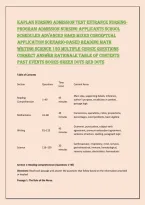
Kaplan Nursing Admission Test Entrance Nursing-
program admission Nursing applicants School
scheduled Advanced Hard Mixed Conceptual
Application Scenario-based Reading Math
Writing Science 150 Multiple Choice Questions
Correct Answer Rationale Table of Contents
Past Events Books Green Dots Red Dots
Table of Contents
Time
Section Questions Content Areas
Limit
Main idea, supporting details, inference,
Reading 45
1–40 author’s purpose, vocabulary in context,
Comprehension minutes
passage logic
45 Conversions, operations, ratios, proportions,
Mathematics 41–80
minutes percentages, word problems, basic algebra
Grammar, punctuation, subject-verb
45
Writing 81–115 agreement, pronoun-antecedent agreement,
minutes
sentence structure, spelling, paragraph logic
Cardiovascular, respiratory, renal, nervous,
30
Science 116–150 gastrointestinal, immune, hematological,
minutes
sensory systems; electrolytes; homeostasis
Section 1: Reading Comprehension (Questions 1–40)
Directions: Read each passage and answer the questions that follow based on the information provided
or implied.
Passage 1: The Role of the Nurse
,Nursing is both an art and a science. While technical skills and medical knowledge are essential, the
ability to connect with patients on a human level is equally important. Nurses must assess not only the
physical symptoms of a patient but also their emotional and psychological state. Florence Nightingale,
the founder of modern nursing, emphasized the importance of a healing environment, including
cleanliness, fresh air, and proper nutrition. Today, nurses continue to serve as advocates, educators, and
caregivers, bridging the gap between physicians and patients.
🟢 1. According to the passage, which of the following is NOT a role of a nurse?
A. Educator
B. Advocate
C. Surgeon
D. Caregiver
🔴🔴 Correct Answer: C
Rationale: The passage lists nurse roles as advocates, educators, and caregivers. Surgeon is not
mentioned as a nursing role; it is a physician's role.
🟢 2. The passage suggests that Florence Nightingale believed:
A. Technical skills are the only important aspect of nursing.
B. The environment plays a significant role in healing.
C. Nurses should not communicate with patients.
D. Physicians and nurses should not work together.
🔴🔴 Correct Answer: B
Rationale: Nightingale emphasized a healing environment including cleanliness, fresh air, and proper
nutrition.
🟢 3. The main idea of the passage is that nursing:
A. Is a purely scientific profession.
B. Requires a combination of technical skills, medical knowledge, and compassionate patient
connection.
C. Is less important than the role of a physician.
D. Has not changed since Nightingale's time.
🔴🔴 Correct Answer: B
Rationale: The passage's central theme is the dual nature of nursing as both an art (compassion) and a
science (technical skills).
Passage 2: Hand Hygiene
Hand hygiene is the single most effective way to prevent the spread of infection in healthcare settings.
The Centers for Disease Control and Prevention (CDC) recommends using alcohol-based hand sanitizers
when hands are not visibly soiled, and washing with soap and water when hands are visibly dirty, before
eating, and after using the restroom. Proper handwashing technique includes wetting hands, applying
soap, scrubbing for at least 20 seconds, rinsing, and drying with a clean towel. Despite its simplicity,
compliance among healthcare workers remains a challenge.
,🟢 4. According to the CDC, when should soap and water be used instead of hand sanitizer?
A. When hands are visibly dirty
B. After touching a patient's chart
C. Before entering a patient's room
D. When time is limited
🔴🔴 Correct Answer: A
Rationale: The passage explicitly states soap and water should be used when hands are visibly soiled,
before eating, and after using the restroom.
🟢 5. What is the recommended minimum duration for scrubbing hands during handwashing?
A. 10 seconds
B. 20 seconds
C. 30 seconds
D. 60 seconds
🔴🔴 Correct Answer: B
Rationale: The CDC recommends scrubbing for at least 20 seconds.
🟢 6. The passage implies that healthcare worker compliance with hand hygiene:
A. Is always 100%.
B. Is not a concern.
C. Could be improved despite its proven effectiveness.
D. Is irrelevant to infection control.
🔴🔴 Correct Answer: C
Rationale: The final sentence states compliance remains a challenge, implying improvement is needed.
Passage 3: The Lymphatic System
The lymphatic system is a network of tissues, vessels, and organs that work together to move a
colorless, watery fluid called lymph back into the circulatory system. Unlike the cardiovascular system,
the lymphatic system does not have a central pump. Instead, lymph is propelled through the vessels by
the contraction of skeletal muscles during movement. The primary organs of the lymphatic system
include the spleen, thymus, and tonsils. The spleen filters blood and destroys old red blood cells, while
the thymus is where T lymphocytes mature. Lymph nodes, which are small, bean-shaped structures
located along the lymphatic vessels, filter lymph and trap pathogens. When the body is fighting an
infection, lymph nodes may become swollen and tender.
🟢 7. What is the primary function of the lymphatic system?
A. To pump blood throughout the body
B. To return excess tissue fluid to the bloodstream and support immunity
C. To produce red blood cells
D. To regulate body temperature
, 🔴🔴 Correct Answer: B
Rationale: The passage states that the lymphatic system moves lymph back into the circulatory system
and describes lymph nodes trapping pathogens. This supports its dual role in fluid return and immunity.
🟢 8. According to the passage, what propels lymph through the vessels?
A. The heart
B. Skeletal muscle contractions
C. Gravity alone
D. The spleen
🔴🔴 Correct Answer: B
Rationale: The passage explicitly states that "lymph is propelled through the vessels by the contraction
of skeletal muscles during movement."
🟢 9. Which organ is responsible for filtering blood and destroying old red blood cells?
A. Thymus
B. Tonsils
C. Spleen
D. Lymph nodes
🔴🔴 Correct Answer: C
Rationale: The passage states that "the spleen filters blood and destroys old red blood cells."
🟢 10. Based on the passage, what can be inferred about swollen lymph nodes?
A. They indicate a healthy immune system
B. They are a sign the body is fighting an infection
C. They occur only in the elderly
D. They are unrelated to the lymphatic system
🔴🔴 Correct Answer: B
Rationale: The passage states that "When the body is fighting an infection, lymph nodes may become
swollen and tender."
Passage 4: Diabetes Mellitus
Diabetes mellitus is a chronic metabolic disorder characterized by high blood glucose levels resulting
from defects in insulin secretion, insulin action, or both. Type 1 diabetes is an autoimmune condition
where the body attacks insulin-producing beta cells in the pancreas. Type 2 diabetes, the most common
form, involves insulin resistance and relative insulin deficiency. Risk factors for Type 2 diabetes include
obesity, sedentary lifestyle, family history, and ethnicity. Complications of uncontrolled diabetes include
cardiovascular disease, neuropathy, nephropathy, and retinopathy. Management typically involves
lifestyle modifications, blood glucose monitoring, and pharmacotherapy.
🟢 11. What is the primary characteristic of diabetes mellitus?
A. Low blood pressure
B. High blood glucose levels
program admission Nursing applicants School
scheduled Advanced Hard Mixed Conceptual
Application Scenario-based Reading Math
Writing Science 150 Multiple Choice Questions
Correct Answer Rationale Table of Contents
Past Events Books Green Dots Red Dots
Table of Contents
Time
Section Questions Content Areas
Limit
Main idea, supporting details, inference,
Reading 45
1–40 author’s purpose, vocabulary in context,
Comprehension minutes
passage logic
45 Conversions, operations, ratios, proportions,
Mathematics 41–80
minutes percentages, word problems, basic algebra
Grammar, punctuation, subject-verb
45
Writing 81–115 agreement, pronoun-antecedent agreement,
minutes
sentence structure, spelling, paragraph logic
Cardiovascular, respiratory, renal, nervous,
30
Science 116–150 gastrointestinal, immune, hematological,
minutes
sensory systems; electrolytes; homeostasis
Section 1: Reading Comprehension (Questions 1–40)
Directions: Read each passage and answer the questions that follow based on the information provided
or implied.
Passage 1: The Role of the Nurse
,Nursing is both an art and a science. While technical skills and medical knowledge are essential, the
ability to connect with patients on a human level is equally important. Nurses must assess not only the
physical symptoms of a patient but also their emotional and psychological state. Florence Nightingale,
the founder of modern nursing, emphasized the importance of a healing environment, including
cleanliness, fresh air, and proper nutrition. Today, nurses continue to serve as advocates, educators, and
caregivers, bridging the gap between physicians and patients.
🟢 1. According to the passage, which of the following is NOT a role of a nurse?
A. Educator
B. Advocate
C. Surgeon
D. Caregiver
🔴🔴 Correct Answer: C
Rationale: The passage lists nurse roles as advocates, educators, and caregivers. Surgeon is not
mentioned as a nursing role; it is a physician's role.
🟢 2. The passage suggests that Florence Nightingale believed:
A. Technical skills are the only important aspect of nursing.
B. The environment plays a significant role in healing.
C. Nurses should not communicate with patients.
D. Physicians and nurses should not work together.
🔴🔴 Correct Answer: B
Rationale: Nightingale emphasized a healing environment including cleanliness, fresh air, and proper
nutrition.
🟢 3. The main idea of the passage is that nursing:
A. Is a purely scientific profession.
B. Requires a combination of technical skills, medical knowledge, and compassionate patient
connection.
C. Is less important than the role of a physician.
D. Has not changed since Nightingale's time.
🔴🔴 Correct Answer: B
Rationale: The passage's central theme is the dual nature of nursing as both an art (compassion) and a
science (technical skills).
Passage 2: Hand Hygiene
Hand hygiene is the single most effective way to prevent the spread of infection in healthcare settings.
The Centers for Disease Control and Prevention (CDC) recommends using alcohol-based hand sanitizers
when hands are not visibly soiled, and washing with soap and water when hands are visibly dirty, before
eating, and after using the restroom. Proper handwashing technique includes wetting hands, applying
soap, scrubbing for at least 20 seconds, rinsing, and drying with a clean towel. Despite its simplicity,
compliance among healthcare workers remains a challenge.
,🟢 4. According to the CDC, when should soap and water be used instead of hand sanitizer?
A. When hands are visibly dirty
B. After touching a patient's chart
C. Before entering a patient's room
D. When time is limited
🔴🔴 Correct Answer: A
Rationale: The passage explicitly states soap and water should be used when hands are visibly soiled,
before eating, and after using the restroom.
🟢 5. What is the recommended minimum duration for scrubbing hands during handwashing?
A. 10 seconds
B. 20 seconds
C. 30 seconds
D. 60 seconds
🔴🔴 Correct Answer: B
Rationale: The CDC recommends scrubbing for at least 20 seconds.
🟢 6. The passage implies that healthcare worker compliance with hand hygiene:
A. Is always 100%.
B. Is not a concern.
C. Could be improved despite its proven effectiveness.
D. Is irrelevant to infection control.
🔴🔴 Correct Answer: C
Rationale: The final sentence states compliance remains a challenge, implying improvement is needed.
Passage 3: The Lymphatic System
The lymphatic system is a network of tissues, vessels, and organs that work together to move a
colorless, watery fluid called lymph back into the circulatory system. Unlike the cardiovascular system,
the lymphatic system does not have a central pump. Instead, lymph is propelled through the vessels by
the contraction of skeletal muscles during movement. The primary organs of the lymphatic system
include the spleen, thymus, and tonsils. The spleen filters blood and destroys old red blood cells, while
the thymus is where T lymphocytes mature. Lymph nodes, which are small, bean-shaped structures
located along the lymphatic vessels, filter lymph and trap pathogens. When the body is fighting an
infection, lymph nodes may become swollen and tender.
🟢 7. What is the primary function of the lymphatic system?
A. To pump blood throughout the body
B. To return excess tissue fluid to the bloodstream and support immunity
C. To produce red blood cells
D. To regulate body temperature
, 🔴🔴 Correct Answer: B
Rationale: The passage states that the lymphatic system moves lymph back into the circulatory system
and describes lymph nodes trapping pathogens. This supports its dual role in fluid return and immunity.
🟢 8. According to the passage, what propels lymph through the vessels?
A. The heart
B. Skeletal muscle contractions
C. Gravity alone
D. The spleen
🔴🔴 Correct Answer: B
Rationale: The passage explicitly states that "lymph is propelled through the vessels by the contraction
of skeletal muscles during movement."
🟢 9. Which organ is responsible for filtering blood and destroying old red blood cells?
A. Thymus
B. Tonsils
C. Spleen
D. Lymph nodes
🔴🔴 Correct Answer: C
Rationale: The passage states that "the spleen filters blood and destroys old red blood cells."
🟢 10. Based on the passage, what can be inferred about swollen lymph nodes?
A. They indicate a healthy immune system
B. They are a sign the body is fighting an infection
C. They occur only in the elderly
D. They are unrelated to the lymphatic system
🔴🔴 Correct Answer: B
Rationale: The passage states that "When the body is fighting an infection, lymph nodes may become
swollen and tender."
Passage 4: Diabetes Mellitus
Diabetes mellitus is a chronic metabolic disorder characterized by high blood glucose levels resulting
from defects in insulin secretion, insulin action, or both. Type 1 diabetes is an autoimmune condition
where the body attacks insulin-producing beta cells in the pancreas. Type 2 diabetes, the most common
form, involves insulin resistance and relative insulin deficiency. Risk factors for Type 2 diabetes include
obesity, sedentary lifestyle, family history, and ethnicity. Complications of uncontrolled diabetes include
cardiovascular disease, neuropathy, nephropathy, and retinopathy. Management typically involves
lifestyle modifications, blood glucose monitoring, and pharmacotherapy.
🟢 11. What is the primary characteristic of diabetes mellitus?
A. Low blood pressure
B. High blood glucose levels


