
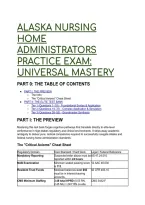
ALASKA NURSING
HOME
ADMINISTRATORS
PRACTICE EXAM:
UNIVERSAL MASTERY
PART 0: THE TABLE OF CONTENTS
● PART I: THE PREVIEW
○ The Intro
○ The "Critical Axioms" Cheat Sheet
● PART II: THE ELITE TEST BANK
○ Tier 1 (Questions 1–18) - Foundational Syntax & Application
○ Tier 2 (Questions 19–37) - Complex Application & Simulation
○ Tier 3 (Questions 38–55) - Grandmaster Synthesis
PART I: THE PREVIEW
Mastering this test bank forges cognitive pathways that translate directly to elite-level
performance in high-stakes regulatory and clinical environments. It strips away academic
ambiguity to deliver pure, tactical competence required to successfully navigate Alaska and
federal nursing home administration standards.
The "Critical Axioms" Cheat Sheet
Regulatory Domain Core Standard / Hard Deck Legal / Federal Reference
Mandatory Reporting Suspected elder abuse must be AS 47.24.010
reported within 24 hours.
NAB Examination Minimum scaled passing score 12 AAC 46.030
is 113.
Resident Trust Funds Medicaid balances over $50 42 CFR 483.10
must be in interest-bearing
accounts.
CMS Minimum Staffing 3.48 total HPRD (0.55 RN, CMS 3442-F
2.45 NA) + 24/7 RN on-site.
,Regulatory Domain Core Standard / Hard Deck Legal / Federal Reference
NLRA Strike Notice Labor unions must provide 10 NLRA Section 8(g)
days' written notice.
PDPM NTA Component Paid at 300% multiplier for days CMS PDPM
1–3, then drops to 100%.
PART II: THE ELITE TEST BANK
Tier 1 (Questions 1–18) - Foundational Syntax & Application
Q1: An applicant whose Alaska Nursing Home Administrator license has been expired for 26
months wishes to resume practice. Based on the principles of AS 08.70.140, which action is the
MOST APPROPRIATE? A) Submit a renewal application with a late penalty fee and proof of
continuing education. B) Apply for a 6-month nonrenewable provisional license while catching
up on required CEUs. C) Apply for a license in the exact same manner as an applicant who has
not been licensed before. D) Request an administrative hearing to waive the expiration period
due to hardship.
● Answer: C (Apply for a license in the exact same manner as an applicant who has not
been licensed before)
● Distractor Analysis:
○ A is incorrect: Standard renewal with a penalty only applies to lapses strictly under
24 months.
○ B is incorrect: Provisional licenses under AS 08.70.130 are for filling urgent
vacancies, not bypassing expiration protocols.
○ D is incorrect: There is no statutory provision granting the Board authority to waive
the 24-month hard limit via hearing.
The Mentor's Analysis: Statutes do not bend for administrative convenience. Once a license
expires beyond the 24-month threshold in Alaska, the administrator's slate is wiped clean, and
they revert to novice applicant status. Professional Intuition: 24 months is the absolute
point of no return for an expired Alaska NHA license.
Q2: An Administrator-in-Training (AIT) candidate in Alaska completes a 900-hour program.
Based on the principles of 12 AAC 46.050, which conclusion is the FIRST determining factor
regarding their licensure eligibility? A) The program is acceptable if the preceptor waives the
remaining 100 hours. B) The candidate is ineligible because an AIT program must consist of at
least 1,000 hours of training and education. C) The candidate is eligible to sit for the NAB exam
but must finish the 100 hours before receiving the license. D) The program is acceptable if
completed within 12 months.
● Answer: B (The candidate is ineligible because an AIT program must consist of at least
1,000 hours of training and education)
● Distractor Analysis:
○ A is incorrect: A preceptor has no legal authority to waive statutory minimums.
○ C is incorrect: The full 1,000-hour threshold must be met as a prerequisite to
fulfilling the AIT requirement.
○ D is incorrect: While timeframe rules exist (completion within two years), the
absolute minimum volume is 1,000 hours.
The Mentor's Analysis: Regulatory training minimums are hard decks. Alaska law strictly
mandates 1,000 hours under an approved preceptor to ensure clinical and operational
competence before an applicant is cleared. Professional Intuition: Never assume
, discretionary authority exists where a statute explicitly dictates a numerical minimum.
Q3: A certified nurse aide (CNA) observes a coworker verbally abusing a resident. Based on the
principles of AS 47.24.010, which action is the IMMEDIATE legal priority? A) Report the incident
to the Director of Nursing within 48 hours. B) Confront the coworker and document the
interaction in the resident's chart. C) Report the suspected abuse to Adult Protective Services
(APS) or law enforcement not later than 24 hours. D) File a grievance with the labor union
before notifying the facility administrator.
● Answer: C (Report the suspected abuse to Adult Protective Services (APS) or law
enforcement not later than 24 hours)
● Distractor Analysis:
○ A is incorrect: 48 hours violates the strict statutory 24-hour reporting mandate.
○ B is incorrect: Confrontation does not fulfill the legal obligation of a mandated
reporter to notify authorities.
○ D is incorrect: Union protocols never supersede state mandatory reporting laws.
The Mentor's Analysis: Mandated reporting is an individualized legal duty. Under Alaska law,
specific healthcare workers must report suspected abuse within 24 hours to prevent ongoing
trauma. Professional Intuition: In abuse scenarios, the 24-hour reporting clock begins the
second suspicion arises.
Q4: A Medicaid resident's personal funds account balance reaches $65. Based on the principles
of 42 CFR 483.10, which action is REQUIRED? A) Transfer the entire balance to the facility's
operating account to cover ancillary charges. B) Maintain the funds in a non-interest-bearing
petty cash fund for immediate access. C) Deposit any funds in excess of $50 into an
interest-bearing account separate from facility operating accounts. D) Notify the resident that
their SSI eligibility is at immediate risk.
● Answer: C (Deposit any funds in excess of $50 into an interest-bearing account separate
from facility operating accounts)
● Distractor Analysis:
○ A is incorrect: Commingling resident funds with facility operating accounts is a
severe federal violation.
○ B is incorrect: Medicaid resident funds over $50 must earn interest for the resident.
○ D is incorrect: The SSI risk notification is triggered at $200 below the SSI resource
limit, not at $65.
The Mentor's Analysis: Facilities act as fiduciaries for resident funds. The $50 threshold for
Medicaid residents (and $100 for Medicare) triggers the strict requirement to generate interest
on behalf of the resident in a distinct account. Professional Intuition: Commingling resident
funds with facility capital is the fastest route to an F-tag and financial penalties.
Q5: Under the CMS Patient-Driven Payment Model (PDPM), a patient requires extensive IV
medications for a severe infection. Based on the principles of PDPM, which conclusion is the
MOST LOGICAL regarding the Non-Therapy Ancillary (NTA) component? A) The NTA
component remains flat for the duration of the 100-day stay. B) The NTA component pays at a
300% multiplier for days 1 through 3, then drops to 100% on day 4. C) The NTA component
decreases by 2% every 7 days starting on day 21. D) The NTA is entirely replaced by the
nursing case-mix index.
● Answer: B (The NTA component pays at a 300% multiplier for days 1 through 3, then
drops to 100% on day 4)
● Distractor Analysis:
○ A is incorrect: PDPM utilizes a variable per diem adjustment, meaning rates change
over time.
HOME
ADMINISTRATORS
PRACTICE EXAM:
UNIVERSAL MASTERY
PART 0: THE TABLE OF CONTENTS
● PART I: THE PREVIEW
○ The Intro
○ The "Critical Axioms" Cheat Sheet
● PART II: THE ELITE TEST BANK
○ Tier 1 (Questions 1–18) - Foundational Syntax & Application
○ Tier 2 (Questions 19–37) - Complex Application & Simulation
○ Tier 3 (Questions 38–55) - Grandmaster Synthesis
PART I: THE PREVIEW
Mastering this test bank forges cognitive pathways that translate directly to elite-level
performance in high-stakes regulatory and clinical environments. It strips away academic
ambiguity to deliver pure, tactical competence required to successfully navigate Alaska and
federal nursing home administration standards.
The "Critical Axioms" Cheat Sheet
Regulatory Domain Core Standard / Hard Deck Legal / Federal Reference
Mandatory Reporting Suspected elder abuse must be AS 47.24.010
reported within 24 hours.
NAB Examination Minimum scaled passing score 12 AAC 46.030
is 113.
Resident Trust Funds Medicaid balances over $50 42 CFR 483.10
must be in interest-bearing
accounts.
CMS Minimum Staffing 3.48 total HPRD (0.55 RN, CMS 3442-F
2.45 NA) + 24/7 RN on-site.
,Regulatory Domain Core Standard / Hard Deck Legal / Federal Reference
NLRA Strike Notice Labor unions must provide 10 NLRA Section 8(g)
days' written notice.
PDPM NTA Component Paid at 300% multiplier for days CMS PDPM
1–3, then drops to 100%.
PART II: THE ELITE TEST BANK
Tier 1 (Questions 1–18) - Foundational Syntax & Application
Q1: An applicant whose Alaska Nursing Home Administrator license has been expired for 26
months wishes to resume practice. Based on the principles of AS 08.70.140, which action is the
MOST APPROPRIATE? A) Submit a renewal application with a late penalty fee and proof of
continuing education. B) Apply for a 6-month nonrenewable provisional license while catching
up on required CEUs. C) Apply for a license in the exact same manner as an applicant who has
not been licensed before. D) Request an administrative hearing to waive the expiration period
due to hardship.
● Answer: C (Apply for a license in the exact same manner as an applicant who has not
been licensed before)
● Distractor Analysis:
○ A is incorrect: Standard renewal with a penalty only applies to lapses strictly under
24 months.
○ B is incorrect: Provisional licenses under AS 08.70.130 are for filling urgent
vacancies, not bypassing expiration protocols.
○ D is incorrect: There is no statutory provision granting the Board authority to waive
the 24-month hard limit via hearing.
The Mentor's Analysis: Statutes do not bend for administrative convenience. Once a license
expires beyond the 24-month threshold in Alaska, the administrator's slate is wiped clean, and
they revert to novice applicant status. Professional Intuition: 24 months is the absolute
point of no return for an expired Alaska NHA license.
Q2: An Administrator-in-Training (AIT) candidate in Alaska completes a 900-hour program.
Based on the principles of 12 AAC 46.050, which conclusion is the FIRST determining factor
regarding their licensure eligibility? A) The program is acceptable if the preceptor waives the
remaining 100 hours. B) The candidate is ineligible because an AIT program must consist of at
least 1,000 hours of training and education. C) The candidate is eligible to sit for the NAB exam
but must finish the 100 hours before receiving the license. D) The program is acceptable if
completed within 12 months.
● Answer: B (The candidate is ineligible because an AIT program must consist of at least
1,000 hours of training and education)
● Distractor Analysis:
○ A is incorrect: A preceptor has no legal authority to waive statutory minimums.
○ C is incorrect: The full 1,000-hour threshold must be met as a prerequisite to
fulfilling the AIT requirement.
○ D is incorrect: While timeframe rules exist (completion within two years), the
absolute minimum volume is 1,000 hours.
The Mentor's Analysis: Regulatory training minimums are hard decks. Alaska law strictly
mandates 1,000 hours under an approved preceptor to ensure clinical and operational
competence before an applicant is cleared. Professional Intuition: Never assume
, discretionary authority exists where a statute explicitly dictates a numerical minimum.
Q3: A certified nurse aide (CNA) observes a coworker verbally abusing a resident. Based on the
principles of AS 47.24.010, which action is the IMMEDIATE legal priority? A) Report the incident
to the Director of Nursing within 48 hours. B) Confront the coworker and document the
interaction in the resident's chart. C) Report the suspected abuse to Adult Protective Services
(APS) or law enforcement not later than 24 hours. D) File a grievance with the labor union
before notifying the facility administrator.
● Answer: C (Report the suspected abuse to Adult Protective Services (APS) or law
enforcement not later than 24 hours)
● Distractor Analysis:
○ A is incorrect: 48 hours violates the strict statutory 24-hour reporting mandate.
○ B is incorrect: Confrontation does not fulfill the legal obligation of a mandated
reporter to notify authorities.
○ D is incorrect: Union protocols never supersede state mandatory reporting laws.
The Mentor's Analysis: Mandated reporting is an individualized legal duty. Under Alaska law,
specific healthcare workers must report suspected abuse within 24 hours to prevent ongoing
trauma. Professional Intuition: In abuse scenarios, the 24-hour reporting clock begins the
second suspicion arises.
Q4: A Medicaid resident's personal funds account balance reaches $65. Based on the principles
of 42 CFR 483.10, which action is REQUIRED? A) Transfer the entire balance to the facility's
operating account to cover ancillary charges. B) Maintain the funds in a non-interest-bearing
petty cash fund for immediate access. C) Deposit any funds in excess of $50 into an
interest-bearing account separate from facility operating accounts. D) Notify the resident that
their SSI eligibility is at immediate risk.
● Answer: C (Deposit any funds in excess of $50 into an interest-bearing account separate
from facility operating accounts)
● Distractor Analysis:
○ A is incorrect: Commingling resident funds with facility operating accounts is a
severe federal violation.
○ B is incorrect: Medicaid resident funds over $50 must earn interest for the resident.
○ D is incorrect: The SSI risk notification is triggered at $200 below the SSI resource
limit, not at $65.
The Mentor's Analysis: Facilities act as fiduciaries for resident funds. The $50 threshold for
Medicaid residents (and $100 for Medicare) triggers the strict requirement to generate interest
on behalf of the resident in a distinct account. Professional Intuition: Commingling resident
funds with facility capital is the fastest route to an F-tag and financial penalties.
Q5: Under the CMS Patient-Driven Payment Model (PDPM), a patient requires extensive IV
medications for a severe infection. Based on the principles of PDPM, which conclusion is the
MOST LOGICAL regarding the Non-Therapy Ancillary (NTA) component? A) The NTA
component remains flat for the duration of the 100-day stay. B) The NTA component pays at a
300% multiplier for days 1 through 3, then drops to 100% on day 4. C) The NTA component
decreases by 2% every 7 days starting on day 21. D) The NTA is entirely replaced by the
nursing case-mix index.
● Answer: B (The NTA component pays at a 300% multiplier for days 1 through 3, then
drops to 100% on day 4)
● Distractor Analysis:
○ A is incorrect: PDPM utilizes a variable per diem adjustment, meaning rates change
over time.


