
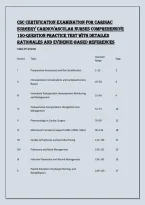
CSC Certification Examination for Cardiac
Surgery Cardiovascular Nurses Comprehensive
150-Question Practice Test with Detailed
Rationales and Evidence-Based References
Table of Contents
Question
Section Topic Page
Range
I Preoperative Assessment and Risk Stratification 1–15 2
Intraoperative Considerations and Cardiopulmonary
II 16–30 4
Bypass
Immediate Postoperative Hemodynamic Monitoring
III 31–50 6
and Management
Postoperative Complications: Recognition and
IV 51–75 10
Management
V Pharmacology in Cardiac Surgery 76–95 15
VI Mechanical Circulatory Support (IABP, ECMO, VADs) 96–110 18
VII Cardiac Arrhythmias and Epicardial Pacing 111–125 21
VIII Pulmonary and Renal Management 126–135 23
IX Infection Prevention and Wound Management 136–143 25
Patient Education, Discharge Planning, and
X 144–150 27
Rehabilitation
, Question
Section Topic Page
Range
References 29
SECTION I: PREOPERATIVE ASSESSMENT AND RISK STRATIFICATION (Questions 1–15)
🟢 1. A 72-year-old patient with severe aortic stenosis is scheduled for aortic valve replacement. Which
preoperative assessment finding would most significantly increase the patient's surgical risk?
A) Systolic murmur radiating to the carotids
B) Left ventricular ejection fraction of 35%
C) History of well-controlled hypertension
D) Mild bilateral pedal edema
🔴🔴 Correct Answer: B
Rationale: A left ventricular ejection fraction (LVEF) of 35% indicates significant left ventricular systolic
dysfunction, which is a major independent predictor of adverse outcomes following cardiac surgery. The
STS risk calculator includes LVEF as a critical variable. Patients with LVEF <40% have substantially higher
rates of postoperative mortality, prolonged mechanical ventilation, and need for inotropic support. The
other options represent expected findings in aortic stenosis or well-managed comorbidities that do not
independently confer the same level of risk.
🟢 2. When obtaining informed consent for CABG, the nurse explains that the left internal mammary
artery (LIMA) is the preferred conduit primarily because:
A) It is the easiest vessel to harvest
B) It has superior long-term patency when anastomosed to the LAD
C) It requires no additional surgical incision
D) It is less susceptible to spasm than the radial artery
🔴🔴 Correct Answer: B
Rationale: The left internal mammary artery (LIMA) provides excellent long-term graft patency,
especially when anastomosed to the left anterior descending (LAD) artery, with patency rates exceeding
90% at 10 years. This is significantly better than saphenous vein grafts, which have a 10-year patency of
approximately 50–60%. The LIMA's superior endothelial function and resistance to atherosclerosis make
it the gold standard conduit.
🟢 3. A patient scheduled for cardiac surgery reports taking clopidogrel (Plavix) 5 days ago. The nurse
should anticipate which preoperative intervention?
A) Administer vitamin K immediately
B) Proceed with surgery as planned
C) Notify the surgeon; surgery may be delayed or platelet transfusion may be required
D) Administer protamine sulfate preoperatively
,🔴🔴 Correct Answer: C
Rationale: Clopidogrel irreversibly inhibits platelet P2Y12 receptors, and its effects persist for 5–7 days
after discontinuation. For cardiac surgery, most guidelines recommend discontinuing clopidogrel at least
5 days before elective surgery to reduce bleeding risk. If surgery cannot be delayed, the surgical team
may consider platelet transfusion. Vitamin K and protamine are not effective for clopidogrel reversal.
🟢 4. Which preoperative laboratory value would be most concerning in a patient scheduled for cardiac
surgery?
A) Hemoglobin 11.5 g/dL
B) Serum creatinine 2.8 mg/dL
C) Platelet count 185,000/mm³
D) International Normalized Ratio (INR) 1.1
🔴🔴 Correct Answer: B
Rationale: A serum creatinine of 2.8 mg/dL indicates significant renal impairment. Preoperative renal
dysfunction is a major risk factor for postoperative acute kidney injury (AKI), which occurs in up to 30%
of cardiac surgery patients and is associated with increased mortality. The other values are within or
near acceptable ranges for cardiac surgery.
🟢 5. A patient with a history of heparin-induced thrombocytopenia (HIT) requires cardiac surgery.
Which anticoagulation strategy should the nurse anticipate?
A) Standard unfractionated heparin during CPB
B) Use of a direct thrombin inhibitor such as bivalirudin
C) Low molecular weight heparin during CPB
D) Protamine sulfate infusion throughout surgery
🔴🔴 Correct Answer: B
Rationale: Patients with a history of HIT must avoid all heparin products, including unfractionated
heparin and low molecular weight heparin. Bivalirudin, a direct thrombin inhibitor, is the preferred
anticoagulant for CPB in HIT patients. Protamine is a heparin reversal agent and would be ineffective
without heparin present.
🟢 6. During preoperative assessment, a patient reports a history of transient ischemic attacks (TIAs).
The nurse should recognize this as a risk factor for which postoperative complication?
A) Atrial fibrillation
B) Postoperative stroke
C) Acute kidney injury
D) Sternal wound infection
🔴🔴 Correct Answer: B
Rationale: A history of TIA or cerebrovascular disease is a significant risk factor for postoperative stroke
following cardiac surgery. Embolic events from aortic manipulation, atrial fibrillation, or carotid disease
can all contribute. The CSC test plan specifically includes stroke (embolic, hemorrhagic) as a key patient
problem under Neurology.
, 🟢 7. The nurse is reviewing preoperative medications for a patient scheduled for CABG. Which
medication should be held the morning of surgery?
A) Metoprolol (Lopressor)
B) Lisinopril (Zestril)
C) Atorvastatin (Lipitor)
D) Aspirin 81 mg
🔴🔴 Correct Answer: B
Rationale: ACE inhibitors such as lisinopril are typically held on the morning of cardiac surgery due to
the risk of refractory hypotension during induction of anesthesia and cardiopulmonary bypass. Beta-
blockers (metoprolol) and statins are generally continued, and aspirin may be continued or held based
on surgeon preference and bleeding risk.
🟢 8. A patient with a body mass index (BMI) of 42 is scheduled for cardiac surgery. The nurse should
recognize that this patient is at increased risk for:
A) Malnutrition and poor wound healing
B) Sternal wound infection and prolonged mechanical ventilation
C) Hyperkalemia and metabolic alkalosis
D) Reduced anesthetic requirements
🔴🔴 Correct Answer: B
Rationale: Obesity (BMI >40) is associated with increased rates of sternal wound infection, prolonged
mechanical ventilation, and difficulty with airway management. Adipose tissue has relatively poor
vascularity, which impairs wound healing and antibiotic delivery to the surgical site. The STS risk model
includes obesity as a risk factor for adverse outcomes.
🟢 9. When teaching a patient about preoperative breathing exercises, which instruction is most
important for preventing postoperative pulmonary complications?
A) "Breathe rapidly through your mouth to increase oxygen levels."
B) "Use the incentive spirometer 10 times every hour while awake."
C) "Limit movement of your arms to protect your sternum."
D) "Sleep flat on your back to keep your airway open."
🔴🔴 Correct Answer: B
Rationale: Incentive spirometry, used 10 times per hour while awake, is a cornerstone of postoperative
pulmonary hygiene. It helps prevent atelectasis and pneumonia by encouraging deep lung expansion.
The CSC test plan includes atelectasis (especially left lower lobe) as a key pulmonary complication
following cardiac surgery.
🟢 10. A patient undergoing cardiac surgery has a history of type 2 diabetes managed with insulin. The
nurse should anticipate which perioperative glucose management strategy?
A) Discontinue all insulin and monitor glucose every 8 hours
B) Maintain blood glucose between 140–180 mg/dL using an IV insulin infusion if needed
Surgery Cardiovascular Nurses Comprehensive
150-Question Practice Test with Detailed
Rationales and Evidence-Based References
Table of Contents
Question
Section Topic Page
Range
I Preoperative Assessment and Risk Stratification 1–15 2
Intraoperative Considerations and Cardiopulmonary
II 16–30 4
Bypass
Immediate Postoperative Hemodynamic Monitoring
III 31–50 6
and Management
Postoperative Complications: Recognition and
IV 51–75 10
Management
V Pharmacology in Cardiac Surgery 76–95 15
VI Mechanical Circulatory Support (IABP, ECMO, VADs) 96–110 18
VII Cardiac Arrhythmias and Epicardial Pacing 111–125 21
VIII Pulmonary and Renal Management 126–135 23
IX Infection Prevention and Wound Management 136–143 25
Patient Education, Discharge Planning, and
X 144–150 27
Rehabilitation
, Question
Section Topic Page
Range
References 29
SECTION I: PREOPERATIVE ASSESSMENT AND RISK STRATIFICATION (Questions 1–15)
🟢 1. A 72-year-old patient with severe aortic stenosis is scheduled for aortic valve replacement. Which
preoperative assessment finding would most significantly increase the patient's surgical risk?
A) Systolic murmur radiating to the carotids
B) Left ventricular ejection fraction of 35%
C) History of well-controlled hypertension
D) Mild bilateral pedal edema
🔴🔴 Correct Answer: B
Rationale: A left ventricular ejection fraction (LVEF) of 35% indicates significant left ventricular systolic
dysfunction, which is a major independent predictor of adverse outcomes following cardiac surgery. The
STS risk calculator includes LVEF as a critical variable. Patients with LVEF <40% have substantially higher
rates of postoperative mortality, prolonged mechanical ventilation, and need for inotropic support. The
other options represent expected findings in aortic stenosis or well-managed comorbidities that do not
independently confer the same level of risk.
🟢 2. When obtaining informed consent for CABG, the nurse explains that the left internal mammary
artery (LIMA) is the preferred conduit primarily because:
A) It is the easiest vessel to harvest
B) It has superior long-term patency when anastomosed to the LAD
C) It requires no additional surgical incision
D) It is less susceptible to spasm than the radial artery
🔴🔴 Correct Answer: B
Rationale: The left internal mammary artery (LIMA) provides excellent long-term graft patency,
especially when anastomosed to the left anterior descending (LAD) artery, with patency rates exceeding
90% at 10 years. This is significantly better than saphenous vein grafts, which have a 10-year patency of
approximately 50–60%. The LIMA's superior endothelial function and resistance to atherosclerosis make
it the gold standard conduit.
🟢 3. A patient scheduled for cardiac surgery reports taking clopidogrel (Plavix) 5 days ago. The nurse
should anticipate which preoperative intervention?
A) Administer vitamin K immediately
B) Proceed with surgery as planned
C) Notify the surgeon; surgery may be delayed or platelet transfusion may be required
D) Administer protamine sulfate preoperatively
,🔴🔴 Correct Answer: C
Rationale: Clopidogrel irreversibly inhibits platelet P2Y12 receptors, and its effects persist for 5–7 days
after discontinuation. For cardiac surgery, most guidelines recommend discontinuing clopidogrel at least
5 days before elective surgery to reduce bleeding risk. If surgery cannot be delayed, the surgical team
may consider platelet transfusion. Vitamin K and protamine are not effective for clopidogrel reversal.
🟢 4. Which preoperative laboratory value would be most concerning in a patient scheduled for cardiac
surgery?
A) Hemoglobin 11.5 g/dL
B) Serum creatinine 2.8 mg/dL
C) Platelet count 185,000/mm³
D) International Normalized Ratio (INR) 1.1
🔴🔴 Correct Answer: B
Rationale: A serum creatinine of 2.8 mg/dL indicates significant renal impairment. Preoperative renal
dysfunction is a major risk factor for postoperative acute kidney injury (AKI), which occurs in up to 30%
of cardiac surgery patients and is associated with increased mortality. The other values are within or
near acceptable ranges for cardiac surgery.
🟢 5. A patient with a history of heparin-induced thrombocytopenia (HIT) requires cardiac surgery.
Which anticoagulation strategy should the nurse anticipate?
A) Standard unfractionated heparin during CPB
B) Use of a direct thrombin inhibitor such as bivalirudin
C) Low molecular weight heparin during CPB
D) Protamine sulfate infusion throughout surgery
🔴🔴 Correct Answer: B
Rationale: Patients with a history of HIT must avoid all heparin products, including unfractionated
heparin and low molecular weight heparin. Bivalirudin, a direct thrombin inhibitor, is the preferred
anticoagulant for CPB in HIT patients. Protamine is a heparin reversal agent and would be ineffective
without heparin present.
🟢 6. During preoperative assessment, a patient reports a history of transient ischemic attacks (TIAs).
The nurse should recognize this as a risk factor for which postoperative complication?
A) Atrial fibrillation
B) Postoperative stroke
C) Acute kidney injury
D) Sternal wound infection
🔴🔴 Correct Answer: B
Rationale: A history of TIA or cerebrovascular disease is a significant risk factor for postoperative stroke
following cardiac surgery. Embolic events from aortic manipulation, atrial fibrillation, or carotid disease
can all contribute. The CSC test plan specifically includes stroke (embolic, hemorrhagic) as a key patient
problem under Neurology.
, 🟢 7. The nurse is reviewing preoperative medications for a patient scheduled for CABG. Which
medication should be held the morning of surgery?
A) Metoprolol (Lopressor)
B) Lisinopril (Zestril)
C) Atorvastatin (Lipitor)
D) Aspirin 81 mg
🔴🔴 Correct Answer: B
Rationale: ACE inhibitors such as lisinopril are typically held on the morning of cardiac surgery due to
the risk of refractory hypotension during induction of anesthesia and cardiopulmonary bypass. Beta-
blockers (metoprolol) and statins are generally continued, and aspirin may be continued or held based
on surgeon preference and bleeding risk.
🟢 8. A patient with a body mass index (BMI) of 42 is scheduled for cardiac surgery. The nurse should
recognize that this patient is at increased risk for:
A) Malnutrition and poor wound healing
B) Sternal wound infection and prolonged mechanical ventilation
C) Hyperkalemia and metabolic alkalosis
D) Reduced anesthetic requirements
🔴🔴 Correct Answer: B
Rationale: Obesity (BMI >40) is associated with increased rates of sternal wound infection, prolonged
mechanical ventilation, and difficulty with airway management. Adipose tissue has relatively poor
vascularity, which impairs wound healing and antibiotic delivery to the surgical site. The STS risk model
includes obesity as a risk factor for adverse outcomes.
🟢 9. When teaching a patient about preoperative breathing exercises, which instruction is most
important for preventing postoperative pulmonary complications?
A) "Breathe rapidly through your mouth to increase oxygen levels."
B) "Use the incentive spirometer 10 times every hour while awake."
C) "Limit movement of your arms to protect your sternum."
D) "Sleep flat on your back to keep your airway open."
🔴🔴 Correct Answer: B
Rationale: Incentive spirometry, used 10 times per hour while awake, is a cornerstone of postoperative
pulmonary hygiene. It helps prevent atelectasis and pneumonia by encouraging deep lung expansion.
The CSC test plan includes atelectasis (especially left lower lobe) as a key pulmonary complication
following cardiac surgery.
🟢 10. A patient undergoing cardiac surgery has a history of type 2 diabetes managed with insulin. The
nurse should anticipate which perioperative glucose management strategy?
A) Discontinue all insulin and monitor glucose every 8 hours
B) Maintain blood glucose between 140–180 mg/dL using an IV insulin infusion if needed


