
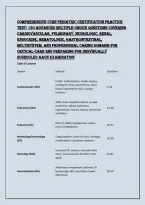
Comprehensive CCRN Pediatric Certification Practice
Test: 150 Advanced Multiple-Choice Questions Covering
Cardiovascular, Pulmonary, Neurologic, Renal,
Endocrine, Hematologic, Gastrointestinal,
Multisystem, and Professional Caring Domains for
Critical-Care RNs Preparing for Individually
Scheduled AACN Examination
Table of Contents
Domain Subtopic Questions
Cardiac malformations, cardiac surgery,
cardiogenic shock, dysrhythmias, heart
Cardiovascular (14%) 1–21
failure, hypertensive crisis, vascular
occlusion
ARDS, acute respiratory failure, air-leak
syndromes, asthma, pulmonary
Pulmonary (18%) 22–48
hypertension, thoracic trauma, mechanical
ventilation
DKA, DI, SIADH, hypoglycemia, inborn
Endocrine (5%) 49–55
errors of metabolism
Hematology/Immunology Coagulopathies, sickle cell crisis, oncologic
56–60
(3%) complications, transfusion reactions
Increased ICP, seizures, traumatic brain
Neurology (14%) injury, neuromuscular disorders, brain 61–81
death
Abdominal compartment syndrome, GI
Gastrointestinal (6%) hemorrhage, NEC, liver failure, bowel 82–90
obstruction
,Domain Subtopic Questions
AKI, HUS, electrolyte imbalances, kidney
Renal (6%) 91–99
transplant
Septic shock, MODS, trauma, burns, toxic
Multisystem (11%) 100–116
ingestions
Professional Caring & Ethical Advocacy, moral distress, end-of-life care,
117–150
Practice (20%) family-centered care, communication
Cardiovascular (Questions 1–21)
🟢 1. A 4-year-old with tetralogy of Fallot experiences a hypercyanotic spell. Which intervention should
the nurse anticipate as the priority?
A. Administration of intravenous furosemide
B. Knee-chest position and oxygen administration
🔴🔴 C. Immediate intubation and mechanical ventilation
D. Administration of intravenous morphine
Rationale: Hypercyanotic spells (Tet spells) are characterized by increased right-to-left shunting. The
priority is to decrease pulmonary vascular resistance and increase systemic vascular resistance. Knee-
chest position and oxygen are first-line interventions. Morphine may be used but is not the immediate
priority. Reference: AACN Pediatric CCRN Test Plan; Hazinski, Manual of Pediatric Critical Care.
🟢 2. A 6-month-old with hypoplastic left heart syndrome is post-Norwood procedure. Which assessment
finding is most concerning?
A. Oxygen saturation of 78%
B. Mild tachypnea
🔴🔴 C. Sudden decrease in urine output to 0.5 mL/kg/hr
D. Blood pressure of 70/40 mmHg
Rationale: After Norwood, adequate systemic perfusion depends on balanced pulmonary and systemic
blood flow. A sudden decrease in urine output indicates inadequate systemic perfusion and possible
shunt obstruction or cardiac failure. Reference: AACN Core Curriculum for Pediatric Acute and Critical
Care Nursing.
🟢 3. A 10-year-old is admitted with new-onset dilated cardiomyopathy. Which medication should the
nurse anticipate as first-line for afterload reduction?
A. Milrinone
🔴🔴 B. Enalapril
,C. Furosemide
D. Digoxin
Rationale: ACE inhibitors (e.g., enalapril) are first-line for afterload reduction in pediatric heart failure.
Milrinone is an inotrope/vasodilator used for acute decompensation. Reference: Pediatric Critical Care
Nursing; AACN Test Plan.
🟢 4. A 2-year-old with a ventricular septal defect (VSD) develops signs of heart failure. Which assessment
finding is most consistent with this complication?
A. Bradycardia
🔴🔴 B. Failure to thrive and diaphoresis with feeds
C. Hypertension
D. Decreased pulmonary blood flow
Rationale: VSD causes left-to-right shunting, leading to pulmonary overcirculation and heart failure.
Infants present with feeding difficulties, diaphoresis, and poor weight gain. Reference: AACN Pediatric
CCRN Test Plan.
🟢 5. A 14-year-old with hypertrophic cardiomyopathy is at risk for which of the following?
A. Aortic stenosis
🔴🔴 B. Sudden cardiac death during exertion
C. Mitral regurgitation
D. Pulmonary embolism
Rationale: Hypertrophic cardiomyopathy is a leading cause of sudden cardiac death in young athletes.
Outflow obstruction worsens with increased contractility and decreased preload. Reference: Pediatric
Critical Care Nursing; past CCRN exam trends.
🟢 6. A 3-year-old is post-cardiac catheterization. Which finding requires immediate intervention?
A. Mild bruising at the femoral site
B. Temperature of 37.8°C
🔴🔴 C. Loss of pedal pulse on the catheterized extremity
D. Complaint of "feeling tired"
Rationale: Loss of pedal pulse indicates arterial compromise, possibly from thrombosis or hematoma.
Immediate assessment and intervention are required. Reference: AACN Pediatric CCRN Test Plan.
🟢 7. A 5-year-old with a heart transplant is on immunosuppressants. Which finding suggests acute
rejection?
A. Weight loss
🔴🔴 B. New-onset gallop rhythm and decreased ejection fraction
C. Mild hypertension
D. Sinus tachycardia
, Rationale: Acute rejection often presents with signs of heart failure, including gallop rhythm and
decreased cardiac function. Reference: AACN Core Curriculum for Pediatric Acute and Critical Care
Nursing.
🟢 8. A 1-day-old with coarctation of the aorta is at risk for which complication?
A. Pulmonary hypertension
🔴🔴 B. Ductal-dependent systemic perfusion
C. Right-to-left shunt
D. Increased pulmonary blood flow
Rationale: Coarctation may become symptomatic when the ductus arteriosus closes, leading to poor
systemic perfusion. Prostaglandin E1 is often required to maintain ductal patency. Reference: AACN
Pediatric CCRN Test Plan.
🟢 9. A 7-year-old is on milrinone infusion. Which parameter should the nurse monitor most closely?
A. Serum potassium
🔴🔴 B. Blood pressure
C. Urine specific gravity
D. Respiratory rate
Rationale: Milrinone is a vasodilator and inotrope; hypotension is a common adverse effect. Blood
pressure monitoring is essential. Reference: Pediatric Critical Care Nursing.
🟢 10. A 12-year-old with myocarditis presents with chest pain and ST changes. Which intervention is
contraindicated?
A. Bed rest
🔴🔴 B. Strenuous activity
C. Oxygen therapy
D. Analgesia
Rationale: Myocarditis increases risk of arrhythmias and sudden death with exertion. Strict rest is
required. Reference: AACN Test Plan; past exam emphasis on myocarditis management.
🟢 11. A 3-month-old with a large VSD is scheduled for surgical repair. Which preoperative finding
indicates worsening heart failure?
A. Weight gain
🔴🔴 B. Increased respiratory rate and intercostal retractions
C. Decreased pulmonary vascular markings on chest X-ray
D. Bradycardia
Rationale: Increased work of breathing and retractions indicate pulmonary overcirculation and
worsening heart failure. Reference: AACN Core Curriculum.
🟢 12. A 9-year-old with a Fontan circulation is admitted with protein-losing enteropathy. Which
laboratory finding is most consistent?
Test: 150 Advanced Multiple-Choice Questions Covering
Cardiovascular, Pulmonary, Neurologic, Renal,
Endocrine, Hematologic, Gastrointestinal,
Multisystem, and Professional Caring Domains for
Critical-Care RNs Preparing for Individually
Scheduled AACN Examination
Table of Contents
Domain Subtopic Questions
Cardiac malformations, cardiac surgery,
cardiogenic shock, dysrhythmias, heart
Cardiovascular (14%) 1–21
failure, hypertensive crisis, vascular
occlusion
ARDS, acute respiratory failure, air-leak
syndromes, asthma, pulmonary
Pulmonary (18%) 22–48
hypertension, thoracic trauma, mechanical
ventilation
DKA, DI, SIADH, hypoglycemia, inborn
Endocrine (5%) 49–55
errors of metabolism
Hematology/Immunology Coagulopathies, sickle cell crisis, oncologic
56–60
(3%) complications, transfusion reactions
Increased ICP, seizures, traumatic brain
Neurology (14%) injury, neuromuscular disorders, brain 61–81
death
Abdominal compartment syndrome, GI
Gastrointestinal (6%) hemorrhage, NEC, liver failure, bowel 82–90
obstruction
,Domain Subtopic Questions
AKI, HUS, electrolyte imbalances, kidney
Renal (6%) 91–99
transplant
Septic shock, MODS, trauma, burns, toxic
Multisystem (11%) 100–116
ingestions
Professional Caring & Ethical Advocacy, moral distress, end-of-life care,
117–150
Practice (20%) family-centered care, communication
Cardiovascular (Questions 1–21)
🟢 1. A 4-year-old with tetralogy of Fallot experiences a hypercyanotic spell. Which intervention should
the nurse anticipate as the priority?
A. Administration of intravenous furosemide
B. Knee-chest position and oxygen administration
🔴🔴 C. Immediate intubation and mechanical ventilation
D. Administration of intravenous morphine
Rationale: Hypercyanotic spells (Tet spells) are characterized by increased right-to-left shunting. The
priority is to decrease pulmonary vascular resistance and increase systemic vascular resistance. Knee-
chest position and oxygen are first-line interventions. Morphine may be used but is not the immediate
priority. Reference: AACN Pediatric CCRN Test Plan; Hazinski, Manual of Pediatric Critical Care.
🟢 2. A 6-month-old with hypoplastic left heart syndrome is post-Norwood procedure. Which assessment
finding is most concerning?
A. Oxygen saturation of 78%
B. Mild tachypnea
🔴🔴 C. Sudden decrease in urine output to 0.5 mL/kg/hr
D. Blood pressure of 70/40 mmHg
Rationale: After Norwood, adequate systemic perfusion depends on balanced pulmonary and systemic
blood flow. A sudden decrease in urine output indicates inadequate systemic perfusion and possible
shunt obstruction or cardiac failure. Reference: AACN Core Curriculum for Pediatric Acute and Critical
Care Nursing.
🟢 3. A 10-year-old is admitted with new-onset dilated cardiomyopathy. Which medication should the
nurse anticipate as first-line for afterload reduction?
A. Milrinone
🔴🔴 B. Enalapril
,C. Furosemide
D. Digoxin
Rationale: ACE inhibitors (e.g., enalapril) are first-line for afterload reduction in pediatric heart failure.
Milrinone is an inotrope/vasodilator used for acute decompensation. Reference: Pediatric Critical Care
Nursing; AACN Test Plan.
🟢 4. A 2-year-old with a ventricular septal defect (VSD) develops signs of heart failure. Which assessment
finding is most consistent with this complication?
A. Bradycardia
🔴🔴 B. Failure to thrive and diaphoresis with feeds
C. Hypertension
D. Decreased pulmonary blood flow
Rationale: VSD causes left-to-right shunting, leading to pulmonary overcirculation and heart failure.
Infants present with feeding difficulties, diaphoresis, and poor weight gain. Reference: AACN Pediatric
CCRN Test Plan.
🟢 5. A 14-year-old with hypertrophic cardiomyopathy is at risk for which of the following?
A. Aortic stenosis
🔴🔴 B. Sudden cardiac death during exertion
C. Mitral regurgitation
D. Pulmonary embolism
Rationale: Hypertrophic cardiomyopathy is a leading cause of sudden cardiac death in young athletes.
Outflow obstruction worsens with increased contractility and decreased preload. Reference: Pediatric
Critical Care Nursing; past CCRN exam trends.
🟢 6. A 3-year-old is post-cardiac catheterization. Which finding requires immediate intervention?
A. Mild bruising at the femoral site
B. Temperature of 37.8°C
🔴🔴 C. Loss of pedal pulse on the catheterized extremity
D. Complaint of "feeling tired"
Rationale: Loss of pedal pulse indicates arterial compromise, possibly from thrombosis or hematoma.
Immediate assessment and intervention are required. Reference: AACN Pediatric CCRN Test Plan.
🟢 7. A 5-year-old with a heart transplant is on immunosuppressants. Which finding suggests acute
rejection?
A. Weight loss
🔴🔴 B. New-onset gallop rhythm and decreased ejection fraction
C. Mild hypertension
D. Sinus tachycardia
, Rationale: Acute rejection often presents with signs of heart failure, including gallop rhythm and
decreased cardiac function. Reference: AACN Core Curriculum for Pediatric Acute and Critical Care
Nursing.
🟢 8. A 1-day-old with coarctation of the aorta is at risk for which complication?
A. Pulmonary hypertension
🔴🔴 B. Ductal-dependent systemic perfusion
C. Right-to-left shunt
D. Increased pulmonary blood flow
Rationale: Coarctation may become symptomatic when the ductus arteriosus closes, leading to poor
systemic perfusion. Prostaglandin E1 is often required to maintain ductal patency. Reference: AACN
Pediatric CCRN Test Plan.
🟢 9. A 7-year-old is on milrinone infusion. Which parameter should the nurse monitor most closely?
A. Serum potassium
🔴🔴 B. Blood pressure
C. Urine specific gravity
D. Respiratory rate
Rationale: Milrinone is a vasodilator and inotrope; hypotension is a common adverse effect. Blood
pressure monitoring is essential. Reference: Pediatric Critical Care Nursing.
🟢 10. A 12-year-old with myocarditis presents with chest pain and ST changes. Which intervention is
contraindicated?
A. Bed rest
🔴🔴 B. Strenuous activity
C. Oxygen therapy
D. Analgesia
Rationale: Myocarditis increases risk of arrhythmias and sudden death with exertion. Strict rest is
required. Reference: AACN Test Plan; past exam emphasis on myocarditis management.
🟢 11. A 3-month-old with a large VSD is scheduled for surgical repair. Which preoperative finding
indicates worsening heart failure?
A. Weight gain
🔴🔴 B. Increased respiratory rate and intercostal retractions
C. Decreased pulmonary vascular markings on chest X-ray
D. Bradycardia
Rationale: Increased work of breathing and retractions indicate pulmonary overcirculation and
worsening heart failure. Reference: AACN Core Curriculum.
🟢 12. A 9-year-old with a Fontan circulation is admitted with protein-losing enteropathy. Which
laboratory finding is most consistent?


