
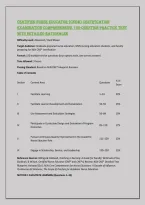
Certified Nurse Educator (CNE®) Certification
Examination Comprehensive 150-Question Practice Test
with Detailed Rationales
Difficulty Level: Advanced / Hard Mixed
Target Audience: Graduate-prepared nurse educators, MSN nursing education students, and faculty
preparing for NLN CNE® certification
Format: 150 multiple-choice questions (four options each, one correct answer)
Time Allowed: 3 hours
Passing Standard: Based on NLN CNE® blueprint domains
Table of Contents
% of
Section Content Area Questions
Exam
I Facilitate Learning 1–33 22%
II Facilitate Learner Development and Socialization 34–55 15%
III Use Assessment and Evaluation Strategies 56–84 19%
Participate in Curriculum Design and Evaluation of Program
IV 85–110 17%
Outcomes
Pursue Continuous Quality Improvement in the Academic
V 111–129 12%
Nurse Educator Role
VI Engage in Scholarship, Service, and Leadership 130–150 15%
Reference Sources: Billings & Halstead, Teaching in Nursing: A Guide for Faculty; Wittmann-Price,
Godshall, & Wilson, Certified Nurse Educator (CNE® and CNE®n) Review; NLN CNE® Detailed Test
Blueprint; Halstead (Ed.), NLN Core Competencies for Nurse Educators: A Decade of Influence;
Christensen & Simmons, The Scope of Practice for Academic Nurse Educators
SECTION I: FACILITATE LEARNING (Questions 1–33)
,🟢 1. A nurse educator is designing a learning activity for a group of Generation Z prelicensure students.
Which teaching strategy best aligns with the generational learning preferences of this cohort?
A. Traditional lecture with PowerPoint slides and note-taking
B. Flipped classroom with pre-class digital modules and in-class active learning
C. Assigned textbook readings followed by written reflection papers
D. Instructor-led demonstration with return demonstration in the skills lab
🔴 🔴 Correct Answer: B
Rationale: Generation Z learners (born approximately 1995–2012) prefer technology-enhanced,
interactive learning environments and value immediate feedback and visual learning. A flipped
classroom with pre-class digital modules and in-class active learning aligns with their comfort with
technology and desire for engagement. Traditional lecture (A) is less effective for this cohort. While
demonstration (D) is valuable for psychomotor skills, it does not represent the broadest generational
alignment. Source: Billings & Halstead, Teaching in Nursing
🟢 2. A nurse educator is teaching in a clinical setting where a student makes a medication error. The
educator recognizes this as a “near miss” rather than a sentinel event. Which action by the educator
best reflects the principle of creating a safe learning environment?
A. Report the student to the program director immediately
B. Debrief with the student privately, focusing on system factors and learning opportunities
C. Remove the student from clinical for the remainder of the day
D. Document the error in the student’s permanent academic record
🔴 🔴 Correct Answer: B
Rationale: Creating a safe learning environment requires that errors be treated as learning
opportunities. Debriefing privately and focusing on system factors aligns with evidence-based practice in
nursing education. The educator must “foster a safe learning environment” and respond effectively to
unexpected events. Immediate reporting (A) may be necessary in some cases, but the best first action in
a near miss is educational debriefing. Removal from clinical (C) may be warranted only if patient safety is
at risk. Permanent documentation (D) may be premature.
🟢 3. Which of the following best describes the application of constructivist learning theory in nursing
education?
A. The educator delivers content in a structured, sequential manner with frequent quizzing
B. Learners build new knowledge by connecting it to prior experiences and actively constructing
meaning
C. The educator reinforces desired behaviors through a system of rewards and consequences
D. Learning occurs primarily through observation and imitation of expert role models
🔴 🔴 Correct Answer: B
Rationale: Constructivism, rooted in the work of Piaget, Vygotsky, and Dewey, posits that learners
construct knowledge through active engagement, connecting new information to prior knowledge and
experiences. This is a foundational educational theory in nursing education. Option A reflects
behaviorism. Option C reflects operant conditioning. Option D reflects social learning theory.
,🟢 4. A nurse educator is preparing to teach a complex skill in the simulation laboratory. Which
sequence reflects the optimal application of the “see one, do one, teach one” model adapted for
simulation?
A. Demonstration → independent practice → return demonstration → peer teaching
B. Return demonstration → demonstration → peer teaching → independent practice
C. Independent practice → demonstration → return demonstration → peer teaching
D. Demonstration → return demonstration → independent practice → peer teaching
🔴 🔴 Correct Answer: D
Rationale: The evidence-based sequence for psychomotor skill acquisition begins with educator
demonstration, followed by learner return demonstration with feedback, then independent practice,
and finally peer teaching to reinforce mastery. This sequence aligns with the psychomotor domain of
learning and best practices in simulation.
🟢 5. A nurse educator notices that a group of students is consistently disengaged during didactic
lectures. Which strategy would best promote active learning in this context?
A. Increasing the number of PowerPoint slides to cover more content
B. Incorporating think-pair-share activities and audience response systems
C. Recording lectures and posting them online for students to watch at home
D. Administering weekly quizzes to increase accountability
🔴 🔴 Correct Answer: B
Rationale: Think-pair-share activities and audience response systems are evidence-based active learning
strategies that engage learners in the classroom. Active learning has been shown to improve retention
and critical thinking. Option A increases passive content delivery. Option C may be helpful but does not
directly address in-class engagement. Option D increases accountability but does not inherently
promote active learning.
🟢 6. A nurse educator is teaching a culturally diverse group of students. One student from a collectivist
culture rarely speaks up in class. Which action by the educator best demonstrates cultural
responsiveness?
A. Call on the student directly to encourage participation
B. Assume the student is unprepared and provide remedial resources
C. Incorporate small-group activities that allow for collaborative contribution
D. Refer the student to the academic support center for communication skills
🔴 🔴 Correct Answer: C
Rationale: Culturally responsive teaching recognizes that learners from collectivist cultures may prefer
collaborative learning over individual verbal participation. Small-group activities allow for meaningful
contribution without the pressure of individual public speaking. The educator must “modify teaching
strategies and learning experiences based on consideration of learners’ cultural background”. Calling on
the student directly (A) may increase anxiety. Assuming lack of preparation (B) is biased. Referral (D) is
premature.
🟢 7. Which teaching strategy is most appropriate for helping students develop clinical reasoning skills?
, A. Requiring students to memorize laboratory values and diagnostic criteria
B. Using unfolding case studies with progressive disclosure of information
C. Lecturing on pathophysiology with detailed slides
D. Assigning students to read textbook chapters and complete worksheets
🔴 🔴 Correct Answer: B
Rationale: Unfolding case studies with progressive disclosure simulate the real-world clinical reasoning
process, requiring learners to gather data, interpret findings, and make decisions as new information
emerges. This strategy develops critical thinking and clinical judgment. Memorization (A) and lecture (C)
are lower-level cognitive strategies. Reading and worksheets (D) are passive learning methods.
🟢 8. A nurse educator is using Socratic questioning in a post-conference debriefing. Which question
best reflects this technique?
A. “Did you complete all your assigned tasks today?”
B. “What evidence supports your decision to prioritize that patient?”
C. “Can you list the five rights of medication administration?”
D. “Why were you late to clinical this morning?”
🔴 🔴 Correct Answer: B
Rationale: Socratic questioning probes the learner’s reasoning and evidence base. Asking “What
evidence supports your decision?” requires the learner to articulate clinical reasoning and justify their
actions, promoting critical thinking. Option A is a yes/no question. Option C is a recall question. Option D
is confrontational and not Socratic.
🟢 9. A nurse educator is teaching a hybrid course. Which technology tool best supports formative
assessment and immediate feedback?
A. A course management system for posting grades
B. Audience response systems (clickers) for in-class polling
C. A discussion board for asynchronous reflection
D. A plagiarism detection tool for written assignments
🔴 🔴 Correct Answer: B
Rationale: Audience response systems provide immediate feedback to both learners and the educator,
allowing real-time adjustment of teaching. This supports formative assessment. Posting grades (A) is
summative. Discussion boards (C) are reflective but not immediate. Plagiarism detection (D) is not
formative assessment.
🟢 10. Which action by the nurse educator best demonstrates enthusiasm for teaching that inspires and
motivates students?
A. Sharing personal clinical experiences that illustrate the relevance of content
B. Strictly adhering to the syllabus without deviation
C. Maintaining a formal, distant relationship with students
D. Emphasizing the difficulty of the NCLEX® examination at every session
Examination Comprehensive 150-Question Practice Test
with Detailed Rationales
Difficulty Level: Advanced / Hard Mixed
Target Audience: Graduate-prepared nurse educators, MSN nursing education students, and faculty
preparing for NLN CNE® certification
Format: 150 multiple-choice questions (four options each, one correct answer)
Time Allowed: 3 hours
Passing Standard: Based on NLN CNE® blueprint domains
Table of Contents
% of
Section Content Area Questions
Exam
I Facilitate Learning 1–33 22%
II Facilitate Learner Development and Socialization 34–55 15%
III Use Assessment and Evaluation Strategies 56–84 19%
Participate in Curriculum Design and Evaluation of Program
IV 85–110 17%
Outcomes
Pursue Continuous Quality Improvement in the Academic
V 111–129 12%
Nurse Educator Role
VI Engage in Scholarship, Service, and Leadership 130–150 15%
Reference Sources: Billings & Halstead, Teaching in Nursing: A Guide for Faculty; Wittmann-Price,
Godshall, & Wilson, Certified Nurse Educator (CNE® and CNE®n) Review; NLN CNE® Detailed Test
Blueprint; Halstead (Ed.), NLN Core Competencies for Nurse Educators: A Decade of Influence;
Christensen & Simmons, The Scope of Practice for Academic Nurse Educators
SECTION I: FACILITATE LEARNING (Questions 1–33)
,🟢 1. A nurse educator is designing a learning activity for a group of Generation Z prelicensure students.
Which teaching strategy best aligns with the generational learning preferences of this cohort?
A. Traditional lecture with PowerPoint slides and note-taking
B. Flipped classroom with pre-class digital modules and in-class active learning
C. Assigned textbook readings followed by written reflection papers
D. Instructor-led demonstration with return demonstration in the skills lab
🔴 🔴 Correct Answer: B
Rationale: Generation Z learners (born approximately 1995–2012) prefer technology-enhanced,
interactive learning environments and value immediate feedback and visual learning. A flipped
classroom with pre-class digital modules and in-class active learning aligns with their comfort with
technology and desire for engagement. Traditional lecture (A) is less effective for this cohort. While
demonstration (D) is valuable for psychomotor skills, it does not represent the broadest generational
alignment. Source: Billings & Halstead, Teaching in Nursing
🟢 2. A nurse educator is teaching in a clinical setting where a student makes a medication error. The
educator recognizes this as a “near miss” rather than a sentinel event. Which action by the educator
best reflects the principle of creating a safe learning environment?
A. Report the student to the program director immediately
B. Debrief with the student privately, focusing on system factors and learning opportunities
C. Remove the student from clinical for the remainder of the day
D. Document the error in the student’s permanent academic record
🔴 🔴 Correct Answer: B
Rationale: Creating a safe learning environment requires that errors be treated as learning
opportunities. Debriefing privately and focusing on system factors aligns with evidence-based practice in
nursing education. The educator must “foster a safe learning environment” and respond effectively to
unexpected events. Immediate reporting (A) may be necessary in some cases, but the best first action in
a near miss is educational debriefing. Removal from clinical (C) may be warranted only if patient safety is
at risk. Permanent documentation (D) may be premature.
🟢 3. Which of the following best describes the application of constructivist learning theory in nursing
education?
A. The educator delivers content in a structured, sequential manner with frequent quizzing
B. Learners build new knowledge by connecting it to prior experiences and actively constructing
meaning
C. The educator reinforces desired behaviors through a system of rewards and consequences
D. Learning occurs primarily through observation and imitation of expert role models
🔴 🔴 Correct Answer: B
Rationale: Constructivism, rooted in the work of Piaget, Vygotsky, and Dewey, posits that learners
construct knowledge through active engagement, connecting new information to prior knowledge and
experiences. This is a foundational educational theory in nursing education. Option A reflects
behaviorism. Option C reflects operant conditioning. Option D reflects social learning theory.
,🟢 4. A nurse educator is preparing to teach a complex skill in the simulation laboratory. Which
sequence reflects the optimal application of the “see one, do one, teach one” model adapted for
simulation?
A. Demonstration → independent practice → return demonstration → peer teaching
B. Return demonstration → demonstration → peer teaching → independent practice
C. Independent practice → demonstration → return demonstration → peer teaching
D. Demonstration → return demonstration → independent practice → peer teaching
🔴 🔴 Correct Answer: D
Rationale: The evidence-based sequence for psychomotor skill acquisition begins with educator
demonstration, followed by learner return demonstration with feedback, then independent practice,
and finally peer teaching to reinforce mastery. This sequence aligns with the psychomotor domain of
learning and best practices in simulation.
🟢 5. A nurse educator notices that a group of students is consistently disengaged during didactic
lectures. Which strategy would best promote active learning in this context?
A. Increasing the number of PowerPoint slides to cover more content
B. Incorporating think-pair-share activities and audience response systems
C. Recording lectures and posting them online for students to watch at home
D. Administering weekly quizzes to increase accountability
🔴 🔴 Correct Answer: B
Rationale: Think-pair-share activities and audience response systems are evidence-based active learning
strategies that engage learners in the classroom. Active learning has been shown to improve retention
and critical thinking. Option A increases passive content delivery. Option C may be helpful but does not
directly address in-class engagement. Option D increases accountability but does not inherently
promote active learning.
🟢 6. A nurse educator is teaching a culturally diverse group of students. One student from a collectivist
culture rarely speaks up in class. Which action by the educator best demonstrates cultural
responsiveness?
A. Call on the student directly to encourage participation
B. Assume the student is unprepared and provide remedial resources
C. Incorporate small-group activities that allow for collaborative contribution
D. Refer the student to the academic support center for communication skills
🔴 🔴 Correct Answer: C
Rationale: Culturally responsive teaching recognizes that learners from collectivist cultures may prefer
collaborative learning over individual verbal participation. Small-group activities allow for meaningful
contribution without the pressure of individual public speaking. The educator must “modify teaching
strategies and learning experiences based on consideration of learners’ cultural background”. Calling on
the student directly (A) may increase anxiety. Assuming lack of preparation (B) is biased. Referral (D) is
premature.
🟢 7. Which teaching strategy is most appropriate for helping students develop clinical reasoning skills?
, A. Requiring students to memorize laboratory values and diagnostic criteria
B. Using unfolding case studies with progressive disclosure of information
C. Lecturing on pathophysiology with detailed slides
D. Assigning students to read textbook chapters and complete worksheets
🔴 🔴 Correct Answer: B
Rationale: Unfolding case studies with progressive disclosure simulate the real-world clinical reasoning
process, requiring learners to gather data, interpret findings, and make decisions as new information
emerges. This strategy develops critical thinking and clinical judgment. Memorization (A) and lecture (C)
are lower-level cognitive strategies. Reading and worksheets (D) are passive learning methods.
🟢 8. A nurse educator is using Socratic questioning in a post-conference debriefing. Which question
best reflects this technique?
A. “Did you complete all your assigned tasks today?”
B. “What evidence supports your decision to prioritize that patient?”
C. “Can you list the five rights of medication administration?”
D. “Why were you late to clinical this morning?”
🔴 🔴 Correct Answer: B
Rationale: Socratic questioning probes the learner’s reasoning and evidence base. Asking “What
evidence supports your decision?” requires the learner to articulate clinical reasoning and justify their
actions, promoting critical thinking. Option A is a yes/no question. Option C is a recall question. Option D
is confrontational and not Socratic.
🟢 9. A nurse educator is teaching a hybrid course. Which technology tool best supports formative
assessment and immediate feedback?
A. A course management system for posting grades
B. Audience response systems (clickers) for in-class polling
C. A discussion board for asynchronous reflection
D. A plagiarism detection tool for written assignments
🔴 🔴 Correct Answer: B
Rationale: Audience response systems provide immediate feedback to both learners and the educator,
allowing real-time adjustment of teaching. This supports formative assessment. Posting grades (A) is
summative. Discussion boards (C) are reflective but not immediate. Plagiarism detection (D) is not
formative assessment.
🟢 10. Which action by the nurse educator best demonstrates enthusiasm for teaching that inspires and
motivates students?
A. Sharing personal clinical experiences that illustrate the relevance of content
B. Strictly adhering to the syllabus without deviation
C. Maintaining a formal, distant relationship with students
D. Emphasizing the difficulty of the NCLEX® examination at every session


