
A-LEVEL MATHEMATICS / TERMS, TOTALS AND INDICES / INDEPENDENT SUPPLEMENT
METHOD SUMMARY + ORIGINAL PRACTICE
Sequences and series:
term, total or time?
A-Level Maths
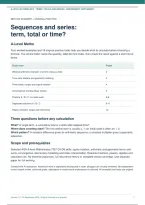
Four worked examples and 18 original practice tasks help you decide what to calculate before choosing a
formula. The central habit: name the quantity, label the first index, then check the result against a short list of
terms.
Study route Pages
Worked arithmetic example: one term versus a total 2
Time-zero timeline and geometric indexing 3
Finite totals, ranges and sigma notation 4
Convergence and boundary checks 5
Practice A / B / C: six tasks each 6-8
Separated solutions A / B / C 9-11
Repair checklist, scope and references 12
Three questions before any calculation
What? A single term, a cumulative total or a state after elapsed time?
Where does counting start? The first ordinal term is usually u_1; an initial state is often at t = 0.
Which pattern? A constant difference gives an arithmetic sequence; a constant multiplier gives a geometric
sequence.
Scope and prerequisites
Selected AQA A-level Mathematics 7357 D3-D6 skills: sigma notation, arithmetic and geometric terms and
sums, convergence, elementary modelling and index interpretation. Requires fractions, powers, algebra and
calculator use. No binomial expansion, full recurrence theory or complete-course coverage. Use separate
paper for full working.
Created with AI assistance. Numerical work is separately recomputed in code; all pages are visually reviewed. No independent
human expert review, achieved grade, attendance or exam-board endorsement is claimed. All examples and tasks are original.
Version 1.0 | 30 September 2026 | Original methods and practice 1
, A-LEVEL MATHEMATICS / TERMS, TOTALS AND INDICES / INDEPENDENT SUPPLEMENT
01 / IDENTIFY THE OBJECT
One entry is not the total
Write u_n for the nth term and S_n for the sum of the first n terms. The subscript describes a position or a
count, not a multiplication. In typed expressions, ^ means a power; in handwritten work use superscripts.
Worked example A: weekly additions
A club adds 14 tokens in week 1, 18 in week 2 and 22 in week 3, continuing with a constant increase of 4
tokens each week. How many are added in week 6, and how many altogether in weeks 1-6?
Week n 1 2 3 4 5 6
Added u_n 14 18 22 26 30 34
Total S_n 14 32 54 80 110 144
One week: u_6 = 14 + (6 - 1)4 = 34 tokens. There are five changes after the first week.
All six weeks: S_6 = 6(14 + 34)/2 = 144 tokens. Six times the average of the first and last terms gives the
total.
Why the arithmetic sum works
For an arithmetic sequence, first plus last equals second plus second-last. Write the sum forwards and
backwards and add: each paired column is a + u_n, and there are n columns. Thus 2S_n = n(a + u_n). This
derivation works for odd n too.
Need Formula and interpretation
nth term u_n = a + (n - 1)d; n - 1 steps from u_1.
First n terms S_n = n[2a + (n - 1)d]/2 = n(a + u_n)/2.
Terms p through q S_q - S_(p-1), with q - p + 1 terms.
Check: 144 lies between 6 x 14 = 84 and 6 x 34 = 204. A total of positive terms must be at least as large as any included term.
These checks catch some errors, but do not replace the calculation.
Version 1.0 | 30 September 2026 | Original methods and practice 2
METHOD SUMMARY + ORIGINAL PRACTICE
Sequences and series:
term, total or time?
A-Level Maths
Four worked examples and 18 original practice tasks help you decide what to calculate before choosing a
formula. The central habit: name the quantity, label the first index, then check the result against a short list of
terms.
Study route Pages
Worked arithmetic example: one term versus a total 2
Time-zero timeline and geometric indexing 3
Finite totals, ranges and sigma notation 4
Convergence and boundary checks 5
Practice A / B / C: six tasks each 6-8
Separated solutions A / B / C 9-11
Repair checklist, scope and references 12
Three questions before any calculation
What? A single term, a cumulative total or a state after elapsed time?
Where does counting start? The first ordinal term is usually u_1; an initial state is often at t = 0.
Which pattern? A constant difference gives an arithmetic sequence; a constant multiplier gives a geometric
sequence.
Scope and prerequisites
Selected AQA A-level Mathematics 7357 D3-D6 skills: sigma notation, arithmetic and geometric terms and
sums, convergence, elementary modelling and index interpretation. Requires fractions, powers, algebra and
calculator use. No binomial expansion, full recurrence theory or complete-course coverage. Use separate
paper for full working.
Created with AI assistance. Numerical work is separately recomputed in code; all pages are visually reviewed. No independent
human expert review, achieved grade, attendance or exam-board endorsement is claimed. All examples and tasks are original.
Version 1.0 | 30 September 2026 | Original methods and practice 1
, A-LEVEL MATHEMATICS / TERMS, TOTALS AND INDICES / INDEPENDENT SUPPLEMENT
01 / IDENTIFY THE OBJECT
One entry is not the total
Write u_n for the nth term and S_n for the sum of the first n terms. The subscript describes a position or a
count, not a multiplication. In typed expressions, ^ means a power; in handwritten work use superscripts.
Worked example A: weekly additions
A club adds 14 tokens in week 1, 18 in week 2 and 22 in week 3, continuing with a constant increase of 4
tokens each week. How many are added in week 6, and how many altogether in weeks 1-6?
Week n 1 2 3 4 5 6
Added u_n 14 18 22 26 30 34
Total S_n 14 32 54 80 110 144
One week: u_6 = 14 + (6 - 1)4 = 34 tokens. There are five changes after the first week.
All six weeks: S_6 = 6(14 + 34)/2 = 144 tokens. Six times the average of the first and last terms gives the
total.
Why the arithmetic sum works
For an arithmetic sequence, first plus last equals second plus second-last. Write the sum forwards and
backwards and add: each paired column is a + u_n, and there are n columns. Thus 2S_n = n(a + u_n). This
derivation works for odd n too.
Need Formula and interpretation
nth term u_n = a + (n - 1)d; n - 1 steps from u_1.
First n terms S_n = n[2a + (n - 1)d]/2 = n(a + u_n)/2.
Terms p through q S_q - S_(p-1), with q - p + 1 terms.
Check: 144 lies between 6 x 14 = 84 and 6 x 34 = 204. A total of positive terms must be at least as large as any included term.
These checks catch some errors, but do not replace the calculation.
Version 1.0 | 30 September 2026 | Original methods and practice 2


