
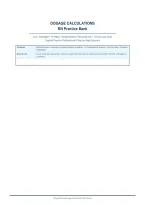
DOSAGE CALCULATIONS
RN Practice Bank
Oral • Injectable • IV Rates • Weight-Based • Reconstitution • Critical Care Drips
Original Practice Problems with Step-by-Step Solutions
Contents Method review • Hundreds of original practice problems • Full dimensional analysis / formula steps • Answers
highlighted
How to use Cover the green answer box. Solve on paper first, then check steps and final answer. Practice until setup is
automatic.
Disclaimer Original educational practice material only. Not affiliated with ATI, NCSBN, or any testing organization. Not an
official proctored exam.
Original Nursing Dosage Calculation Practice Series
,Dosage Calculations Practice Bank | RN Med-Surg Review Original Practice Material
PART 1: CALCULATION METHODS REVIEW
1. Formula Method (basic oral / injectable)
(Order / Available) × Quantity = Amount to give
Example: Order 500 mg; Available 250 mg/tab → (500/250)×1 = 2 tablets
2. Dimensional Analysis
Set up so units cancel, leaving the desired unit.
Example: 650 mg × (5 mL / 160 mg) = 20.3 mL
3. IV Pump Rate (mL/hr)
mL/hr = Total volume (mL) ÷ Time (hours)
For times under 1 hour: convert minutes to hours (min/60).
4. IV Drop Rate (gtt/min)
gtt/min = (Volume mL × Drop factor) ÷ Time in minutes
Microdrip (60 gtt/mL): gtt/min numerically equals mL/hr.
5. Weight-Based
mg or mcg needed = ordered dose per kg × client weight in kg. Convert lb → kg (÷ 2.2).
6. Critical Care mcg/kg/min → mL/hr
1) mcg/min = mcg/kg/min × weight(kg)
2) Concentration in mcg/mL
3) mL/hr = (mcg/min × 60) ÷ (mcg/mL)
Always: Convert units first • Check decimal placement • Round per facility policy • Question unusual results.
Educational Use Only — Not Affiliated with ATI Page 2 Not an Official Exam
,Dosage Calculations Practice Bank | RN Med-Surg Review Original Practice Material
PART 2: PRACTICE PROBLEMS WITH SOLUTIONS
Section 1: Oral Medications (Tablets & Liquids)
Problem 1. Order: Amoxicillin 500 mg PO. Available: Amoxicillin 250 mg tablets. How many tablets will you administer?
• Identify: Order = 500 mg; Available = 250 mg/tablet
• Formula: (Order / Available) × Quantity = (500 mg / 250 mg) × 1 tab
• Calculate: 500 ÷ 250 = 2
Answer: 2 tablets
Problem 2. Order: Levothyroxine 125 mcg PO daily. Available: Levothyroxine 0.05 mg tablets. How many tablets?
• Convert units: 125 mcg = 0.125 mg (divide by 1000)
• Order = 0.125 mg; Available = 0.05 mg/tab
• (0..05) × 1 = 2.5
Answer: 2.5 tablets
Problem 3. Order: Ibuprofen 600 mg PO. Available: Ibuprofen 200 mg tablets. How many tablets?
• (600 mg / 200 mg) × 1 tab = 3
Answer: 3 tablets
Problem 4. Order: Digoxin 0.125 mg PO. Available: Digoxin 0.25 mg tablets. How many tablets?
• (0..25) × 1 = 0.5
Answer: 0.5 tablet (1/2 tablet)
Problem 5. Order: Liquid acetaminophen 650 mg PO. Available: 160 mg/5 mL. How many mL?
• (650 mg / 160 mg) × 5 mL = 4.0625 × 5 = 20.3125 → round per policy (often 20.3 mL or as directed)
• Dimensional analysis: 650 mg × (5 mL / 160 mg) = 20.3 mL
Answer: 20.3 mL (or per facility rounding)
Problem 6. Order: Potassium chloride 20 mEq PO. Available: KCl liquid 10 mEq/15 mL. How many mL?
• (20 mEq / 10 mEq) × 15 mL = 2 × 15 = 30 mL
Answer: 30 mL
Problem 7. Order: Prednisone 30 mg PO. Available: Prednisone 10 mg tablets. How many tablets?
• () × 1 = 3
Answer: 3 tablets
Problem 8. Order: Furosemide 40 mg PO. Available: Furosemide 20 mg tablets. How many tablets?
• () × 1 = 2
Answer: 2 tablets
Problem 9. Order: Metformin 850 mg PO. Available: Metformin 500 mg tablets. How many tablets?
• () × 1 = 1.7 → typically 1.5 tabs if scored, or follow pharmacy/policy; exact math = 1.7
Answer: 1.7 tablets (confirm scoring/policy)
Problem 10. Order: Azithromycin 400 mg PO suspension. Available: 200 mg/5 mL. How many mL?
• () × 5 mL = 2 × 5 = 10 mL
Answer: 10 mL
Section 2: Injectable Medications (IM / SQ)
Educational Use Only — Not Affiliated with ATI Page 3 Not an Official Exam
, Dosage Calculations Practice Bank | RN Med-Surg Review Original Practice Material
Problem 11. Order: Morphine sulfate 8 mg IM. Available: Morphine 10 mg/mL. How many mL?
• (8 mg / 10 mg) × 1 mL = 0.8 mL
Answer: 0.8 mL
Problem 12. Order: Heparin 5,000 units SQ. Available: Heparin 10,000 units/mL. How many mL?
• (5000 units / 10000 units) × 1 mL = 0.5 mL
Answer: 0.5 mL
Problem 13. Order: Insulin regular 6 units SQ. Available: 100 units/mL. How many mL?
• (6 units / 100 units) × 1 mL = 0.06 mL
Answer: 0.06 mL
Problem 14. Order: Ceftriaxone 1 g IM. Available: After reconstitution, 350 mg/mL. How many mL?
• Convert: 1 g = 1000 mg
• (1000 mg / 350 mg) × 1 mL ≈ 2.86 mL
Answer: 2.86 mL (round per policy)
Problem 15. Order: Enoxaparin 40 mg SQ. Available: Enoxaparin 100 mg/mL prefilled. How many mL?
• () × 1 mL = 0.4 mL
Answer: 0.4 mL
Problem 16. Order: Lorazepam 1.5 mg IM. Available: Lorazepam 2 mg/mL. How many mL?
• (1.) × 1 = 0.75 mL
Answer: 0.75 mL
Problem 17. Order: Vitamin B12 1000 mcg IM. Available: 1000 mcg/mL. How many mL?
• () × 1 = 1 mL
Answer: 1 mL
Problem 18. Order: Hydromorphone 1 mg SQ. Available: Hydromorphone 2 mg/mL. How many mL?
• () × 1 = 0.5 mL
Answer: 0.5 mL
Section 3: IV Flow Rates (mL/hr)
Problem 19. Order: Infuse 1000 mL NS over 8 hours. What is the rate in mL/hr?
• Rate (mL/hr) = Total volume ÷ Time in hours
• 1000 mL ÷ 8 hr = 125 mL/hr
Answer: 125 mL/hr
Problem 20. Order: Infuse 500 mL over 4 hours. Rate in mL/hr?
• 500 ÷ 4 = 125 mL/hr
Answer: 125 mL/hr
Problem 21. Order: 250 mL antibiotic to infuse over 30 minutes. Rate in mL/hr?
• Convert 30 min to hours: 30/60 = 0.5 hr
• 250 mL ÷ 0.5 hr = 500 mL/hr
Answer: 500 mL/hr
Problem 22. Order: Infuse 1 L over 10 hours. Rate in mL/hr?
• 1 L = 1000 mL; 1000 ÷ 10 = 100 mL/hr
Answer: 100 mL/hr
Educational Use Only — Not Affiliated with ATI Page 4 Not an Official Exam
RN Practice Bank
Oral • Injectable • IV Rates • Weight-Based • Reconstitution • Critical Care Drips
Original Practice Problems with Step-by-Step Solutions
Contents Method review • Hundreds of original practice problems • Full dimensional analysis / formula steps • Answers
highlighted
How to use Cover the green answer box. Solve on paper first, then check steps and final answer. Practice until setup is
automatic.
Disclaimer Original educational practice material only. Not affiliated with ATI, NCSBN, or any testing organization. Not an
official proctored exam.
Original Nursing Dosage Calculation Practice Series
,Dosage Calculations Practice Bank | RN Med-Surg Review Original Practice Material
PART 1: CALCULATION METHODS REVIEW
1. Formula Method (basic oral / injectable)
(Order / Available) × Quantity = Amount to give
Example: Order 500 mg; Available 250 mg/tab → (500/250)×1 = 2 tablets
2. Dimensional Analysis
Set up so units cancel, leaving the desired unit.
Example: 650 mg × (5 mL / 160 mg) = 20.3 mL
3. IV Pump Rate (mL/hr)
mL/hr = Total volume (mL) ÷ Time (hours)
For times under 1 hour: convert minutes to hours (min/60).
4. IV Drop Rate (gtt/min)
gtt/min = (Volume mL × Drop factor) ÷ Time in minutes
Microdrip (60 gtt/mL): gtt/min numerically equals mL/hr.
5. Weight-Based
mg or mcg needed = ordered dose per kg × client weight in kg. Convert lb → kg (÷ 2.2).
6. Critical Care mcg/kg/min → mL/hr
1) mcg/min = mcg/kg/min × weight(kg)
2) Concentration in mcg/mL
3) mL/hr = (mcg/min × 60) ÷ (mcg/mL)
Always: Convert units first • Check decimal placement • Round per facility policy • Question unusual results.
Educational Use Only — Not Affiliated with ATI Page 2 Not an Official Exam
,Dosage Calculations Practice Bank | RN Med-Surg Review Original Practice Material
PART 2: PRACTICE PROBLEMS WITH SOLUTIONS
Section 1: Oral Medications (Tablets & Liquids)
Problem 1. Order: Amoxicillin 500 mg PO. Available: Amoxicillin 250 mg tablets. How many tablets will you administer?
• Identify: Order = 500 mg; Available = 250 mg/tablet
• Formula: (Order / Available) × Quantity = (500 mg / 250 mg) × 1 tab
• Calculate: 500 ÷ 250 = 2
Answer: 2 tablets
Problem 2. Order: Levothyroxine 125 mcg PO daily. Available: Levothyroxine 0.05 mg tablets. How many tablets?
• Convert units: 125 mcg = 0.125 mg (divide by 1000)
• Order = 0.125 mg; Available = 0.05 mg/tab
• (0..05) × 1 = 2.5
Answer: 2.5 tablets
Problem 3. Order: Ibuprofen 600 mg PO. Available: Ibuprofen 200 mg tablets. How many tablets?
• (600 mg / 200 mg) × 1 tab = 3
Answer: 3 tablets
Problem 4. Order: Digoxin 0.125 mg PO. Available: Digoxin 0.25 mg tablets. How many tablets?
• (0..25) × 1 = 0.5
Answer: 0.5 tablet (1/2 tablet)
Problem 5. Order: Liquid acetaminophen 650 mg PO. Available: 160 mg/5 mL. How many mL?
• (650 mg / 160 mg) × 5 mL = 4.0625 × 5 = 20.3125 → round per policy (often 20.3 mL or as directed)
• Dimensional analysis: 650 mg × (5 mL / 160 mg) = 20.3 mL
Answer: 20.3 mL (or per facility rounding)
Problem 6. Order: Potassium chloride 20 mEq PO. Available: KCl liquid 10 mEq/15 mL. How many mL?
• (20 mEq / 10 mEq) × 15 mL = 2 × 15 = 30 mL
Answer: 30 mL
Problem 7. Order: Prednisone 30 mg PO. Available: Prednisone 10 mg tablets. How many tablets?
• () × 1 = 3
Answer: 3 tablets
Problem 8. Order: Furosemide 40 mg PO. Available: Furosemide 20 mg tablets. How many tablets?
• () × 1 = 2
Answer: 2 tablets
Problem 9. Order: Metformin 850 mg PO. Available: Metformin 500 mg tablets. How many tablets?
• () × 1 = 1.7 → typically 1.5 tabs if scored, or follow pharmacy/policy; exact math = 1.7
Answer: 1.7 tablets (confirm scoring/policy)
Problem 10. Order: Azithromycin 400 mg PO suspension. Available: 200 mg/5 mL. How many mL?
• () × 5 mL = 2 × 5 = 10 mL
Answer: 10 mL
Section 2: Injectable Medications (IM / SQ)
Educational Use Only — Not Affiliated with ATI Page 3 Not an Official Exam
, Dosage Calculations Practice Bank | RN Med-Surg Review Original Practice Material
Problem 11. Order: Morphine sulfate 8 mg IM. Available: Morphine 10 mg/mL. How many mL?
• (8 mg / 10 mg) × 1 mL = 0.8 mL
Answer: 0.8 mL
Problem 12. Order: Heparin 5,000 units SQ. Available: Heparin 10,000 units/mL. How many mL?
• (5000 units / 10000 units) × 1 mL = 0.5 mL
Answer: 0.5 mL
Problem 13. Order: Insulin regular 6 units SQ. Available: 100 units/mL. How many mL?
• (6 units / 100 units) × 1 mL = 0.06 mL
Answer: 0.06 mL
Problem 14. Order: Ceftriaxone 1 g IM. Available: After reconstitution, 350 mg/mL. How many mL?
• Convert: 1 g = 1000 mg
• (1000 mg / 350 mg) × 1 mL ≈ 2.86 mL
Answer: 2.86 mL (round per policy)
Problem 15. Order: Enoxaparin 40 mg SQ. Available: Enoxaparin 100 mg/mL prefilled. How many mL?
• () × 1 mL = 0.4 mL
Answer: 0.4 mL
Problem 16. Order: Lorazepam 1.5 mg IM. Available: Lorazepam 2 mg/mL. How many mL?
• (1.) × 1 = 0.75 mL
Answer: 0.75 mL
Problem 17. Order: Vitamin B12 1000 mcg IM. Available: 1000 mcg/mL. How many mL?
• () × 1 = 1 mL
Answer: 1 mL
Problem 18. Order: Hydromorphone 1 mg SQ. Available: Hydromorphone 2 mg/mL. How many mL?
• () × 1 = 0.5 mL
Answer: 0.5 mL
Section 3: IV Flow Rates (mL/hr)
Problem 19. Order: Infuse 1000 mL NS over 8 hours. What is the rate in mL/hr?
• Rate (mL/hr) = Total volume ÷ Time in hours
• 1000 mL ÷ 8 hr = 125 mL/hr
Answer: 125 mL/hr
Problem 20. Order: Infuse 500 mL over 4 hours. Rate in mL/hr?
• 500 ÷ 4 = 125 mL/hr
Answer: 125 mL/hr
Problem 21. Order: 250 mL antibiotic to infuse over 30 minutes. Rate in mL/hr?
• Convert 30 min to hours: 30/60 = 0.5 hr
• 250 mL ÷ 0.5 hr = 500 mL/hr
Answer: 500 mL/hr
Problem 22. Order: Infuse 1 L over 10 hours. Rate in mL/hr?
• 1 L = 1000 mL; 1000 ÷ 10 = 100 mL/hr
Answer: 100 mL/hr
Educational Use Only — Not Affiliated with ATI Page 4 Not an Official Exam


